- Subscribers are starting to receive their copies in the mail and the pdf subscribers got theirs on the 20th, so it's time to share the table of contents here on the blog. It's a terrific issue, and we have plenty left. To subscribe, visit The Essential Herbal website!
-

- Field Notes
- Some thoughts on sharing gardens with neighbors.
- Black Strap Syrups, Adrian White
- An interesting, little-used method to make syrups that are filled with vitamins and minerals.
- Herbal Beverage Syrups, Stephany Hoffelt
- Preserve the herbs and flowers so that you can drink them for months to come.
- Oh Cover; My Cover: The “Skinny” on Herbs, Suzan Scholl
- For such a large organ, we don’t think about our skin nearly enough.
- Herb Crafts, Heddy Johannesen
- A delightful mélange of crafts that will be fun to play with during the last months of summer.
- Crossword Puzzle—Around the Garden, Tina Sams
- A little something light to work in the hammock.
- Mediterranean Diet—You Still Have Time to Garden for It, Jackie Johnson
- A guide to one of the healthiest eating plans on the planet.
- Rose Rosette, Jamie Jackson
- Are your roses doing okay? Be on the look-out for Rosette.
- Preserving Culinary Herbs, Sandy Michelsen
- Several delicious methods of keeping the herbs that will empower you to savor and use them all year long—and plant even more next year.
- Soap Connections, Marci Tsohonis
- Marci shares some of the things she’s learned from years of soaping.
- Elders & Herbs: Simple Skin Care from the Kitchen and Garden, Janice Masters
- Some simple and nourishing kitchen skin soothers to use topically and as food.
- Trial by Herbs, Molly Sams
- After a life time of watching from the sidelines, it’s time to step up to the plate.
- Roots to Dye For, Marita Orr
- Natural dying can be very fulfilling and the roots are just about ready!
- What is an Herbal Meat Rub? Marcy Lautanen-Raleigh
- Wet or dry? What goes into them? Why? Well, Marcy will tell us and add a couple recipes as well!
Sunday, June 22, 2014
Jul/Aug '14 issue of The Essential Herbal


Saturday, June 14, 2014
Garden Highlights in Pictures
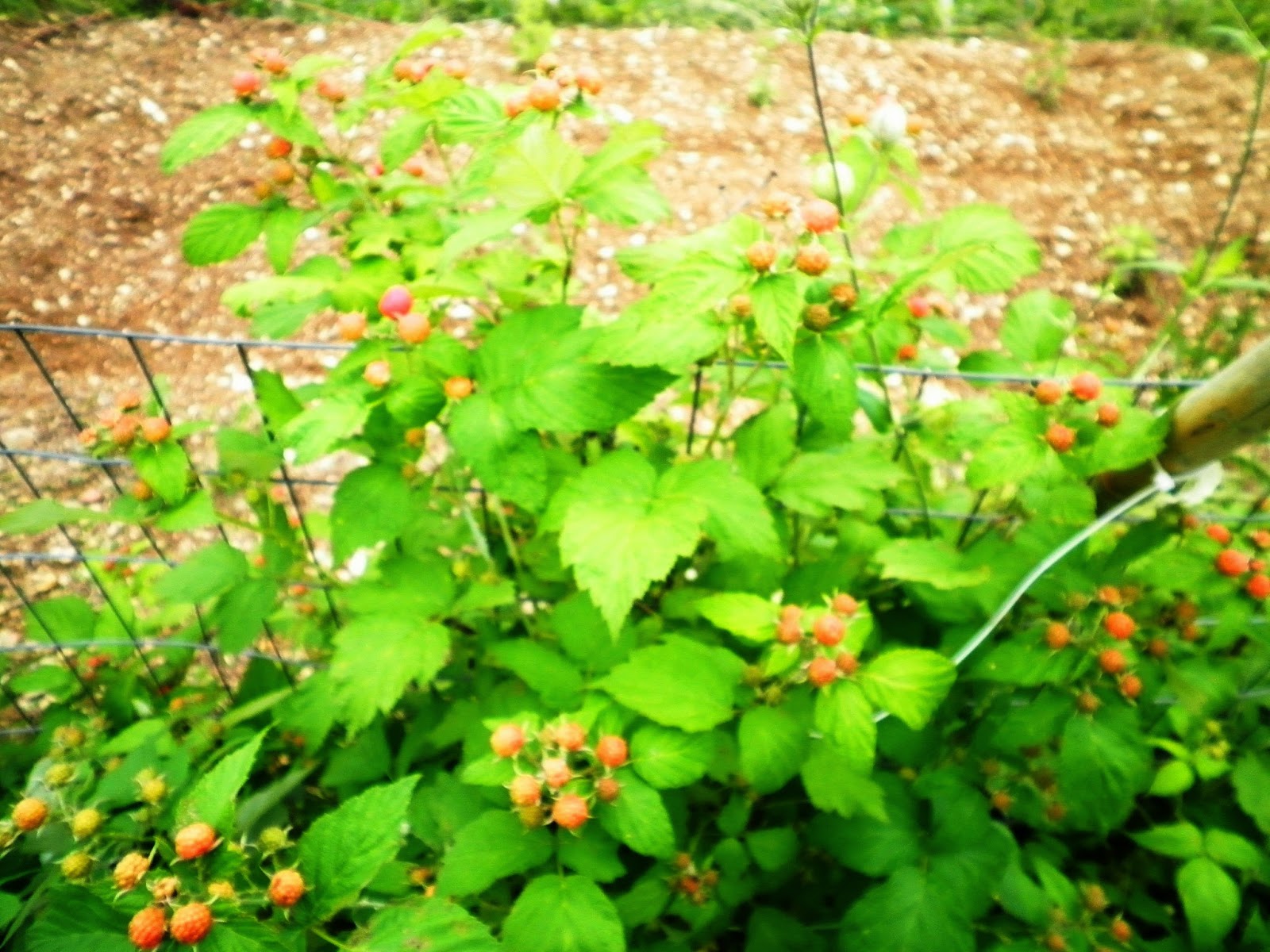 |
| There will be several quarts of black raspberries! |
 |
| Maybe this year the borage will reseed - like we hear others speak of. |
 |
| An annual (here) milkweed for the butterflies. |
 |
| Comfrey almost finished blooming. |
 |
| First daylily. |
 |
| Echinacea budding |
 |
| elderberries forming |
 |
| frilly henbit blooms above the chickweed and speedwell |
 |
| horehound blooming |
 |
| hyssop blooms are well loved by the bees (as are all of the blossoms in the garden) |
 |
| jewelweed growing around the porch |
 |
| lavender spikes are coloring up |
 |
| we can't eat the nasturtium flowers fast enough |
 |
| rose campion has been in every one of my gardens for the last 30 years |
 |
| last year there was no St John's wort, but this year it is everywhere |
Tuesday, June 03, 2014
In search of the perfect chicken salad
contributed by Molly Sams
Over the past couple weeks I have been craving chicken
salad. While there are plenty of restaurants with good chicken salad, I have
yet to find one that had everything I wanted. Some had cranberries but no
walnuts, while others had walnuts but no spice. There was always something
missing.
I first had chicken salad while I was away at college.
During one of my study sessions at a local coffee shop, I decided to try
something new. I was shocked when I found out the chicken salad I thought was
only made in diners for the early bird special could actually be incredibly
delicious. Since then I’ve been determined to find it again.
So Mom took on the task to make the perfect chicken salad.
During one of the days I was away at class, she painstakingly prepared a
chicken salad that had everything from cashews to cranberries, even nasturtium.

She succeeded.
And I had to share the greatness.
First you start with:
1 C of water
1 sprig of rosemary
1 sprig of time
Roast for one hour.
Once the chicken is done roasting mix the cooled, cubed chicken
with:
¼ C craisuns
2 ribs of celery, chopped
¼ C of sweet onion chopped
½ C of salted cashew pieces
1 hardboiled egg
After that it is time to add the herbs!
2 nasturtium blossoms
3 lemon verbena leaves
¼ c parsley
2 sprigs of thyme
1 small sprig of rosemary
1 chive blossom
Chop all fine and then mix well into the chicken salad and
add one cup of mayo.

Afterward you should let chill in the fridge, buy some
fantastic buns or even croissants and enjoy!
Sunday, May 25, 2014
Sale - This week only!
Get
your warm weather reading lined up. This week only, enter promo code
SUMMER and receive 30% off all downloadable items (books, back issues,
and classes). Excludes pdf subscriptions.
5/24/14 through 5/31/14
www.essentialherbal.com
 All of our listed back issues and the following titles:
Wild Foods for Every Table
An Elder Gathering
Balms & Salves - How to and Recipes
Perfect Potpourri and Scented Crafts
Making and Using Herbal Vinegars
Blending Herbal Teas
Fairy Home Companion
Herbal Soaps from Scratch
Under the Sun
By the Hearth
and
the soap and balms and salves classes (may take a long time to upload, depending on your connection).
Be sure to look around while you're on the website. We've got some great herbal supplies and gifts.
5/24/14 through 5/31/14
www.essentialherbal.com
Wild Foods for Every Table
An Elder Gathering
Balms & Salves - How to and Recipes
Perfect Potpourri and Scented Crafts
Making and Using Herbal Vinegars
Blending Herbal Teas
Fairy Home Companion
Herbal Soaps from Scratch
Under the Sun
By the Hearth
and
the soap and balms and salves classes (may take a long time to upload, depending on your connection).
Be sure to look around while you're on the website. We've got some great herbal supplies and gifts.
Tuesday, May 13, 2014
Wild Food Trends
I've been pondering this post for a few days after a conversation with friends, but this morning I saw a photo of 4 men with 3 wheelbarrows and a trash can filled with morel mushrooms, and it pushed me over the top. I read that the mushrooms bring $50/pound in upscale natural groceries, and looking at the picture it was pretty clear the men were harvesting money, not food.
The other day I was reading about someone stumbling across a patch of ramps and harvesting most of the bulbs.
Having spent the last 20 years encouraging people to eat the wild fruits and vegetables around them, I have some very mixed feelings. On the one hand, when wild eats get mainstream recognition it can raise awareness and stoke an interest in learning more. On the other hand, it can create a trend if the food is considered 'upscale' or rare, sending people into the woods in search of gold with no regard to the delicate environment in which they grow.
Wouldn't it be wonderful if foods like dandelion, chickweed, and lambsquarters became all the rage? What if the coolest restaurants decided to start serving purslane in a signature dish with a side of steamed stinging nettles and a dollop of ghee? Maybe an amazing seafood sauce created from the rampant garlic mustard and wild onions? Why do we only want that which we can destroy?
I know that I am very fortunate to have access to just the right kind of land to be able to grow all of the trendy wild vegetables. We were gifted with a few shovels full of ramps several years ago, and they've spread beautifully. We still only harvest the leaves, allowing the plants lots of time to get themselves situated. Perhaps we'll never take the bulbs.
The only time I've ever found morels, there were fewer than a dozen, so we left them to spread. I love all kinds of mushrooms, so can probably survive if I don't ever taste that specific variety.
To my way of thinking, learning about wild foods is sort of the opposite of what happens when an uncommon, short-seasoned delicacy becomes popular.
Instead of creating a pinpoint market for one or two vulnerable plants, why aren't we getting more to the point and enjoying all of the weeds rather than poisoning them in order to grow more soybeans and corn? Why are we taking the quinoa from the people who have grown and lived on it for centuries when we have lambsquarters with very similar seeds growing wild and free here?
Marketing. That's why.
So while my personal social media feeds are filled with all sorts of delicious, nutritious, gorgeous wild food dishes - dandelion cakes, violet jelly, mashed burdock root, etc. - these things aren't getting the same adoring marketing from the media or the chefs that could be making a difference. Wouldn't it be great to eat at a restaurant that focused on wild vegetables and fruits? Now there's a trend I could get behind! Imagine the appetizers, soups, salads, main courses and desserts that they could come up with while keeping costs low. Imagine it. Each week in the spring, summer, and fall the menu would reflect the growing season in that region. In winter, they would serve what was preserved from that season, just as our ancestors did.
It's free food. Is that the problem? That it doesn't cost enough? Whether you believe in climate change or not (and by now, that's sort of a silly question), learning to find nourishment around you is pretty important. With the droughts that have hit the major food producing states in the last couple of years, we would all do well to look around, learn what is edible, and start trying it on the table.
Just as herbs belong to all of us, so do wild foods. When an artificial need is created for just a few, they are taken out of the wild food realm, separated from that which wild food educators have been working for years to accomplish. It doesn't make people more interested in investigating the plants around them, only serves to somehow rarify a few special plants. Like truffles or ginseng, we create these crushing markets.
So... yes, that's a rant, I suppose. Do me a favor. Eat a violet today. While you're weeding the garden, set aside a couple wild onions and use them in dinner tonight. Saute some garlic mustard with a scrambled egg. Just do it.
The other day I was reading about someone stumbling across a patch of ramps and harvesting most of the bulbs.
 |
| baby ramps emerging in spring |
Wouldn't it be wonderful if foods like dandelion, chickweed, and lambsquarters became all the rage? What if the coolest restaurants decided to start serving purslane in a signature dish with a side of steamed stinging nettles and a dollop of ghee? Maybe an amazing seafood sauce created from the rampant garlic mustard and wild onions? Why do we only want that which we can destroy?
 |
| wild onions are everywhere |
I know that I am very fortunate to have access to just the right kind of land to be able to grow all of the trendy wild vegetables. We were gifted with a few shovels full of ramps several years ago, and they've spread beautifully. We still only harvest the leaves, allowing the plants lots of time to get themselves situated. Perhaps we'll never take the bulbs.
The only time I've ever found morels, there were fewer than a dozen, so we left them to spread. I love all kinds of mushrooms, so can probably survive if I don't ever taste that specific variety.
To my way of thinking, learning about wild foods is sort of the opposite of what happens when an uncommon, short-seasoned delicacy becomes popular.
Instead of creating a pinpoint market for one or two vulnerable plants, why aren't we getting more to the point and enjoying all of the weeds rather than poisoning them in order to grow more soybeans and corn? Why are we taking the quinoa from the people who have grown and lived on it for centuries when we have lambsquarters with very similar seeds growing wild and free here?
Marketing. That's why.
 |
| young lambsquarters - YUM! |
So while my personal social media feeds are filled with all sorts of delicious, nutritious, gorgeous wild food dishes - dandelion cakes, violet jelly, mashed burdock root, etc. - these things aren't getting the same adoring marketing from the media or the chefs that could be making a difference. Wouldn't it be great to eat at a restaurant that focused on wild vegetables and fruits? Now there's a trend I could get behind! Imagine the appetizers, soups, salads, main courses and desserts that they could come up with while keeping costs low. Imagine it. Each week in the spring, summer, and fall the menu would reflect the growing season in that region. In winter, they would serve what was preserved from that season, just as our ancestors did.
It's free food. Is that the problem? That it doesn't cost enough? Whether you believe in climate change or not (and by now, that's sort of a silly question), learning to find nourishment around you is pretty important. With the droughts that have hit the major food producing states in the last couple of years, we would all do well to look around, learn what is edible, and start trying it on the table.
Just as herbs belong to all of us, so do wild foods. When an artificial need is created for just a few, they are taken out of the wild food realm, separated from that which wild food educators have been working for years to accomplish. It doesn't make people more interested in investigating the plants around them, only serves to somehow rarify a few special plants. Like truffles or ginseng, we create these crushing markets.
 |
| violet flowers and leaves are delicious and beautiful in salads, etc. |
So... yes, that's a rant, I suppose. Do me a favor. Eat a violet today. While you're weeding the garden, set aside a couple wild onions and use them in dinner tonight. Saute some garlic mustard with a scrambled egg. Just do it.
Saturday, May 03, 2014
Herbalism and YOU
The terminology and dogma of herbalism are ever-changing. I know I've mentioned this before, but when we started out several decades ago, there were relatively few people who were referred to as herbalists. Everyone else considered themselves to be enthusiasts or as just being "into" herbs. Now it has changed, and that's okay. You're an herbalist, you're an herbalist, everybody's an herbalist! In some dictionaries, the term is defined as one who studies herbs - so it's all good, and since there is really no legal definition in the US, it doesn't make a lick of difference.
Then there are the (apparent) rules. There are many new ones, many of which are driven by the vastness of the internet and the many, many voices. Some of those voices are harsh, critical, and exclusionary though, and that is a shame. In some ways I suppose it's a good thing to have some homogenization of information, but in other ways it tamps down the creativity and freedom with which we approach the plant world. However, when there weren't a million herbalists, there wasn't so much jostling to reach the top rung of the imaginary ladder. That is creating a much less welcoming environment for those just starting to look around. I'm not sure we would have been able to navigate all of this back when we first started. We might have given up.
There are hundreds of different levels of herbalism, and all of us approach it on our own terms. It seems that there is a lot of effort going on with people trying to pin down, label, and define a thing which is limitless and requires no boundaries. I'm particularly bothered by some of the rules and absolutes that people throw around. They are all well and good if one is living a pure and wholesome lifestyle, but seriously that is a very judgmental, myopic, and exclusive standpoint. We get bound and entwined by surrounding ourselves with people most like us, and forget that there's a reason there's a whole aisle filled with various brands of white bread at the grocery store. The oh-so-pure herbalist can chastise and look down on the rest of humanity all they like, but that sort of defeats the purpose in my opinion.
 The goal as I see it, has always been to throw open wide the doors to herbs and welcome as many people as want to come in and learn that which is such a part of all of us.
You want to find some herbs that will help with a chronic illness? Fine, you should not be shamed for using herbs like a pill. I believe that almost all of us first come to medicinal herbs that way. To hear some people talk about it, you'd think it was some kind of crime, but I'd be willing to bet they started that way too. Allopathy has been our mindset for 50 years and if it takes a little time to learn about prevention, constitution, energetics and all the latest lingo - it's fine. Hop onboard.
You use sugar in your syrups because maple syrup and honey are too expensive? (insert any number of individual personal preferences that can be levied for or against one's practices here) Great! Just get started. Maybe in time you'll decide that you want to switch, maybe you won't. We're glad to see you working with herbs in a way that is manageable for you. Don't let other people make you feel like you're not doing it right because you're not doing it their way.
You don't get enough exercise or eat right, but you still want to learn more about herbs? TERRIFIC! Nobody has the right to judge your lifestyle unless they're walking in the same shoes - and even then we are all individuals with different wiring. Maybe you're working too many hours and do what you can. Maybe you're caring for someone who saps all of your energy. Maybe you grew up in a family that considered fried chicken and fish to be health foods and vegetables were garnishes. Who cares? Come on in.
You can work with herbs in a tiny city apartment or a many-acred farm. You can use dried herbs you purchased, or herbs you grew from seed in soil you amended with home made compost. You can call it a dandelion or a Taraxacum officinale.

You can learn to fix the typical household complaints and run of the mill first aid, or you can take pre-med courses in anatomy and physiology. You can choose your own path. There is no one right way - and that is truly a beautiful thing.
There are good reasons for most of the admonishments, so I'm not dissing them out of hand. We should use Latin names for plants so that they aren't confused. We should be learning all we can about how our bodies work and what we can do to strengthen them to prevent illness. At the same time, we must appreciate that there are a million reasons why people come to herbs, and they're not all coming from the same place. Those who have come before must be welcoming and inclusive, allowing each person to find their own comfort. Nobody owns herbalism. It belongs to everyone, and each approach is valid.
FINALLY... There are some real do's and don't's with herbs. Just because they are natural, doesn't mean they are harmless. Read books. Experiment. Learn from your mistakes. Start small, one herb at a time. Be comfortable.
Then there are the (apparent) rules. There are many new ones, many of which are driven by the vastness of the internet and the many, many voices. Some of those voices are harsh, critical, and exclusionary though, and that is a shame. In some ways I suppose it's a good thing to have some homogenization of information, but in other ways it tamps down the creativity and freedom with which we approach the plant world. However, when there weren't a million herbalists, there wasn't so much jostling to reach the top rung of the imaginary ladder. That is creating a much less welcoming environment for those just starting to look around. I'm not sure we would have been able to navigate all of this back when we first started. We might have given up.
There are hundreds of different levels of herbalism, and all of us approach it on our own terms. It seems that there is a lot of effort going on with people trying to pin down, label, and define a thing which is limitless and requires no boundaries. I'm particularly bothered by some of the rules and absolutes that people throw around. They are all well and good if one is living a pure and wholesome lifestyle, but seriously that is a very judgmental, myopic, and exclusive standpoint. We get bound and entwined by surrounding ourselves with people most like us, and forget that there's a reason there's a whole aisle filled with various brands of white bread at the grocery store. The oh-so-pure herbalist can chastise and look down on the rest of humanity all they like, but that sort of defeats the purpose in my opinion.
You want to find some herbs that will help with a chronic illness? Fine, you should not be shamed for using herbs like a pill. I believe that almost all of us first come to medicinal herbs that way. To hear some people talk about it, you'd think it was some kind of crime, but I'd be willing to bet they started that way too. Allopathy has been our mindset for 50 years and if it takes a little time to learn about prevention, constitution, energetics and all the latest lingo - it's fine. Hop onboard.
You use sugar in your syrups because maple syrup and honey are too expensive? (insert any number of individual personal preferences that can be levied for or against one's practices here) Great! Just get started. Maybe in time you'll decide that you want to switch, maybe you won't. We're glad to see you working with herbs in a way that is manageable for you. Don't let other people make you feel like you're not doing it right because you're not doing it their way.
You don't get enough exercise or eat right, but you still want to learn more about herbs? TERRIFIC! Nobody has the right to judge your lifestyle unless they're walking in the same shoes - and even then we are all individuals with different wiring. Maybe you're working too many hours and do what you can. Maybe you're caring for someone who saps all of your energy. Maybe you grew up in a family that considered fried chicken and fish to be health foods and vegetables were garnishes. Who cares? Come on in.
You can work with herbs in a tiny city apartment or a many-acred farm. You can use dried herbs you purchased, or herbs you grew from seed in soil you amended with home made compost. You can call it a dandelion or a Taraxacum officinale.
There are good reasons for most of the admonishments, so I'm not dissing them out of hand. We should use Latin names for plants so that they aren't confused. We should be learning all we can about how our bodies work and what we can do to strengthen them to prevent illness. At the same time, we must appreciate that there are a million reasons why people come to herbs, and they're not all coming from the same place. Those who have come before must be welcoming and inclusive, allowing each person to find their own comfort. Nobody owns herbalism. It belongs to everyone, and each approach is valid.
FINALLY... There are some real do's and don't's with herbs. Just because they are natural, doesn't mean they are harmless. Read books. Experiment. Learn from your mistakes. Start small, one herb at a time. Be comfortable.
Tuesday, April 22, 2014
Garden check-in, Earth Day '14
We've been keeping a blog for 9 years now. One of the things I love best about it is how it functions as a garden journal. It is easy to look back over the 7 seasons of work here and see what's worked, what has gotten out of control (!!!) and just how much things have changed. Each year we've added perennial food and medicine plants, while encouraging or transplanting others to make them more accessible. Where there was once unimaginable space, now we're starting to take over the lawn. I like that. Sort of how the pictures in this post shove over too far into the side border. Nature is like that. She pays no attention to the rules we try to impose upon her :-)
 |
| Black currants went in last year. First bloom. |
 |
| Wild black raspberries dug and transplanted along the garden fence. They'll be a challenge to contain. |
 |
| Colors! I didn't realize how much I missed them until they returned. |
 |
| Comfrey - so far behaving. |
 |
| We've got daylily patches everywhere because we love the flavor of the flower buds. |
 |
| The elderberries are looking to give it another go this year. Fruitflies be gone! |
 |
| Fennel surprised me by coming back, nestled against the hyssop. |
 |
| Horseradish spreading vigorously. |
 |
| Today we'll plant the new fig tree and put the blue cohosh into the woods. |
 |
| The new little orchard. |
 |
| Soon the brilliant chartreuse of the maple will flood the morning light of the kitchen and packing room. |
 |
| St John's wort volunteered just where I might have planted it! |
 |
| Hard to see, but the thyme has left the garden, spreading across the so-called path. |
Thursday, April 17, 2014
Old Herbs and Patent Medicines
Up until about a dozen years ago, I never really thought about these things. I'd never seen the little boxes of herbs or the little packages of pills and oils. It all started with a visit to a friend's house and seeing her collection. That was it. Now whenever I'm at a flea market or antique store, I have to look around.
This past weekend, The Rosemary House was selling off a good portion of Bertha Reppert's collection, and I was all over that stuff! Here's what I got (along with a few things I had before):
It's pretty interesting to see these old things, and I'm looking forward to placing them behind the glass front on the shelves.
This past weekend, The Rosemary House was selling off a good portion of Bertha Reppert's collection, and I was all over that stuff! Here's what I got (along with a few things I had before):
 |
| All of these packages are full. |
 |
| American Saffron = Carthamus tinctorious (safflower), although true saffron is grown here in Lanc. PA |
 |
| Bottle of Lydia Pinkham's Tonic. |
 |
| Diverse, simple packages - all full. Bet the orris is more fragrant than ever. |
 |
| I love the turmeric tin, and the instructions inside the laxative box. Lots of laxatives... |
 |
| Helps are still available, but not in the tin. The eye cup was my grandmother's. |
 |
| I'm not sure what this was for, but the packaging sure made it look important. |
 |
| And we thought Flintstones were the first candy-like vitamin... |
Monday, April 07, 2014
The Essential Herbal May/June '14 issue
We are so excited about this issue! It's so full of wonderful information and sharing, and for the second issue in a row, we added extra pages. It is stunning. Beautiful, lush, and full of spring and early summer. You're going to love it! Subscribe today

- The cover is from Carolina Gonzalez
- Field Notes, Tina Sams
- Finding the rhythm in the seasons and life in general.
- Bees in Peril, Heddy Johannesen
- What’s happening to the bees and how can we help?
- Rosacea, Michele Pfaff
- Natural solutions.
- Companion Planting with Herbs, Sandy Michelsen
- Helping plants to prosper with good neighbors.
- Cooking with Lavender, Cherylann McFetridge
- Learn about using lavender in a lot of new ways.
- Losing Your Nerve: Lion’s Mane and Medicinal Mushrooms, Adrian White
- Wild mushrooms have a lot to offer us.
- Spring Cleaning That’s Good for You, Gale LaScala
- Clearing the clutter from the inside out.
- Growing Edible Marigolds, Marcy Lautanen-Raleigh
- Those tasty little gems do more than keep rabbits out of the garden.
- Ginseng Companions, Madison Woods
- Do you know the indicator plants that grow near ginseng?
- Havin’ a Dandy Day! Jessica Morgan
- Dig those crazy dandelions!
- Elders & Herbs—Herbal Support for Sexy Seniors, Janice Masters
- Can the best really be yet to come?
- Medicinal Roots, Marita Orr
- The beginning of a great new series from Marita.
- Passionflower, Kristine Brown
- These strange, otherworldly flowers might be just the thing for you.
- Herbal Canine Shampoo Bar (or Human Deep Woods Outdoor Soap), Marci Tsohonis
- It started out as a dog shampoo, but like so much of what we do, went in a completely different direction!
- The Chakra Garden, Jackie Johnson
- Such an inspiring garden idea!
- Ready for My Big Girl Boots, Elizabeth Weaver-Krieder
- She’s ready to take on the Spring.
- Rita’s Pitas, Rita Richardson
- Simple and versatile snack.
- Natural Ant Deterrent, Michele Pfaff
- When the ants come marching one by one, be ready.
- How to Sell at Craft Fairs and Festivals, Jamie Jackson
- Lots of insider information to help you learn the ropes.
- “Gutsy” Herbs, Suzan T Scholl
- Some say that all disease begins in the gut. Learn how to support a healthy gut.
Tuesday, March 18, 2014
Herb Pastes - beyond delicious

When you think of pesto, it is usually the flavor that comes to mind. Maybe after that, you think about how easy it is to whip up a last minute meal without heating up the kitchen in the summer. We mostly think about Basil, but many other herbs can be used. Rarely do most of us think about the immense health benefits derived from these herb pastes, but we really should. It can go on pasta, you can slather it on a sandwich, add a dollop to soups, or use it as dip. Pesto is an easy food to eat in a lot of different ways.
Earlier this year, I was trying to think of pleasant ways to eat more raw garlic during cold and flu season. This is really a subject that has confounded me for many years since garlic was not a typical ingredient in the PA German fare of my childhood. It is an ingredient that I at first struggled to acquire a taste for and eventually came to enjoy. Still, eating raw garlic is one of the simplest ways to kick a virus, and when I realized that pesto was not cooked, it was a revelation for me.
Here are some of the reasons that pesto is more than just a sauce:
Garlic

- Incredible healing powers that help to prevent influenza, colds, yeasts and fungus and contains antiseptic, antibiotic, antiviral, bactericidal, and anti-inflammatory properties. After watching my daughter go through over a week of the nasty, wheezing, upper respiratory virus this winter (after refusing all offers of my herbal concoctions), naturally, I started coming down with it. Over the course of a day and a half, I ate about 2 full bulbs of garlic and was quickly on the mend. You could smell me coming, but at least I wasn't sick.
Basil

- All of the culinary basils (and of course holy basil as well) work hard against inflammation. Basil is rich in anti-oxidants that combat aging and support the immune system and can combat stress, help with upper respiratory illnesses, battle headaches, or calm the stomach and improve digestion.
Walnuts (who can afford pine nuts anymore?) - Walnuts contain both monounsaturated fatty acids and Omega 3 essential fatty acids to promote healthier arteries and cholesterol levels, helping to possibly prevent strokes and heart disease. They contain very high levels of antioxidants and are packed with the B Complex vitamins, tons of beneficial minerals, and vitamin E.

Olive Oil - Bolsters immune system and helps to fight viruses. Consuming olive oil mproves bone mineralization and calcification. It helps calcium absorption. There are many long term benefits to olive oil.
Many other herbs can be blended into pastes. They don't have to be single, they can be blends like Basil and Chickweed, Sage and Nettles, etc., but do consider some of these benefits:
Thyme

Thyme is a rich source of nutrition, even in small quantities. It is a treasure trove of vitamins C, B6, K, and A, riboflavin, iron, copper, manganese, calcium, folate, phosphorus, potassium, and zinc. One compound, Thymol is one of a naturally-occurring class of compounds known as biocides that can destroy harmful organisms like bacteria, microbes, and viruses. Combined with other biocides, such as carvacolo (also in thyme), it has strong antimicrobial power and displays significant anti-oxidant protection of cellular membranes.
Sage

Chickweed

Packed with vitamins and minerals like iron, calcium, magnesium, manganese, silicon, zinc, phosphorus, potassium, protein sodium, copper, carotenes, and vitamins B and C, chickweed also has saponins that help with joint inflammation.
Nettles

Contain tannic acid, lecithin, chlorophyll, iron, silica, potassium, phosphorus, sulfur, sodium, and vitamins A and C. Some of the talents Nettles bring to the table include being diuretic, astringent, pectoral, anodyne, tonic, styptic, nutritive, anti-rheumatic, anti-allergenic, decongestant, expectorant, anti-spasmodic, and anti-histamine, herpetic, galactagogue, and an anti-histamine. Grinding the herb to paste takes the sting away without destroying the valuable components.
Violet Leaves

There are lots of vital minerals, especially calcium and magnesium available in the leaves. The leaves and flowers contain Rutin, a bioflavonoid that is helpful in the treatment of venous insufficiency and lowered blood flow to various parts of the body. Specifically, hemorrhoids and varicose veins may respond to consuming violet leaves. The leaves especially contain saponins and mucilage, having a positive effect on regularity of elimination, lung health, and can soothe the entire gastro-intestinal and urinary tracts.
There are lots of vital minerals, especially calcium and magnesium available in the leaves. The leaves and flowers contain Rutin, a bioflavonoid that is helpful in the treatment of venous insufficiency and lowered blood flow to various parts of the body. Specifically, hemorrhoids and varicose veins may respond to consuming violet leaves. The leaves especially contain saponins and mucilage, having a positive effect on regularity of elimination, lung health, and can soothe the entire gastro-intestinal and urinary tracts.
Simple Basil Pesto Recipe
Put the following directly into the food processor:
1 Cup basil leaves
1 Cup basil leaves
5 - 6 cloves of Garlic
1 Cup grated Parmesan cheese
1/2 Cup Walnuts
1/4 Cup olive oil
Process until smooth.
Subscribe to:
Posts (Atom)