Friday, January 30, 2015

A Taste for Herbs

Many times over the years, we've seen an interesting thing happen.  Herbs that are hard to get down when one is feeling great, suddenly aren't so terrible when you really need them.  Sometimes we've put together teas for friends and given them along with a warning that it will probably taste pretty bad, but should do the trick... and then, they tell us that they LOVE the taste!

And so today, there was another instance of this strange occurrence, but this time, it is me experiencing the transformation of taste.
This past month has held more illness for me than any 5 year period in my recollection.  The final insult has been an upper respiratory thing that I probably picked up at the trade show we did.  I was very good about washing hands and taking elderberry, but slacked off on the syrup when we got home.  Too soon.  I missed the window, and that bug caught me, but good.  The air is too dry, and it's difficult to stay hydrated enough, I think.
Elderberry didn't do it.  Fire cider didn't do it.

Eating raw garlic kept it from getting worse, but hasn't been enough to kick it to the curb (although it has kept everyone else from getting too close to me).
So today, with the vice gripping my lungs and the hacking cough starting to cause real muscular pain, it was time to pull out the big guns.  The ones I really don't like the taste of.  Sigh...
I filled a pot with water and added:
osha root
elecampane root
slippery elm bark
wild cherry bark
reishi mushroom
horehound herb
and toward the end of simmering, mullein leaf.


The contents of the strainer will be returned to the pot with the rest, and used again.
I added some lemon and lime honey, the seriously thick, white dregs of the garlic honey, and a licorice root stick to stir.   Not exactly my cup of tea.
This is a deep, dark brew.

But not only did I like it, I went back for more!  I can take a few deep breaths, and that's a great improvement.  I'll add more water and keep drinking this all day long.  I don't know that it will *cure* this bug, but it is helping.  A lot.

If this thing has a hold of you, try some of these barks and roots if you have them.  Some or all - or add others that make sense to you.  Even hot liquids will give you some relief, and hydrate, hydrate, hydrate!

Monday, January 26, 2015

Herb of the Week: Chamomile


When I think of Chamomile I’m immediately transported back to my childhood (as is everyone, I think). Any night that started with nightmares, sniffles, a tummy ache, or restlessness usually ended with a cup of chamomile tea and my mother carrying a passed out Molly back to her bedroom. Those were the days…

While I may not teleport in my sleep anymore, I still take chamomile. Its ability to calm anxiety and soothe stomachaches can be fantastic for children as well as women during their menstrual cycle.

Chamomile’s fragrance also makes it a treat to drink. The aroma of apples makes a fantastic and delicate tea, which can be perfect for children who tend to be picky eaters.

Because chamomile is antioxidant, antimicrobial, antiplatelet, anti-inflammatory, antispasmodic, and anxiolytic, it is able to aid in a number of ailments. While we all know to drink it before bed it can be used for less common ailments such as blemishes or hemorrhoids.

My favorite use for it, however, is for PMS. Chamomile can be used as a diuretic if brewed in a decoction according to Modern Botanical. It also helps with any feelings of moodiness or frustration since it can soothe an anxious mind. As if it wasn’t enough, chamomile is also an antispasmodic, which makes it perfect to drink for cramps.

So while your office is filled to the brim with paperwork or your children have to go to four different games this afternoon take a second to brew yourself some chamomile tea!

Chamomile tea:

1 tsp dry or 1 Tbsp fresh chamomile
1 cup boiled water
steep for 5 minutes
add a touch of honey if child is over 2 years of age, sugar if younger. 
Lemon is a nice addition.

Sources:


Friday, January 23, 2015

Rosemary, Herb of the Week


Herb of the Week: Rosemary
Molly Sams
 
Working with herbs is a wonderful experience that continually gives me knowledge and inspiration. Learning from others, reading, researching, and creating offers an endless amount of information to me.
A rooftop garden in Manhattan, with Rosemary, Thyme, Basil, Bay, and other herbs.
As mentioned before, interning at The Rosemary House has been an amazing opportunity that has given me different perspectives on plants, medicine, and the earth itself. Susanna answers any and all of my bizarre and sometimes random questions as we work on teas, mixes, and a million other things. Every day she amazes me with her ability to be an endless fountain of knowledge. Much like my mother and aunt, Susanna inspires me to continue my studies and shows me that there is always something new to learn.

Being there I have, of course, heard a lot about Rosemary. 

Early spring Rosemary, Chamomile, and Chives greening up.
Rosemary is a clarifying herb, which is great in shampoo and soap. The herb is also incredibly aromatic so your hair smells wonderful throughout the day. Because of its aroma many brides in the medieval period (even royalty) wore wreaths dipped in scented water to their weddings. These wreaths represented fidelity, love, and remembrance.

It was also worn to funerals. Since it has a strong fragrance, rosemary was used to keep the room fresh. Many funeral goers would wear it on their person since rosemary is known for remembrance. Often wearing sprigs on their clothes or giving some to the deceased, they hoped their loved ones would know they would never be forgotten.

We have about a 60% chance of Rosemary making it through the winter here.  Zone 6b.
Even scholars used rosemary for memory. In ancient Greece many students would bring sprigs of rosemary to class and sniff while they studied. Many students today will even bring some in during finals week or rub their pencil with rosemary oil while studying and during a test to retain information.

This tonic, astringent, and diaphoretic herb has been used for hundreds of years to help retain memory, clean and clarify, and has even been used as a nervine. The calming affects of smelling the plant may help some focus and retain memories such as lessons. So before your next exam, presentation, or just to remember to pick up the milk don’t forget the rosemary!

Sources:

Monday, January 12, 2015

Icy Walk to the Mailbox (Post #1000)

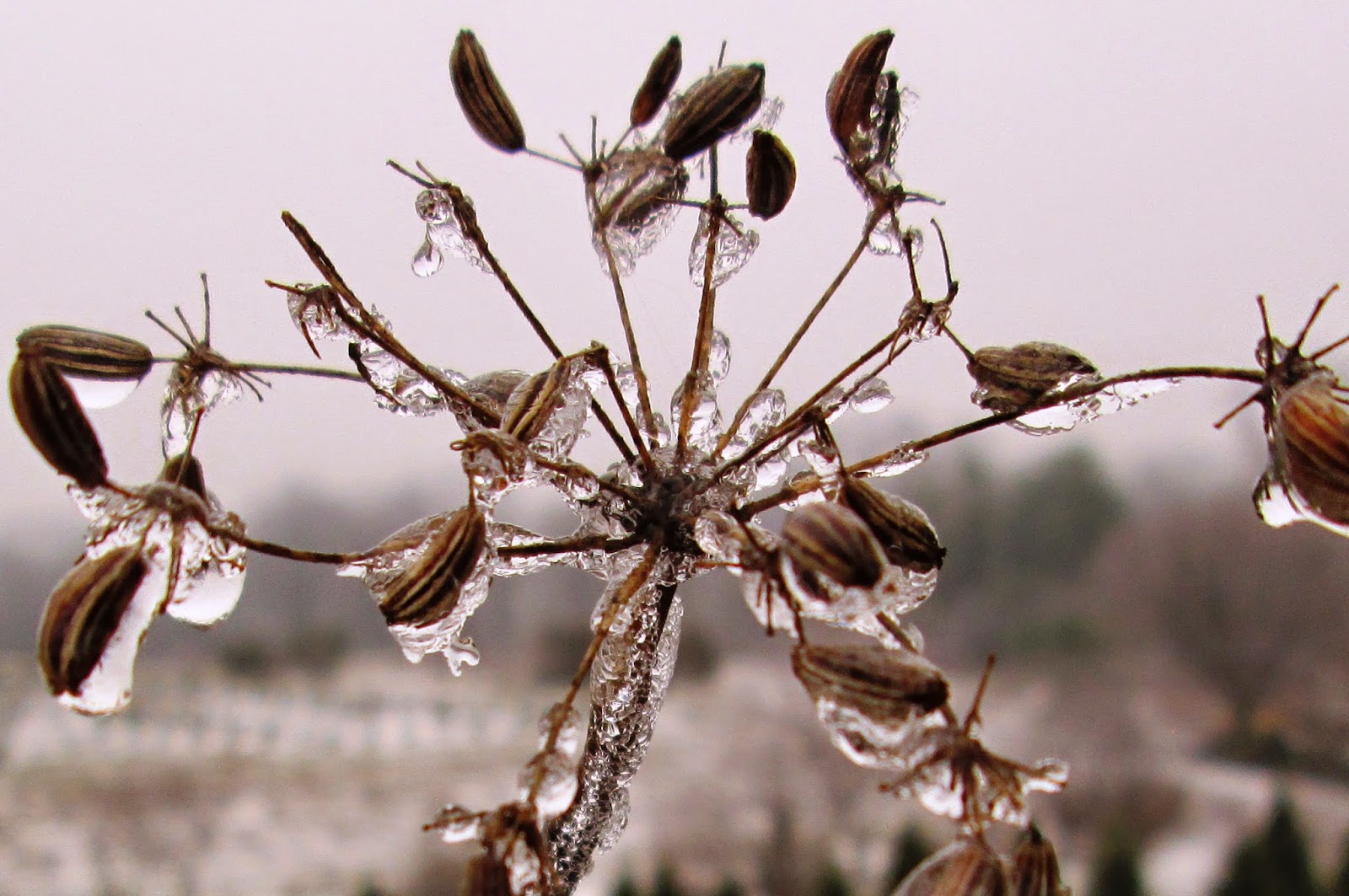
Molly took the orders out to the mailbox this morning as she and Maryanne headed out on deliveries.  Later I noticed a couple of things she missed, and grabbed the camera before taking them out.  The weather has been obnoxious here, as it has been all over the US, but from my perch looking out the window, I could see iced droplets hanging on everything.  Makes for some beautiful sights in the middle of winter.

And I just noticed that this is our 1000th blog post!  I'm going to share this post several places.  Comment on it, and I'll choose someone to get a free pdf subscription on Wednesday!**** our winner is Tj Holley**** Thanks for playing, everyone!


 Here's what I saw out in the yard...
The Juniper berries that are so easily visible in summer are nearly hidden in their icy cases.  

 Although we've gone way below freezing for several days and nights running, the Chickweed beneath some of the evergreens is still cheerful and vibrant.
 The Concolor Fir (aka White Fir) out back stands silently watching over the fields ensconced in a shimmering gown of crystalline ice.  To those of us living here, this tree is very special.  Our mother (and grandmother) loved it, and it is where we go to talk to her.  It holds its own universe inside, with many bird families in the boughs, and I suspect an occasional skunk beneath them.  One winter night during a full moon, I saw a great horned owl perched on the uppermost part of the tree with the glowing round moon as her backdrop.
 A piece of garden decor stands as a protector for a small Fig tree in our new fruit tree orchard.  It kept the mower and weed whacker away, but I noticed today that it did not do the same for whatever nibbled the top of the fig branches.  I learned last year that it will survive, growing up from the roots (as my completely banded 6 year old fig tree did last year).
We had an enormous Fennel return last year - not bronze either - Florence!  I gathered about 1/2 the seeds this year, but left plenty behind.  Maryanne makes a great salad using fennel and oranges.
 All of the leaves on the Holly bush are sheeted with ice.
 Parsley umbel under ice.  This is another plant that I'd love to see reseeding as well as the Fennel.  We use a lot of parsley here.  It grows near the Cilantro and Borage, and they have all the room they need to stretch out and multiply.
 A beautiful, mature White Pine serves as a windbreak on the side of the house.  When my sister and her husband bought this farm, nearly all of the trees were White Pines, but there are few of them now as tastes have changed, and people prefer Balsam Firs, Concolor Firs, and Scots Pines.  They are all wonderful, but I'm happy to have this one nearby.
How's the weather in your neck of the woods?

Sunday, January 11, 2015

FREE ISSUE

With half (or more) of the US dipping into very cold temperatures, we thought we'd share a little memory of warm weather with you, via the PDF of our Jul/Aug '14 issue of the print magazine, The Essential Herbal
Please read, enjoy, and share with your herbie friends!  Click on this link to download:
http://tinyurl.com/my57us9

 If you enjoy it, we publish every 2 months, and you can order a subscription on our website.  
Subscription link
If you really like it, we have two 5 year compilation sets (we're in the 14th year now).  If you LOVE it, you can pick up all 10 years in book form at a pretty good price.  
Books link
When we compile the magazines into books, we separate the articles into chapters.  We pull the recipes and remedies from the text of the articles, and put them into chapters that you'll just love wandering through.  We do exhaustive indexes.  It's like getting 7 or 8 books in one!
We've got all kinds of great herbal things on our site.  So sit back, make a cup of tea, read the magazine, and forget about that nasty weather for a little while.  Think summer!

Friday, January 09, 2015

Herb of the Week: Agrimony


During my time as a Homestead Herbalism student my favorite experience was watching my classmates fall in love with herbs. While I have experienced it, (Heaven knows how many times now) watching someone see a specific plant in a whole new light just motivated me to learn more.

One story that sticks in my mind is that of my classmate, Rachel. Rachel has a passion for the earth that was apparent during our first day of class. Her commitment to sustainable landscape and farming practices was always fascinating to me and watching her knowledge of herbs grow was utterly inspiring.

So when she decided to focus on agrimony as her final project I was sure I was going to learn more about this plant than I ever expected.

Agrimony is native to the U.K. and is part of the rose family. It has bright yellow flowers that along with other aerial parts can be used teas, tinctures, and elixirs.

In France agrimony is commonly used to bring a delicate and citrusy taste to teas. It was known as a “spring drink” or “diet drink” and was used as a blood purifier after a long winter. Rachel stated in her final project that agrimony was often used in l’eau de arquebusade which is an herbal tonic containing many different herb essences. Used to wash wounds and help skin issues, l’eau de arquebusade is still used by those with acne, psoriasis, and eczema.

Bach believes that the flower essence of agrimony can help those who deal with emotions associated with pain, sickness, and suffering by hiding it under a mask of humor and positive reinforcements. While being able to laugh in times of frustration or stress can be beneficial, using laughter to push away your issues and those around you can be detrimental in the long run. Bach believes that, “ Agrimony helps us come to terms with the darker side of our lives and personalities, so that we can become more rounded human beings.”

Agrimony and my classmate’s adoration for the plant truly encompass what makes the study of herbs so great. All plants have a way of helping humans, even if we don’t realize we need it. Agrimony has a long list of benefits varying from skin relief to mood stabilizers. If one plant can offer so much to humanity, imagine what the rest of the herb world has to offer?

Sources:


Thursday, January 08, 2015

Healing Herbs - Book Pre-Sale

We've got another book coming out in March, and you can sign up now to be one of the first to get it!  By doing so, you'll get a signed copy and your choice of one of our smaller books (listed below).  You won't want to pass this book up.

Healing Herbs - A Beginner's Guide to Identifying, Foraging, and Using Medicinal Plants by Tina Sams
Healing Herbs discusses 20 of the most useful, common, easily obtained plants for use in medicine and/or as food.  Each chapter also includes the favorite recipe or remedy from a contributing herbalist.  If you're an Essential Herbal reader, I'm sure you'll recognize some familiar names!  From plantain to chickweed, garlic to violet, you'll find some of these plants just by walking out the door.  You'll learn how to make medicinal preparations and how to use them, as well as whipping up some tasty dishes!
192 pages with over 40 color pictures, over 100 recipes/remedies, and lots of good, common sense information.  Flexibound.  Fair Winds Press

Ready to ORDER?

 As an incentive, please choose one of the following books
Shipping will be $5.00 (US - outside US shipping will be determined when we have the book in our hands), but the book of your choice will offset that cost.
Choose from:
-Herbal Soaps from Scratch
-Perfect Potpourri and Scented Crafts
-Blending Herbal Teas
-Crafting the Bath
-Making and Using Herbal Vinegar
-Herb Beads
Please make note of your choice in the "comments" section upon checkout.

Click HERE to order.
Note - These will be signed copies.
$22.95 + shipping

You can also pre-purchase the books directly from the publisher.  If you're a business interested in wholesale, please contact Fair Winds Press!
http://www.qbookshop.com/products/213591/9781592336500/Healing-Herbs.html

Thursday, January 01, 2015

Review - The Organic Artist

It has been a while since a book came along that combined so many of my favorite things.  This was written by Nick Neddo, who teaches wilderness survival and living skills along with drawing at ROOTS School in Vermont (www.nickneddo.com for his artwork).  He did a fantastic job of explaining and illustrating the hows and whys of the various projects in the book, and managed to instill a real excitement for making almost all of them.


Reading along, I could picture many Essential Herbal readers just waiting for the berries of summer to arrive (as I am currently thinking about pulling some of my hard won black raspberries out of the freezer), foraging for the woods and barks suggested, and quite possibly using the internet to swap reeds for black walnuts and turkey feathers.  There *will* be discussions about the projects in this book.  Oh yes...


Although there are a couple different sized kilns here on the farm, his description of the process of making charcoal for drawing makes me want to build a fire and make it his way.

The Organic Artist is going to have a lot of people looking at the ground differently.  From the clay in the creek bed to the colors of the rocks on the ground for pigments, we'll be thinking differently about the textures of twigs and even those whiskers on the cat!  My herbie friends will be experimenting with all kinds of plants for color and those who have been dyeing fibers will be adding mordants to the instructions given in the book to take the inks to a different place.  I've already been thinking about the boiling water from the distiller, and how deep and dark some of those colors get as it boils down...


In any case, I think this book will be very popular among our readers, with good reason.  It's so well done, and written very purely, in close touch with the earth.  It's kind of a love story, because you can feel how appreciated all of the earth's offerings are to the artist.  The writer/artist did many of the illustrations inside, using charcoal, ink, or pigment made from the subject of the illustration.  For instance, a depiction called Oak and Acorn is done in acorn ink.  A panel of different berries are all drawn with ink from the individual berries.  Amazing!


The book is $24.99 and is available from www.quarrybooks.com.  It may also be available from the writer at the website above, but it is brand new, due to release this month, so I'm not sure about that.

Monday, December 29, 2014

New Subscription Option!

We don't make a lot of changes to subscriptions around here.  About 10 years ago we had our last price increase, and 2 years ago we added PDF subscriptions.
When we added the PDFs, we got a lot of requests for a print/pdf combo (with a discount), but we weren't ready to take on the additional record keeping - wanting to be sure we had the second option under control, first. Now we're ready to offer the combination!

This option is available only in the US an Canada because we only ship printed copies within those countries.

The US combo is $36 ($24 + $12)
The Canadian combo is $45 ($33 + $12)
The pdf version is half priced as part of the combination.

If you are already a subscriber and would like to start taking advantage of this right now, you can renew early (choosing this option) and we will give you the pdf for the remainder of your current subscription free through the month of January.  The Jan/Feb issue download comes along when you place the order.

I know it took us a while, but we wanted to be sure that we could handle the additional paperwork.

To order, visit www.essentialherbal.com

Saturday, December 27, 2014

Making a Mini-Poultice

Right now I'm working on an issue that's inside my mouth.  Christmas day, one of my salivary glands got plugged.  I was instructed to bite into lemons or suck on lemon drops to encourage salivation, hopefully washing out the blockage.  If this has not resolved in the next 5 days, there will be some as-yet-unnamed alternative remedy, which doesn't sound like fun.
So... having seen a large, lush patch of chickweed on the way out the door, I decided to try my favorite drawing combination, chickweed and plantain.  After some discussion with knowledgeable friends, clay powder was added to the mix, and I decided to put the blend into a heat-sealable teabag so that the poultice would stay in place.
While putting these together, it seemed so fortuitous that these herbs were growing fresh in late December.  That's really pretty unusual.  Then it seemed like a good idea to put together some extras and freeze them - just in case their drawing powers were needed over the winter.
Here's how to do it:


The chickweed and plantain were snipped finely and then ground in the mortar and pestle.  Because there is no liquid added, it was difficult to get anything resembling a smooth paste - but that's okay.


Once that was finished, about a teaspoon or so of kaolin clay was added.  That's the clay we had available, but other clays could be used.


Small amounts of the mixture is spooned into the teabags. Some were filled more than others, as I want very small ones for the current project.


Iron set on high, and a padded surface prepared...


These heat-sealable teabags can be ironed "to size" so that I could shape them and get rid of the extra paper, or leave them whole for future use.


Here they are ironed and trimmed

The larger poultices were put into a labelled bag and will wait in the freezer, just in case we need them.
Here's hoping this works!  I know it works great on difficult splinters and pulling out gunk from wounds, so there's every reason to expect it to help.

Friday, December 19, 2014

Oh Christmas Tree!


                               Oh Christmas Tree!
                               By Marci Tsohonis ~ Monitor, WA.
                               Published in Essential Herbal Nov/Dec '12
                               and Through the Seasons

Every winter, right around Thanksgiving time, our heart’s focus moves from “everything else” to the Christmas season.   The hunt is on for the perfect Christmas tree.  Some families mark the tradition of tree hunting with a romantic outing in the woods, complete with a tailgate picnic and hot chocolate.  If that sounds familiar, perhaps you’ve noticed, too, that ``perfect’’ tree generally ends up being one of the first ones you passed, 2 hours and 17 muddy ruts ago!                                                                                                                      

Some families buy their tree from a commercial vendor; others grow a tree on their own property, or sell acres of them to others.  In my experience, the selection process is just not logical, no matter how you approach the choosing of that magical tree.  In the minds eye, the candidate is archetypal, compared with all the trees in all the living rooms and all the experiences of Christmas Past you’ve ever had.  My husband has been remarkably patient, even that time he had to cut off the top third of the tree, and then prune a perfectly angled 2+ feet off the entire circumference, from top to bottom, to accommodate our furniture in our then very small living room.  

In 1999, the year we officially became Empty Nesters, Tom and I decided we weren’t going to be the cause of the sacrifice of any more living trees.  We had developed some environmental awareness and were learning about sustainability.  Alas, shopping excursions to hunt for the perfect artificial tree were disappointing.  We saw trees that lit up with blinky fiber optic lights, trees with built in rain or ornaments that flashed, flocked trees with fake Christmas tree scents, and weird, (not even remotely natural looking) trees with limbs of flexible steel that hurt when you brushed against them.   However, we were committed.  (In hindsight, we should have been!) Eventually we settled on a “tree” priced at the upper limits of our spending range, reasoning it would be our forever Christmas tree.


A Christmas CD played in the background as Tom hauled all the ornament boxes up from the basement.  I lit a Balsam Fir scented Yankee candle, and made two mugs of Hot Cocoa.  It was lightly snowing outside, and a fire blazed brightly in the fireplace. The stage was set.  Oh, what commendable earthlings we were!   Traditional carols trilled through the house, interrupted by a few choice cusswords as Tom assembled the tree.  Finally, our tree was in the stand, in front of the bay window where we always placed our tree.  The fake branches looked a bit sparse.  We adjusted the branches, fluffing up the bendy needles as suggested in the assembly book.  We covered them in as many ornaments as the tree would hold, though it could not hold all the sentimentally inspired ornaments we had made or collected over the years.


Christmas came.  We both missed the wild scent of a real Balsam Fir every moment during those holidays. Christmas went.  We learned that assembling a fake tree isn’t nearly as difficult as getting it to fit back in the box after the holidays. 
Part of any growth process is being able to admit that you’ve made a mistake.  We changed our minds again.   We could not, would not, celebrate another Christmas without a real Christmas tree.  To compensate for future sacrifices, we have learned to propagate Evergreens and plant new trees whenever we can.  We now have several future Christmas trees growing on our own property.   Oh, bet you are wondering what ever happened to that pathetic, artificial tree.  To the best of our knowledge it is still up in the attic at our previous home, gathering dust.  We moved seven years ago. 

While morphing into a tree hugger, I was learning about herbs, soap making, infusions, lotions and potions. I researched medicinal uses and cottage crafts for retired Balsam Firs,  as they are easily the most readily available for Christmas trees in the Pacific Northwest.  I have really enjoyed making the following remedies and crafts.

Balsam Fir:

Inhale steaming vapors to relieve sinus or chest congestion.  Snip a cup or two of needles off a branch.  Add them to an equal part of water in an electrical inhaler, if you have one.  If not, simmer the needles in a covered saucepan for about 10-15 minutes.  Drape a towel over your head to contain the vapors and lean over the pan, breathing deeply for a few minutes until it quits steaming.

Cold and Flu Tea:  Add a fat teaspoon of Fir needles to a mug or personal teapot.  Cover and steep about 10 minutes.  Sweeten with honey.  Drink 3 mugs full over the course of the day to ease congestion.

Cold and Flu Bath:  Fill a muslin drawstring bag with Fir needles and Rosehips.  Float it in the tub while you are soaking, then use the bag as a washcloth once the contents have softened.

Balsam Fir Oil infusion:  Fill a small crock-pot ¾ full of fir needles.  Add Soybean or Olive Oil to cover.  Heat at about 100 degrees for most of a day.  Strain and place in a quart jar with a lid.  Store in a cool place.

Balsam Fir Salve:  To make a wonderful anti-viral, anti-bacterial salve, melt 1¼ oz. Bee’s Wax pastilles into 8 oz. of infused oil.  Cool to 140 degrees. If desired, add a little Balsam Fir essential oil just before pouring into storage containers.

Aromatic Coasters or Hot Pads:  If you are handy with a sewing machine, make coasters lined with thin wool or cotton quilt batting.  Before sewing the last seam closed, drop in 2-3 Tbsp. of Fir needles for the coaster and 1/2 cup for the hot pad.  Sew closed.  Shake the coaster to evenly distribute the needles.  Topstitch the coaster or hot pad with a “corner to corner X” to hold the Fir needles in place, and keep them from clumping.

Wishing you all a warm and cozy Christmas!


Monday, December 15, 2014

Herb of the Week: Ginger


posted by Molly Sams

Ginger has become one of my favorite herbs (as many have) over the past year. When I was little it usually took some sort of bribery to get me to eat ginger for an upset stomach or for motion sickness. While it seems silly now I associated ginger with getting sick so I would never want to take it. Sorry Mom, I didn’t mean to be such a stubborn little kid.

Luckily, my mom has shown me the error of my ways. A warm cup of ginger and honey can be the best remedy for a day spent out in the cold or menstrual cramps. Ginger can also be a fantastic addition to your soup or stew to add flavor and heat without it being too spicy. A fantastic way to stay refreshed throughout the day is by drinking an iced ginger tea mixed with hibiscus flowers. The vitamin C mixed with the ginger will keep you alert and in good health no matter how hectic your day gets.

One of my favorite ways to eat ginger, however, is when it has just become crystallized. I eat way too much of it (most of it) this way. Since it is warm and just rolled in sugar it is the perfect candy to eat after running in from making snow angels or shoveling the driveway.

It’s great in Chai as well. Instead of adding tons of sugar just add a bit of honey and ginger for the perfect amount of spice.

Great for stomach aches, motion sickness, nausea, and is just really tasty. Energetically ginger is hot and dry, which can be helpful when you have the sniffles or painful flu symptoms. Ginger may also help during menstruation since it is a menagogue and drinking it as a warm tea may help soothe cramping pain. You can keep a bag of crystallized ginger during your time of the month or when you have a long drive ahead of you. It tastes amazing and can help curb your candy cravings.

If you need a new recipe for the holidays here is one my mother tried and we really enjoyed it. Perfect substitute for a fruitcake:

Banana Apple Bread with Persimmon and Walnuts
2 lg. ripe bananas
1 c persimmon pulp
1 c. sugar
1 egg
4 T butter, softened
1 1/2 c. all purpose flour
1 t each, salt and baking soda
1 apple diced small
1/2 t ground nutmeg
1/2 t ground cinnamon
1 t finely chopped crystallized ginger
1/2 c. chopped walnuts

Preheat oven to 325 degrees. Lightly grease a 9 x 5 inch loaf pan; set aside.
In a bowl mash bananas and persimmon together.  Beat in sugar, then egg and butter. In another bowl, stir together flour, salt and baking soda; add to banana mixture and stir just until all flour is moistened. Add apples and nuts; stir just until well mixed. Pour batter into prepared pan.
Bake for 60 minutes. Center will be very moist.  This is why persimmon breads are often called "pudding" but it is perfectly delicious.

If you don't have persimmon, you can just add another banana or some applesauce to make up the difference.