For the last week or so, there has been an underlying theme that seems to be popping up in the books I'm reading, the things I'm seeing on TV, and even casual conversations. It's always interesting to take note when things come up again and again. This theme is about what risk is involved in creativity, and how important it is to make mistakes along the way.
It can be scary to let your creativity out to share it with the world. A "conversation" I reluctantly engaged in on the magazine's Facebook page this morning is a perfect illustration...
I shared something and included an opinion.
Out of nowhere, someone I wouldn't know from Adam pops up and starts making bizarre accusations and statements. Eventually, she just had to be kicked to the curb, because it was of no value to anyone.
Of course that was chump change compared to the terror of releasing a new book, or a new issue of the magazine. Still, I suppose there's some kind of lesson in there. Somewhere. I've been trying for years to understand the motivation behind that kind of thing.
Now I've been around for a loooong time. If you remember the early days of internet with flame wars and shocking personal attacks, you know we all got our skin thickened if we wanted to play with the big kids.
But here's the thing. I have made mistakes. In the past (and surely in the future) it happens, and on those occasions I'm not afraid to take my licks. It makes no sense to expend energy defending an invalid point or incorrect information. Everybody makes mistakes.
What I've been getting from the theme of late, is that in order to grow, create, or stretch to that next great thing, we all have to take risks. For some of us, it might be a public post, while for others it is putting out our artwork, our writing, our inventions... our ideas. It's the only way. You have to take that risk, and trust that it will work OR that the mistake won't kill you.
Now I wish that weren't the case. I wish there weren't always people lurking around just waiting for someone to give them an opportunity to attack, but it seems to be some kind of aberration of human nature.
But don't let them get you.
Know that there will be mistakes. There must be mistakes. Nothing can be learned without a few wrong turns along the way.
Understand that you will be afraid. Let the fear guide, but not control. Everyone is afraid. It isn't easier for other people, they just do it anyway.
Another aspect (that doesn't really fit in here, but I think it's got
some heft) is that often the more limited we are, the better our
creativity is. I'm rolling that thought around. Thinking about the
piece of art on my wall made from a scraped 55 gal oil drum lid, or hobo
art, prison art, and things where people who had nothing created wonderful work.
Let your creative self out to play. There isn't an artist, writer, actor, or inventor who hasn't been critiqued. Perhaps the internet has made it harder for creatives, because now you have two choices - share your work and be a sitting duck, or never let your light shine.
In this ever-changing world, it's more important than ever to go ahead and shine.
Thursday, November 05, 2015


Sunday, November 01, 2015
Review: Aromatherapy and Herbal Remedies for Pregnancy, Birth, and Breastfeeding
Aromatherapy and Herbal Remedies for Pregnancy, Birth, and
Breastfeeding by Demetria Clark
A Review by Molly Sams
A Review by Molly Sams

Aromatherapy and
Herbal Remedies for Pregnancy, Birth, and Breastfeeding is a wonderful
addition to your baby book collection. Demetria
Clark is a midwife as well as an aromatherapist and works with mothers to
create safe and useful aromatherapy options and herbal remedies.
What I truly enjoyed about this book is that Clark is
incredibly knowledgeable and still understands the importance of basics. She
walks you through why aromatherapy and herbalism can be advantageous and then
helps you create your own remedies. This way you create blends, teas, and
crafts that are safe and beneficial.
Clark also explains basics of aromatherapy before delving
into recipes or blends in the book. While to some this may seem like a review,
for new mothers learning about aromatherapy for the first time this is vital.
She explains why some essential oils can be harmful and how. Though some seemed
clear to me others were surprising. I appreciated that she explained
differences in notes, diffusers, and even created lists for safe and unsafe
herbs depending on how far along you were in pregnancy or post partum. Clark
also discusses why ingesting essential oils and applying them undiluted or
“neat” can be harmful for you and your child.
While the book focuses on aromatherapy it emphasizes the
importance of basic herbalism as well. Clark gives several (delicious) recipes
for soups, teas, and other remedies that may help you unwind after a stressful
day or prepare for labor. She also gives recipes for important postpartum
remedies such as poultices and sitz baths. Clark strives to find gentle herbs
that will help prepare the body for birth and postpartum.
While I have never been pregnant I feel as though I have a better
idea of how I could work through a future pregnancy and help other loved ones
who become pregnant as well after reading this book. I also have a newfound
interest in essential oils. I suggest anyone who wants to learn about herbal
remedies for pregnancy and use of essential oils, this is a wonderful
introduction for doing so.
Suggested reading:
Saturday, October 31, 2015
Surviving the Zombie Apocalypse: The Herbie Way
Surviving
the Zombie Apocalypse: The Herbie
Way
Molly Sams - TEH Sept/Oct ‘10
Molly Sams - TEH Sept/Oct ‘10
So
I think we can all agree that the end of the world is upon us. The Gulf of
Mexico is exploding, UFOs are reportedly seen in China's sky, and the public's
growing fascination with Lindsay Lohan shows that the end is nigh. Though
humanity may not know when it will hit (and it will), you must be ready for
it. Luckily, with a bit of herbie
knowledge your chances of survival will increase quite a bit.
 |
| If only Maryanne and I had read this article "before". |
One
of the safest places to be during a zombie outbreak is a rural or forested
area. Even though it may be the setting for many a zombie movie, it is safe
because even before the dead began reanimating it was scarcely populated so
zombies won't see much point in going there. However, in order to survive in
these areas, you must know the land and how to put it to use.
After you get your shelter and a source of
water, you will want to find a certain plant that is unfortunately a bother to
pick. Stinging Nettle is nutritious, mineral-rich, tasty, and can be prepared
in a number of ways. It can be made into a tea, a soup, or a veggie with
another dish as long as you steam or boil it before eating to get rid of the
painful sting.
Minerals
are not the only thing you will need when trying to keep up with your
reanimated neighbors. Wild Leeks or ramps, grow wild and are extremely useful
during the zombie apocalypse. They are known for being “antiseptic, [and have]
antiviral properties as well as the benefits to blood pressure and the
respiratory system” as Tina Sams wrote in The Essential Herbal blog. During the
winter, the antiviral properties will help you stay healthy and with its
respiratory benefits, you can keep on running perhaps literally.
However,
ramps give off a particularly potent scent which can secrete from your pores,
you may want to cover this with an earthy smell such as patchouli to convince
the zombies there is no all-you-can-eat-buffet in the woods.
While on the topic of smells, you may also
want to avoid smelling like garlic. These are not vampires, they do not
sparkle, they do not drink blood, they eat you. Garlic reminds them of the
tastes they enjoyed when living, like garlic chicken or pesto. It may also have something to do with brains
(their prime source of “nourishment”) and spaghetti being somewhat similar in
appearance. This will only attract them
more. Basil is much worse, though scientists are unsure as to why, they say,
“it’s like crack to them.” So avoid basil at all costs.
Despite
popular belief, during large outbreaks a zombie bite is not the most likely
thing to kill you. Due to scrapes, friendly fire, or cuts, infection is
possibly the most common way to die in any apocalypse. Packing and bandaging a
wound with Plantain can help clean and hinder infection until you have the
proper amount of time and tools to treat the wound. At one point, scientists studied the effects
of a combination of plantain and chickweed for their drawing properties, hoping
that it might fight off the effects of a zombie bite. A zombie bite however is completely
incurable. It will not heal no matter what, and the person will die and
reanimate into a zombie. The best thing to do in the case of a zombie bite is
to shoot the infected quickly as to save others and preserve the dignity of the
bitten.
Red
clover may be the best plant to have during any zombie outbreak, or just for
whenever. Women of all ages should take it in a zombie apocalypse in order to
keep them healthy, awake, and alert. The plant is supposed to ease menstrual
cramps and menopausal symptoms so you can keep moving and red clover may also
help with bronchitis and asthma and is even said to help with cardiovascular
problems amongst women going through menopause.
On
a more agricultural note, it is a great green manure. It has been used for many
years to help put nutrients in the soil so you can grow all the things you need
to keep you fighting.
Comfrey
is another good, healing herb to know.
It will help with the lacerations of life on the run.
Now,
there is much more to learn when it comes to the eventual reanimation of the
dead. You've taken the first step towards survival by reading this article but
if you value your survival in the dark times that will soon be upon us I'd
suggest you'd keep reading The Essential Herbal, and then find out all you can about the
undead. Happy apocalypse!
Wednesday, October 21, 2015
Why Print Advertising?
The other day, we got an order for a subscription, and in the section where we ask where you found us, the customer had noted a now defunct herbal publication. It put a huge smile on my face. Why? Because that ad was at *least* 12 years old, and it is still paying dividends.
It works on me, too. On the way home from an herb conference years ago, one of the highlights for me was stopping at an herb farm that was always on the inside cover of a publication I subscribed to. I couldn't wait to finally visit (and buy out half of their shop).
There is something more substantial to a print ad. You know that a real business is stable enough to prepare and purchase an ad. There is a trail. They didn't just throw an online come-on up on the web and wait for someone to take the hook, so there's an element of trust that is much harder to create online.
It takes a few viewings, so a single ad doesn't carry the full effect. Repeated ads bring the advertiser to mind when customers need or want something. In a magazine like ours, we have a feeling of community, and advertisers are part of that community.
People keep (or share) magazines for a long time. They look back over them, or they pass them on to new herbies, who then discover our advertisers all over again.
If you've got an herb related business and have been considering print advertising, we make it very easy and very reasonable. In fact, if you purchase a year upfront, you get 6 ads for the price of 5, and can change the ad at any time during that year, by just sending us a new ad for insertion.
Here's the link to our ad page:
http://www.essentialherbal.com/category/ADVERTISING-5
Simple - order and pay for the advertising, send us the ad, and we're good to go.
We don't sell classified ads, but shops that carry the magazine get a free one. It's a great value that we feel offsets the price of the wholesale subscription. Contact us with questions - tina@essentialherbal.com
It works on me, too. On the way home from an herb conference years ago, one of the highlights for me was stopping at an herb farm that was always on the inside cover of a publication I subscribed to. I couldn't wait to finally visit (and buy out half of their shop).
There is something more substantial to a print ad. You know that a real business is stable enough to prepare and purchase an ad. There is a trail. They didn't just throw an online come-on up on the web and wait for someone to take the hook, so there's an element of trust that is much harder to create online.
It takes a few viewings, so a single ad doesn't carry the full effect. Repeated ads bring the advertiser to mind when customers need or want something. In a magazine like ours, we have a feeling of community, and advertisers are part of that community.
People keep (or share) magazines for a long time. They look back over them, or they pass them on to new herbies, who then discover our advertisers all over again.
If you've got an herb related business and have been considering print advertising, we make it very easy and very reasonable. In fact, if you purchase a year upfront, you get 6 ads for the price of 5, and can change the ad at any time during that year, by just sending us a new ad for insertion.
Here's the link to our ad page:
http://www.essentialherbal.com/category/ADVERTISING-5
Simple - order and pay for the advertising, send us the ad, and we're good to go.
We don't sell classified ads, but shops that carry the magazine get a free one. It's a great value that we feel offsets the price of the wholesale subscription. Contact us with questions - tina@essentialherbal.com
Tuesday, October 20, 2015
Halloween Lore and Recipes
Halloween
Mary Ellen Wilcox
Essential Herbal, Sep/Oct '09
It is estimated that the age of Halloween is somewhere around 6000 years, 4000 years before the birth of Christ. Tribal peoples would bring their animals back in from their grazing places before the earth became cold and dark again. These peoples would later be known as the Celts. Eventually, over the centuries, they would move around and would land in Ireland and Britain around 350 BC. The Celts celebrated four fire festivals, one being Samhain, which was the celebration of the end of summer and which also honored the dead. It is also the Celtic New Year, and took place on November 1st. They believed in the faery folk and thought them to be players of practical jokes. Not evil, but no one you wanted to annoy.

As time passed and Christianity was proclaimed by Constantine the Great in 314 A.D., the problems began. At first the Celts welcomed Christianity, but it soon became evident that they did not want to give up their celebrations or the traditions which had been with them over the centuries. The Christians misunderstood the meaning of the Samhain festival, and though it was meant to honor the dead, they thought of it as a way of worshiping Satan. In trying to stop the Samhain celebration, the church tried making the traditions associated with it frightening. The Celts belief in faeries became a belief in demons, thus far unknown to the Celts. Their use of fire in festivals was now to keep the devil at bay. Even so, the Celts were not about to give up the celebration of Samhain. Eventually, under Pope Gregory the IV in 835 A.D. a compromise of sorts took place. This change included honoring the saints. October 31st became All Hallows Even (later Halloween) and November 1st became Hallowmas, a Mass to honor the saints. All Soul's Day, November 2nd, was to honor the dead and was a reason to bring back the pre-Christian customs.

Settlement in America brought many Halloween traditions. Where the Anglican church was established, honoring the saints on November 1st and celebrating All Souls Day continued. German and Irish immigrants, with their Celtic heritage, brought the All Hallows Even customs and other festivals of the harvest.
During Victorian times most of the religious significance of Halloween came to an end. It became a time of party-giving, costume balls and community gatherings. Today, Halloween means dressing up as devils and witches, trick or treating, bobbing for apples and carving pumpkins, but those early fire festivals still show themselves in our autumn bonfires and harvest celebrations!
With parties and gatherings, food is of course, a big part of Halloween. Enjoy some of these harvest time recipes!
~ Apples - Peeling an apple in front of a mirror might bring the image a someone you would marry.
~ Pumpkins - In Europe, turnips were used at Halloween to carve faces and light up with candles. The American pumpkin replaced them because of its better shape and size.
~ Elderberry has strong ties with Halloween and harvest time. People carried pieces of it's wood for protection. Prayers were tied to its branches. It can be made into yummy pies, jams, jellies and syrups, as well as used in medicinal preparations.
~ Caraway was used to keep evil spirits or robbers from entering the house.
~ Dill offered protection against witchcraft.

Apple Crisp
4 cups pared and sliced apples (about 4 med.)
2/3 cup brown sugar, packed
1/3 cup flour
1/2 cup uncooked rolled oats
3/4 tsp. ground cinnamon
3/4 tsp. freshly ground nutmeg
1/3 cup margarine
Heat oven to 375 degrees. Grease an 8X8X2" pan. Spread apples in pan. Mix remaining ingredients thoroughly; sprinkle over apples. Bake until apples are tender and topping is golden brown, about 30 mins. Serve warm with light cram, ice cream or hard sauce.
Pumpkin Ring Cake
1 package yellow cake mix
2 tsp. ground cinnamon
1/2 tsp. ground ginger
1/2 tsp. freshly ground nutmeg
2 eggs
1 cup pumpkin
1 cup chopped nuts
Combine cake mix and spices in a large bowl. Add egg and water as directed on mix package, substituting the pumpkin for 1/3 cup of water. Stir in nuts. Pour into greased and floured tube pan. Bake at 350 degrees for 40 to 45 mins. Cool 10 minutes and remove from pan. Cool thoroughly.
Lemon Glaze
1 cup confectioners sugar
1 tsp. lemon juice
1/2 tsp. grated lemon rind
Add just enough milk to make glaze slightly thin. Drizzle over cooled cake.
Elderberry Syrup
2 pounds elderberries rinsed, with stems removed
4 cups water
2-1/2 cups sugar
2 tsp. freshly squeezed lemon juice
Put the berries in a large non-reactive pan. Bring to a boil and cook 15-20 mins., till tender and soft. Put through a food mill and discard skins. Pour the juice back into the pan. Add sugar and cook at a low boil over medium-low heat till it starts to thicken. Cool for 15 mins, until the syrup has thickened. Add the lemon juice. Cool completely. Pour into a bottle or jar and store in refrigerator.
Sauerkraut and Pork Chops
2-3 cups fresh sauerkraut or 1 large can
4 boneless pork chops
1 medium onion, chopped
2 bay leaves
1 tbsp. caraway seed
Water
Brown chops in olive oil. Mix sauerkraut, onion , bay leaves and caraway seed in crock pot. Add water to cover. Lay chops on mixture, pushing them down a bit into the kraut. Cook for 6 hours, checking water level. Remove bay leaves. Serve with baked potatoes.

Brethren Cheese Bread
4 cups flour
2 tbsp. sugar
3 tsp. baking powder
1/2 tsp. salt
1/2 cup unsalted butter
4 cups shredded cheddar cheese
2 tbsp. fresh minced dill weed
2 eggs
2 cups milk
Sift dry ingredients; cut in butter. Stir in cheese and dill. Combine eggs and milk. Add liquid all at once to dry ingredients. Stir just to moisten. Pour into well-greased pans. Bake at 400 degrees for 35-40 mins, till nicely browned. Cool 10 mins. and remove from pans. Slice fairly thick. Freezes well. Yields 6 small loaves.
Mary Ellen Wilcox
Essential Herbal, Sep/Oct '09
It is estimated that the age of Halloween is somewhere around 6000 years, 4000 years before the birth of Christ. Tribal peoples would bring their animals back in from their grazing places before the earth became cold and dark again. These peoples would later be known as the Celts. Eventually, over the centuries, they would move around and would land in Ireland and Britain around 350 BC. The Celts celebrated four fire festivals, one being Samhain, which was the celebration of the end of summer and which also honored the dead. It is also the Celtic New Year, and took place on November 1st. They believed in the faery folk and thought them to be players of practical jokes. Not evil, but no one you wanted to annoy.

As time passed and Christianity was proclaimed by Constantine the Great in 314 A.D., the problems began. At first the Celts welcomed Christianity, but it soon became evident that they did not want to give up their celebrations or the traditions which had been with them over the centuries. The Christians misunderstood the meaning of the Samhain festival, and though it was meant to honor the dead, they thought of it as a way of worshiping Satan. In trying to stop the Samhain celebration, the church tried making the traditions associated with it frightening. The Celts belief in faeries became a belief in demons, thus far unknown to the Celts. Their use of fire in festivals was now to keep the devil at bay. Even so, the Celts were not about to give up the celebration of Samhain. Eventually, under Pope Gregory the IV in 835 A.D. a compromise of sorts took place. This change included honoring the saints. October 31st became All Hallows Even (later Halloween) and November 1st became Hallowmas, a Mass to honor the saints. All Soul's Day, November 2nd, was to honor the dead and was a reason to bring back the pre-Christian customs.

Settlement in America brought many Halloween traditions. Where the Anglican church was established, honoring the saints on November 1st and celebrating All Souls Day continued. German and Irish immigrants, with their Celtic heritage, brought the All Hallows Even customs and other festivals of the harvest.
During Victorian times most of the religious significance of Halloween came to an end. It became a time of party-giving, costume balls and community gatherings. Today, Halloween means dressing up as devils and witches, trick or treating, bobbing for apples and carving pumpkins, but those early fire festivals still show themselves in our autumn bonfires and harvest celebrations!
With parties and gatherings, food is of course, a big part of Halloween. Enjoy some of these harvest time recipes!
~ Apples - Peeling an apple in front of a mirror might bring the image a someone you would marry.
~ Pumpkins - In Europe, turnips were used at Halloween to carve faces and light up with candles. The American pumpkin replaced them because of its better shape and size.
~ Elderberry has strong ties with Halloween and harvest time. People carried pieces of it's wood for protection. Prayers were tied to its branches. It can be made into yummy pies, jams, jellies and syrups, as well as used in medicinal preparations.
~ Caraway was used to keep evil spirits or robbers from entering the house.
~ Dill offered protection against witchcraft.

Apple Crisp
4 cups pared and sliced apples (about 4 med.)
2/3 cup brown sugar, packed
1/3 cup flour
1/2 cup uncooked rolled oats
3/4 tsp. ground cinnamon
3/4 tsp. freshly ground nutmeg
1/3 cup margarine
Heat oven to 375 degrees. Grease an 8X8X2" pan. Spread apples in pan. Mix remaining ingredients thoroughly; sprinkle over apples. Bake until apples are tender and topping is golden brown, about 30 mins. Serve warm with light cram, ice cream or hard sauce.
Pumpkin Ring Cake
1 package yellow cake mix
2 tsp. ground cinnamon
1/2 tsp. ground ginger
1/2 tsp. freshly ground nutmeg
2 eggs
1 cup pumpkin
1 cup chopped nuts
Combine cake mix and spices in a large bowl. Add egg and water as directed on mix package, substituting the pumpkin for 1/3 cup of water. Stir in nuts. Pour into greased and floured tube pan. Bake at 350 degrees for 40 to 45 mins. Cool 10 minutes and remove from pan. Cool thoroughly.
Lemon Glaze
1 cup confectioners sugar
1 tsp. lemon juice
1/2 tsp. grated lemon rind
Add just enough milk to make glaze slightly thin. Drizzle over cooled cake.
Elderberry Syrup
2 pounds elderberries rinsed, with stems removed
4 cups water
2-1/2 cups sugar
2 tsp. freshly squeezed lemon juice
Put the berries in a large non-reactive pan. Bring to a boil and cook 15-20 mins., till tender and soft. Put through a food mill and discard skins. Pour the juice back into the pan. Add sugar and cook at a low boil over medium-low heat till it starts to thicken. Cool for 15 mins, until the syrup has thickened. Add the lemon juice. Cool completely. Pour into a bottle or jar and store in refrigerator.
Sauerkraut and Pork Chops
2-3 cups fresh sauerkraut or 1 large can
4 boneless pork chops
1 medium onion, chopped
2 bay leaves
1 tbsp. caraway seed
Water
Brown chops in olive oil. Mix sauerkraut, onion , bay leaves and caraway seed in crock pot. Add water to cover. Lay chops on mixture, pushing them down a bit into the kraut. Cook for 6 hours, checking water level. Remove bay leaves. Serve with baked potatoes.

Brethren Cheese Bread
4 cups flour
2 tbsp. sugar
3 tsp. baking powder
1/2 tsp. salt
1/2 cup unsalted butter
4 cups shredded cheddar cheese
2 tbsp. fresh minced dill weed
2 eggs
2 cups milk
Sift dry ingredients; cut in butter. Stir in cheese and dill. Combine eggs and milk. Add liquid all at once to dry ingredients. Stir just to moisten. Pour into well-greased pans. Bake at 400 degrees for 35-40 mins, till nicely browned. Cool 10 mins. and remove from pans. Slice fairly thick. Freezes well. Yields 6 small loaves.
Sunday, October 18, 2015
First "Wintry Mix" 2015
This is the tenth year of blogging here, and after a couple of years I learned how much value there is to looking back and seeing what previous years held weather-wise. There is one year that I neglected to record properly, during which *I think* we had a very early snow, followed by a winter that ended in the beginning of February.
So this is really just for my own info.
We were advised to expect frost last night or tonight. The S-word was possible to the north and west. We didn't get frost, but surely will tonight. At around 11 this morning I was working on cleaning the office and looked out the window (probably because I subconsciously heard the ice balls hitting) to see our first snow/sleet/rain of the year.
Temps are in the low-mid 40's.
Later, while out on some errands, half the sky was wintry, and the other half was bright blue with puffy skies.
We ran into a real sleet-storm, where it was even laying.
Just now (4:30), I was out and even though the sunny blue sky was barely marked by fluffy clouds, there was a light misting rain - which led me to look for the darkest part of the sky, where sure enough, I found the rainbow.
So basically today held about 6 days worth of weather.
So this is really just for my own info.
We were advised to expect frost last night or tonight. The S-word was possible to the north and west. We didn't get frost, but surely will tonight. At around 11 this morning I was working on cleaning the office and looked out the window (probably because I subconsciously heard the ice balls hitting) to see our first snow/sleet/rain of the year.
Temps are in the low-mid 40's.
Later, while out on some errands, half the sky was wintry, and the other half was bright blue with puffy skies.
We ran into a real sleet-storm, where it was even laying.
Just now (4:30), I was out and even though the sunny blue sky was barely marked by fluffy clouds, there was a light misting rain - which led me to look for the darkest part of the sky, where sure enough, I found the rainbow.
So basically today held about 6 days worth of weather.
Thursday, October 15, 2015
Echinacea - Purple Coneflower

Echinacea just might have been the "gateway herb"
leading to the current renaissance in herbal medicine for the people. In the late 1980's and early 1990's word of
this plant spread like wild fire, like a secret password to a special
club. I still remember the first time it
was uttered in my presence. At our
quaint little shop filled with teas, potpourris, and sweet pillows, a customer
asked for it. As was our custom back in
those days, we listened, nodded, and upon arriving home, tore into our
books. "What was it?" my sister
said, "ecky stuff... what?" It
took us a while since the internet was still wet behind the ears, but a few
books, a few phone calls, and we were on the trail.

As soon as you learn about it, you'll begin to see it everywhere. It is a very common garden plant, even when
the gardener doesn't use it for medicine.
Echinacea is a beautiful flower, and in the last 20 years many cultivars
have been bred so that the colors and form are varied and to some,
improved. For medicinal use, the old
heirlooms are what we use. Angustifolia,
purpurea, and a few other natives (for instance in Tennessee, there is a native variety with
very slim petals called tennesseensis) are the most useful. Most commercial preparations use purpurea, but
for home use we don't differentiate too much.
Ours here on the farm has crossbred quite a bit. It all seems to work for us just fine.

Over the years Echinacea has been proven, disproven, and
proven again. Studies have been done
that show it works to boost and support the immune system, and others that show
it does not. If you ask any herbalist or
herb enthusiast who has used Echinacea though, you will hear that it does in
fact work. It must be taken at the very
first sign of a viral assault, be it a scratch in the throat or an achy arm
muscle (my own tip-off). It must be
taken early, often, and in a form that will be effective. I have a friend who will only take the capsules,
no matter how many times I tell him the tincture is better, and feels that it
is a good option. Personally, I like to
make my own tincture. I pull a plant
every year or so and clean the roots carefully before grinding them along with
some leaves and a flower or two, to mix with high proof vodka in a jar. The fresh roots will tingle on your tongue
and a good tincture made with fresh roots will have a bit of that tingle
too. A pint lasts at least a year,
sometimes two.

When people learn about Echinacea's immune boosting
properties, they often decide to take it every day in an effort to avoid ever
becoming ill. This is much like
continually sounding the alarm bell at the fire station, and eventually the
fire fighters become exhausted and fail to respond to the call. Some people "pulse" Echinacea by
taking it 3 days on, and then a day or two off.
I don't. I just keep Echinacea at
the ready and use it before the bug gets a good hold. If you miss that window of opportunity and a
virus or flu gets a grip, it's time to switch to Elderberry.
Wednesday, October 14, 2015
Nov/Dec '15 Essential Herbal

Field Notes, Tina Sams
As the seasons change, we prepare to begin our 15th year!
Carey's cover - perfectly captures the sights and scents of the season.
The Lazy Composter, Sue Kusch
Down to earth instructions that anyone with a little plot
of land can use.
American Ginseng, Jackie
Johnson
The ethics of cultivated and wild growing as well as the
history challenges of growing ginseng as a crop.
Gift Idea - Mug Mat, Tina
Sams
Share the scents of the season with friends.
Herbs for Holiday Stress
Relief, Catherine Love
Lots of options to help you cope with the pressures that
can arise.
Holiday Sweets w/ Exotic
Herbs, Marcy Lautanen-Raleigh
Ginger shortbread and a spectacular citrus dessert sure
to delight family and holiday visitors.
Fall in Love with Hydrosols,
Part 2, Liz Fulcher
Hydrosols are becoming more available, so good
information on their uses is great to have!
Putting Together a Gift
Basket, Tina Sams
It looks so simple, but there are a few tricks to putting
together a visually attractive presentation.
Perfectly Pine, Kristine
Brown
Pine needles and resin have many medicinal, culinary, and
even handy household uses. You won’t
look at one in the same way again.
Urine for It (You’re in for
It), Suzan Tobias Scholl
We rarely think of our urinary system until there’s a
problem. There are many ways we can care
for it to keep it up and running.
Holiday Sugar & Spice
Soap & Scrubs, Marci Tsohonis
Beautiful ideas for gift giving or to brighten up the
guest bathroom.
The Herb Taste War: Cilantro vs. Ivory Soap, Rita
Richardson
We have this battle on the farm, with half of us loving
it and half of us unable to bear it.
Gift Idea - Solid Perfume,
Maryanne Schwartz
Last minute idea (if need be). Make them today, share them tomorrow.
Enjoying Your Christmas Tree,
Sandy Michelsen
Recipes for salve and syrup, and more history and lore.
Last Words After S.P., Adrie
Lester
Gardening while grieving.
Artwork by Debra Sturdevant
Cover Art by Carey Jung
 |
| Debra's work, submitted to illustrate a poem. |
Saturday, October 10, 2015
An elixir for winter coughs and colds
This morning I started thinking about making a tincture with the white horehound in the back garden. It's such a great herb for the coughing, wheezing, and chest congestion, and is a pretty decent expectorant - but the taste is very bitter. We usually see it in candy lozenges and syrups, with lots of sugar used to tone down that aspect, which usually means it has been heated to pretty high temps. That led me to consider a tincture. Which eventually turned into an elixir.
But as I headed out to the garden, I started thinking about adding some sage. Sage is so helpful for sore throats. And just a few feet away there is the huge patch of thyme, another great expectorant that can also help to relieve spasmodic coughing. Lastly, I remembered the bag of meadowsweet I have, and thought it would make a nice addition for its pain relieving qualities.
Instead of a tincture, some honeys - both raw and natural from neighborhood beekeepers - would help to make this smoother, tastier (though I'm not certain anything will make it "delicious") and even more beneficial. That addition make it an elixir.
At first, I was going to make one jar, but quickly realized that two would be better.
Recipe for one quart jar:
1/4 cup dried meadowsweet flowers
1/4 cup chopped fresh thyme
1 cup chopped fresh sage leaves
1 cup chopped fresh horehound
zest of 1/2 orange
1 cup honey
Fill with vodka. I used 150 proof. 100 would be fine.
You'll note that the jars aren't full. I didn't bring in enough to finish, but will do so tomorrow morning, and then add whatever vodka is needed.
Some other additions I considered would be licorice root and cinnamon. I'll see how this is in a couple of weeks, and then decide if those would improve it or if it's fine as is.
Horehound should be avoided during pregnancy.
 |
| Ingredients gathered |
 |
| Filling the jars |
 |
| honey |
 |
| The jar on the left "burped" just before I took the picture, and needed additional alcohol to even up. |
1/4 cup dried meadowsweet flowers
1/4 cup chopped fresh thyme
1 cup chopped fresh sage leaves
1 cup chopped fresh horehound
zest of 1/2 orange
1 cup honey
Fill with vodka. I used 150 proof. 100 would be fine.
You'll note that the jars aren't full. I didn't bring in enough to finish, but will do so tomorrow morning, and then add whatever vodka is needed.
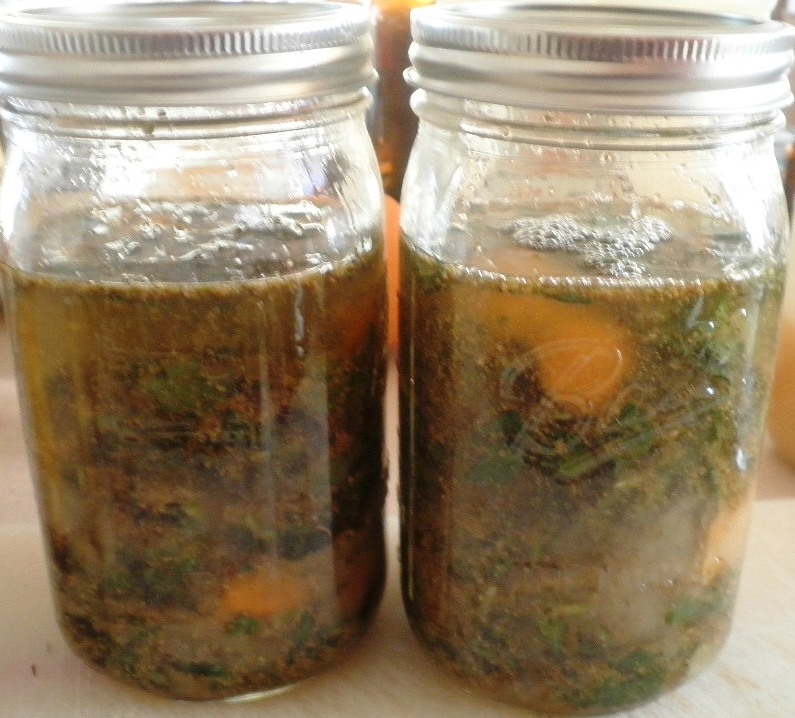 |
| Room left to add more botanicals and alcohol/honey in the morning. |
Horehound should be avoided during pregnancy.
Subscribe to:
Posts (Atom)