Thursday, May 28, 2015

Herbs for Bees and Beekeepers

Herbs for Bees and Beekeepers
Suzan Tobias Scholl, Herbalist, C.N.M.A. aladyinthyme@outlook.com
From the May/June '12 issue of The Essential Herbal Magazine

Whether you are a Beekeeper, a gardener, or just a happy observer of nature, you can promote a healthy environment for our happy pollinators and provide an area that is attractive to these special friends.

Did you know that there are different kinds of pollinating bees? If you are not a beekeeper, you may not realize that there are pollinating bees that do not live in hives. We often speak of “busy” Honey Bees and Bumble Bees- but did you know that there are several other pollinator Bees? Solitary, non-swarming bees like the Red Mason bee, The Blue Orchard Bee, and the Bumble Bee live in holes in wood. The Red Mason bee can be seen in the garden from March to July and is responsible for pollinating top fruit and soft fruit. The Blue Orchard Bee is active from May to September and is an effective pollinator of summer flowers, herbs and vegetables. Both the Mason and the Orchard Bee are non-stinging and gentle. Bumble Bees pollinate shrubs, trees, garden flowers, and vegetables.
hiding out during a rain shower
In spring, you can provide solitary wooden beehives perforated with holes for the Red Mason and Blue Orchard Bees, and Bumble Bee “nest-houses” for your pollinators. By attracting all bees to your garden, you will ensure effective pollination and happy flowers. By planting Herbs that are especially beneficial to bees with flowers that are blue, purple and yellow, you will be certain to attract the attention of a variety of pollinators. Aromatic herbs such as Lavender, Rosemary, Sage, Thyme, “Bee Balm” (Bergamot or Minarda), Hyssop, Basil, Anise Hyssop, and Marjoram; Wild Herbs such as Kudzu, Motherwort, Catnip and Purple Loosestrife; Bitter Herbs such as Southernwood, Wormwood and Rue: Nectar-rich Herbs such as Clover, Alfalfa, Mint, Borage; and the Rose Family are all Herbs that will attract these hard-workers to your garden.  By noting the bloom-time of your Herbs, you can plant a variety that invites pollinators throughout the growing season. Many Herbs “bolt” –they flower, and then decline. If you like to harvest your Herbs for cooking, potpourri, or medicine-making, you may want to plant extra plants to share with your pollinators.          (To keep plants viable for harvest, you have to snip off blossoms as they appear. That way, the plant continues to mature and you can engender several harvests throughout the growing season.)
calendula
You might also plan a dedicated “Bee Garden.” By planting all the Bee-attracting Herbs in one place you get to observe their behavior more closely. Look for a spot with some shade. Add a swing or bench so you can sit, read a book, and enjoy their behaviors and hard endeavors. Perennial Herbs such as Bee Balm, Catnip, Mint, Rosemary, Sage, Thyme and some Lavenders will be the “backbone” of your Bee Garden, while annuals like Borage, Chamomile, Cilantro, Fennel, Dill, and Parsley will add interest, too. Providing building supplies such as a heap of well-sifted soil, moistened with water nearby will keep your bees content.

By growing large plots of nectar-rich herbs, Beekeepers can promote good health for the hives and improve the quality and quantity of their honey. Noted animal herbalist, Juliette de Bairacli-Levy felt that Bees are “instinctive and highly skilled herbalists.” Cultivars such as Clover, Alfalfa, Buckwheat, and Sweet Clover; and Wild Herbs such as Goldenrod and Aster, Chicory, and Kudzu are important sources of nectar. Frequently these are not abundant or are rendered poisonous to bees by herbicides and/or pesticide.

If you have space to plant singular herbs for honey you will have success placing your hives within close proximity to the following:
~Alfalfa is an excellent nectar-rich herb. Its honey is white to amber.
~Anise-hyssop makes bees drunk with pleasure. They stumble over its perennial blooms all summer.
~Bergamot (Bee Balm) attracts with its red, pink, and purple “raggedy Anne” heads of color.
~Buckwheat is another excellent nectar-rich herb which produces dark, thick, strong-flavored honey. Bees cannot get enough!
~Catnip, rich in nectar, blooms well on wastelands, over a long period.
~Red Clover is another nectar-rich perennial herb which produces with to amber honey.
~Hyssop causes bees to happily stumble over it s blooms June to September.
anise hyssop
~Joe-Pye Weed is a perennial nectar- producer in early autumn. Its tall pink blossoms produce strong-flavored light amber honey.
~Kudzu produces a lovely magenta colored honey with a fruity taste.
~Marjoram, a perennial, blooms mid-summer. Honey from Marjoram is high in flavor, aroma, and quality.
~Sweet Clover, an annual, produces a white honey that is mild and spicy.
~Motherwort, a perennial, blooms most of the summer. Very easy to naturalize in waste areas, its honey is amber with a strong mint overlay.
~Mountain-Mint is an abundant source of nectar. A perennial, it produces minty flavored honey.
mountain mint
~Thyme honey is amber to dark with a delicate herbal flavor. There is nothing quite as enjoyable as watching a “carpet of bees on a carpet of thyme.”
~Blue Vervain grows in wet lowlands. This perennial produces good nectar in July and August with honey that is dark in color and pleasantly flavored.
field of blue vervain
For Beekeepers, faced with Colony Collapse Disorder [CCD] no pesticide or herbicide is good for bee populations; they are innately designed to “kill something living.” [*Note* There is a (new) pesticide which is a neurotoxin used in seed dressing to protect the seed and resulting plant against attack. Observers noted that CCD started after these neonicotinoid pesticides were introduced. Residues of this pesticide are found in the pollen and soil causing disorientation, paralysis and death to bees. Although it does not happen immediately, bees exposed to this pesticide died from CCD within about six months. You can watch this observation in the film, “Vanishing of the Bees.”]

American Foul Brood [AFB] is another bee colony disease that beekeepers are striving to eradicate. Studies have been ongoing that two fatty acids (palmitic and oleic) found in some pollens are able to kill AFB. Two fatty acids (linoleic and linolenic) have been found to be effective against AFB in laboratory tests. It has been asserted that antibiotic pollen in one bee cell, soaking through one wall of a neighboring cell has the potential to essentially kill bacteria in seven cells, as all cells are six-sided. Experiments with fields of Borage, which contains four of the fatty acids mentioned above, are ongoing.

yarrow
Planting Herbs like Anise-hyssop, Borage, Catnip, Hyssop, Marjoram, Motherwort, Mountain-Mint, and the Salvias attract bees by their color, nectar production, and hardiness. Herbs are utilized within the hives as well. Scented Geraniums and Rosemary can be rubbed on the inside to condition new hives before starting a colony. Wormwood rubbed on the hands can disguise the “human odor” and allow easier access to the hive (and masks the odor of the queen, if rubbed on areas where swarms have been removed.) Catnip, mint, or pennyroyal can be laid on top of the inner cover to deter ants from a weak colony. Beekeepers are growing seed trays of creeping thyme which are slid beneath the hive for a week before replacing it with a fresh tray. In the spring, a tea brewed from sage, thyme and chamomile and added to honey can be fed to each colony as a “spring cleanser.”

And remember: Comfrey, Calendula, and Plantain –rubbed on bee stings- soothes pain/itch and decreases swelling. Homeopathic Apis works great, too!


Wednesday, May 27, 2015

Mints are in the Meadow

All of our mints are up and waving.  It won't be long before they start to bloom and the pollinators will be buzzing around them. 
The mint family (lamiaceae) is very large.  Although right now I'm thinking about the mentha or menthol group, this family includes lavender, basil, thyme, and catnip for starters, and even many common weeds like dead nettle and ground ivy.  A family reunion for lamiaceae would be quite diverse.

In this part of the country, meadow mint is something that most country kids brought home for tea.  It was also encouraged in farmhouse gardens. 
Meadow mint - Spearmint

Spearmint is what I think of as "meadow mint" and it grows wild in many places.  The creek where I spent most of my childhood summer days was lined with it - along with stinging nettle (we called it burn hazel), wild forget-me-nots, and jewelweed.  For years, I associated the scent of spearmint vaguely with tadpoles, newts, sweat, and sunfish.
It showed up here on the farm, and has become a renewed favorite for my brother-in-law, who has nurtured a patch (in addition to that which has been plowed in the fields, and will forever continue to spread).
Around the same time, another mint that Susan Hess identifies as "fuzzy mint" while many also call it apple mint, but it is a very sweet and mild spearmint to my tastes, showed up and has also spread.

Fuzzy mint or apple mint, a type of spearmint
I planted peppermint which also got plowed one year, so now it is a loooong row, and then later, chocolate mint went into the garden.  Chocolate peppermint tastes very strong to me, like peppermint patties, but the chocolate part isn't that pronounced (again, to me).
Chocolate mint.  Note the dark stems and veins.
 Mints are very much taken for granted.  They can be invasive, so we need to take care where we plant them, but once they're in they ask for nothing.  They will thrive on being ignored.  Mint is in so many things!  Toothpaste and mouthwash are usually mint flavored (a very miniscule amount of the essential oil is used).  Candy and gums are made with mint, and we even use menthol derived from the plant in salves or commercial preparations to cool sore muscles or arthritic joints. 
menthol crystals
 The leaves are combined in many teas, and fruit and/or grain dishes benefit from the chopped leaves. One of our best selling soaps contains mint.  And what would the Kentucky Derby be without mint juleps?  For such an unassuming plant that we don't think that much about, we sure use it a lot. Do I need to mention mint chocolate chip iced cream?
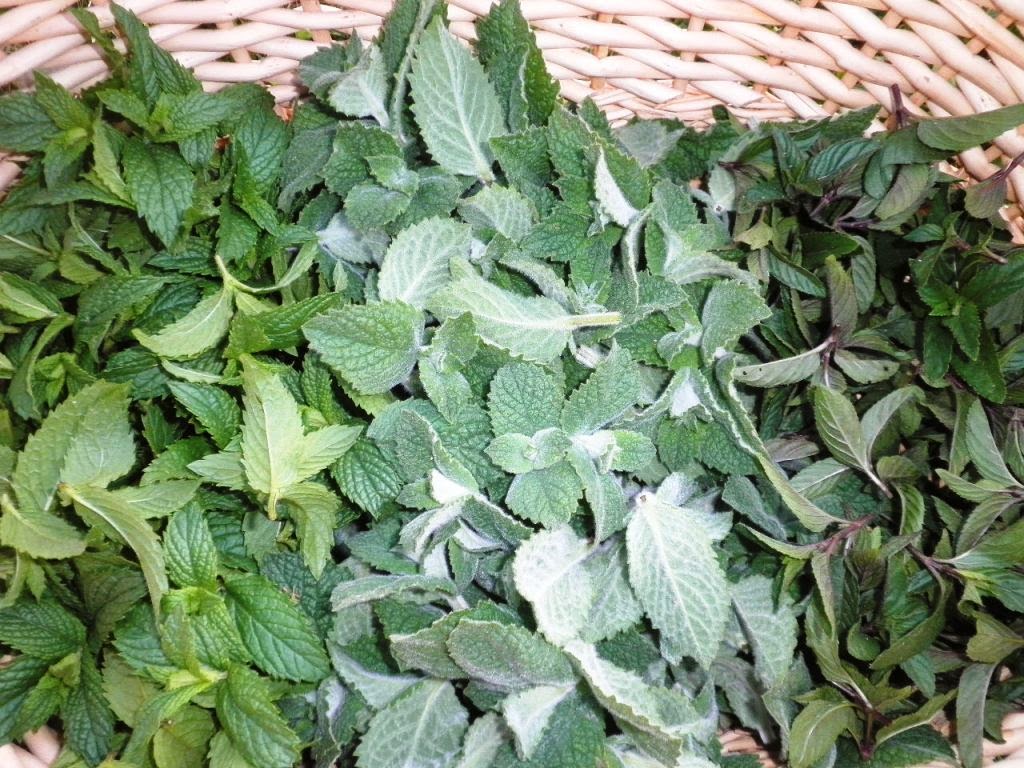
Meadow mint, fuzzy mint, and chocolate mint together in a basket.
Above, I've gathered the three mints that I use in one of the tea blends I make.  It's early, so the gathering is comparatively small and this will only dry down to a couple of ounces (if that), so every day, I'll toss the contents of the basket until it is dry.  Recently, there have been articles about herb teas containing very little of what is on the label, but THIS is how small herbal businesses make their blends.  No grass, no filler, just the beautiful fresh herbs in there. 

Medicinally, mint has a lot to offer too.
It is so cooling and relaxing that it just claims a hot summer night.  Iced mint tea on the porch, nice and sweet - right?  It's full of antioxidants, has antibacterial properties, and has long been used for settling an upset tummy or flatulence.  If you're prone to GERD, avoid peppermint, though.  My friend Betty Pillsbury clued me into the fact that peppermint will relax the esophageal valve that causes that particular problem - but spearmint is fine.  The tea calms coughs, soothes colds and sore throats, and can help bring down a fever.

One important caution -
While the essential oil is used commercially in all of these culinary treats, a very small quantity is toxic or even fatal (less than 1/4 ounce).  A single drop can more than sufficiently flavor over a pound of mint candy.  Use of the essential oil on infants can cause cardio-respiratory failure.

Grow and use the plants - it's got all the strength you need.

Monday, May 18, 2015

Walkin' to work

At this time of year, most days end with my sister and me making 6 batches of soap, and then the next morning we cut and stack it.
This is my walk to work this morning:
Peaches forming

Spearmint lines part of the path

Wild yarrow is everywhere

We're going to have a bumper crop of bayberries this year!

White dog roses.  So fragrant

A single rose

Star shaped flowers popped up wild under the motherwort

Motherwort is only a few days away from blooming

Wild chamomile

plantain seed heads kissing in front of the chickweed

Serviceberries - the birds are already excited

Patches of red clover have been showing up unbidden

Chive blossoms

Native persimmon is looking good

I threw some iris roots under the elder.  They like it.

Lupine was in the wildflower seed mix last year, and will soon bloom.

Centaury - one of Mom's favorites, still comes back year after year.
Elder blossoms have started reaching for the sky

Lambsquarters are as common as plantain and chickweed here.

Not sure, but I think this is a locust tree in bloom.  Have to get a closer look.
Walking to work is a pretty sweet deal.

Wednesday, April 29, 2015

Wildflower Preserve (vs the pipeline)

The kids were all around today, so we took the opportunity to visit Shenk's Ferry Wildflower Preserve.  As you look at the photos I took as we walked (and oh did I ever miss the drifts of bluebells, the squirrel corn, the dutchman's breeches, and a tiny bright yellow bloom that I'm certain is related to the other Dicentras), know that many are fighting to save this from being defiled by a high pressure pipeline that will not in any way benefit our area, or probably even the U.S.  It's hard to imagine taking this beauty so for granted.  Acres and acres packed with so many lovely and valuable wildflowers and herbs ... this is important. 
The trip there was also filled with vistas of these gorgeous plants, although not as many in one place. 
It was a beautiful day!

Tons of blue cohosh growing with bluebells and spring beauty all around.

The color is off on this, but these are blue phlox, and they are baby blue.

Part of a huge patch of VA bluebells.

We missed most (but not all) of the Dutchman's Breeches.  These are seedpods.

False Solomon's Seal - at home it is barely out of the ground, but 30 minutes south it is ready to bloom.

Hepatica - I don't know whether we missed the flowers or it didn't bloom yet, but the flowers are lovely.

Ragwort grows all along the creek running along the bottom of the gorge 50 or so feet below.

Solomon's seal also way ahead of the stuff in our woods at home.

Star of Jerusalem grows in large patches.

Nice lush toothwort

The trillium and bluebells went on for acres.

Close-up of the nodding trillium.

Stunning large white violets.

Wild columbine grows on the rock walls leading in.  It's the only place I've ever seen it.

Wild geranium is just beginning to bloom.  In a few days it will be breathtaking.
 
Spring beauty beside yellow violet.
There was also some putty root, lots and lots of wild ginger, a beautiful little white spray of flowers springing from a tiny rosette, wild bergamot, mayapple, and so much more.  The kids loved it and it was beautiful enough that Maryanne and I walked far longer than we'd normally do voluntarily.  I'm so glad we got there this year.  I hope it is still there next year.

Monday, April 20, 2015

A Dilly of a Weekend!

Several months ago, our friend Debbie Stiffler-Zugates asked if we'd be interested in coming to help the Indiana County Herb Study Group that she helped found celebrate 30 years.  Lately we've been doing less and less scooting around the countryside, but this was different.  We couldn't resist!  So after the PA Herb Fest the previous week, we didn't bother to unpack, and just headed out on Friday morning.

We stayed at the beautiful Dillweed Bed & Breakfast, hosted by Kyra and Corey Gilmore.


There is a Dillweed Herb Festival in June, and I will be posting information at the end of this entry.  The B&B is right next to a trail that was once a railway, and it passes through towns that were once bustling coal or steel towns that are now ghost towns and may now be not much more than a few foundations in the woods.

 That's why they call it the Ghost Town Trail (and we were relieved to hear the explanation).  We wandered a short way in both directions on the trail.  We wandered the gardens in back of the house.


Friday evening we had dinner with several of the Study Group members at a little restaurant in Blairsville.  Delicious and a very nice time.

Then we went back to the B&B to sit on the side porch and listen to the Spring peepers.
Saturday morning Kyra served us a scrumptious breakfast with just the right amount of herbs sprinkled in.

The whole stay at Dillweed was so comfortable and homey.  We really enjoyed it.  I do wish we'd taken the time to visit the gift and antique shop on the one side of the building, as I'm certain it holds treasures galore.
We drove over to The Rustic Lodge in Indiana PA to set up a table with our offerings, and get ourselves prepared to give a talk before lunch.  As the club members began to arrive, they shopped, and shopped, and shopped!  Eventually everyone arrived, and after we posed for a couple news photogs, we hit the lectern.  That hour flew, and they practically had to get the hook out (as I'd warned) to end the talk so that lunch could be served.
We ate, talked with the new friends at our table, and listened to a bit about the history of this vibrant and large herb study group.  This area is really pretty mountainous and rural, so to have 50 people show up was pretty amazing.  Not only did they show up, they were enthusiastic, engaged, and fun to be around.  After another round of shopping, the crowd thinned out and it was time to pack up to go home.
I'm skipping over the part where the GPS couldn't find Dilltown.  And the part where I realized that heights and cliffs and windy roads have gotten scarier than when I was young.  The beautiful vistas were thrilling last time I was there (nearly 40 years ago),  Apparently I need to get out more... I'm also excluding the part where we were lost in Indiana and Kyra had to talk Maryanne to the lodge.  Stupid GPS!
It was a beautiful weekend, and we enjoyed it.  Here's the info on the Herb Festival, just in case you're anywhere near western PA.  They draw a couple thousand people and have lots of great vendors and speakers, so it's worth a drive.

The Herb Festival:


Get ready for Dillweed’s annual Pick-A-Dilly Herb Faire!
 The Dillweed Bed & Breakfast in Dilltown is pleased to announce the 17th Annual Pick-A-Dilly Herb Faire, scheduled for Saturday, June 14th, from 9am to 4pm. Admission is free and open to the public.  The one day event is co-sponsored by The Herb Study Group of Indiana County.   


The herb festival has grown in popularity over the past years, attracting hundreds of visitors to the quiet village of Dilltown.  The event is a great way to spend the day visiting area growers that feature a large variety of flowering plants, HERBS and perennials - all in one location!  Food offerings will not be in short supply this year as Dillweed welcomes Gert’s Concession featuring stadium sandwiches, cheese steaks, fresh cut fries, cheese fries and cold beverages.  And once again the bed & breakfast will provide its’ fresh, sizzling hot Pesto Pizza by the slice!

Enjoy a unique selection of artisans selling country crafts,  handmade beeswax products, hand carved wood items for the home, all natural gourmet herb vinegars, spice blends & dipping oils, lavender sugar, and herb bean soups.  Returning artisans include original botanical artwork, herb teas, hand poured soap products, jewelry, and other garden inspired specialties. 

            Visitors to the event will gain valuable gardening information, growing tips and learn how to care for and cultivate their own herbal gardens.  Explore the history and many uses of this year’s featured herb, Savory ( will be available for sale during the show). Visit the “Ask the Gardening Expert” table with your herb and general gardening questions anytime throughout the duration of the Herb Faire. The Herb Study Group will be presenting three free seminars during the event - just look for the colorful balloons to indicate the location:
(Programs not yet finalized)

For additional information, directions and/or questions please contact:

Corey Gilmore at 814-446-6465.


dillweed@floodcity.net         Dillweed Bed & Breakfast    
www.dillweedinc.com           7453 Route 403 Hwy S
                                                Dilltown, PA  15929