Friday, April 28, 2023

Fun and Easy Way to Try a Few Wild Plants in the Kitchen

From our FREE 4/24/23 "Just the Essentials" newsletter that you can sign up for on our website.

 Incorporating Wild Plants

We were lucky in many ways to have had the grandfather we did, but especially because of his appreciation for found food. He suddenly found himself with 6 extra mouths to feed (Mom and the 5 of us) and he wasn’t above picking up that pheasant or rabbit that just got hit in front of the house, or snagging a couple dozen ears of very young field corn for the table.  He could always find fruit and nuts.  It shouldn’t be surprising that it rubbed off on me. For some reason, Maryanne is a little more hesitant.

We’d gotten away from those things for many years until we got involved in herbs during the early 90’s and somehow found ourselves at a meeting of The Herb Nerds on a farm across the Susquehanna river. It was a potluck, and the star of the table was a salad with pansies and violets.  Shortly after that, we went to an Int’l Herb Assoc. conference in SC, and I saw a book on wild foods by Billie Jo Tatum that lit my fire.  From that moment on, foraging was my “thing.”


 One of the easiest ways to get started is to ADD one or many wild edibles to a regular salad.  If you try something and don’t like it, you can easily eat around that.  I think they make a salad just beautiful, and full of flavor and nutrition.  The leaves that are young are most tender and flavorful. Flowers are a great addition.  If you decide to try maple seeds, you can use them raw, or roast them first.  The ones shown here are a little bitter because they’re large, but in a salad, sometimes a little bitter is good!
Mild but pleasant tastes:
    violet flowers and leaves
    garlic mustard
    young dandelion leaves (try flowers in fritters)
    chickweed
    redbud flowers
    maple seeds
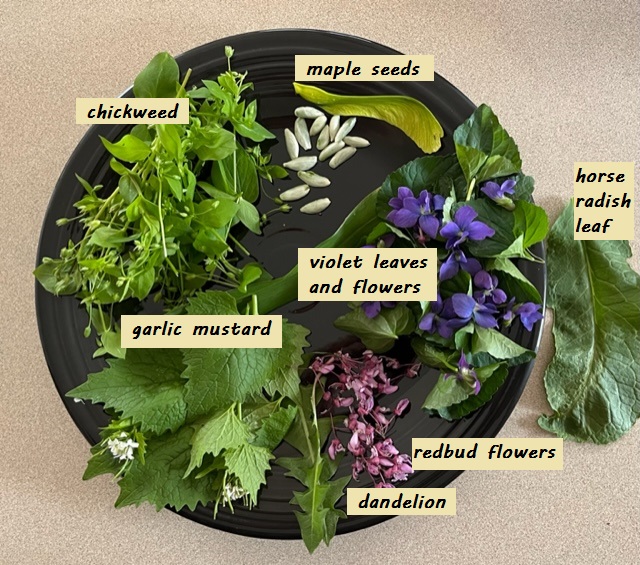
Note:  If you grow horseradish, the leaves are good to eat before they're too big.
6" is perfect.  Fresh or in cooked dishes - don't miss out on them!

You could also try plantain, daylilies (wild), forsythia, strawberry leaves, wild mustard, pine or spruce tips, Jerusalem artichokes, wild onions, dead nettle, and other well-known greens/plants that may grow where you are (miner’s lettuce comes to mind). The list is pretty long and changes as the growing season progresses.

Here is a bed of various spring lettuces and some carrots with the foraged "weeds" topped with a scrumptious goat cheese a friend made with preserved lemons. It could also include radish, cucumber, tomato - etc.!


Want to make a special oil and vinegar dressing? Start with this vinegar. Use 3 parts oil to 1 part vinegar.  In this case we use chives, but you can use any herbs or spices.  Mustards and wild onions are good addition!

Chive Blossom Vinegar
https://theessentialherbal.blogspot.com/2012/05/chive-blossom-vinegar.html

Last but not least, we have a few seasonal items in the SPECIALS category that are 10% off through Sunday, April 30, 2023. Only items in that category apply.
Outdoor Survival Kit
Gardener's Kit
Printed Cotton Totes
Hiker's Releaf
Teas (Snuffles is great for hayfever)
and
Wild Foods for Every Table book pdf

Sorry, we don't ship physical goods outside the US.

The newest issue went out last week. If you are not a subscriber, you're missing some pretty great stuff!
Have a great spring. It's here.

Monday, April 24, 2023

May/June 2023 Essential Herbal Magazine

The magazine went out to subscribers last week.
You can get a single issue OR
Subscribe!

May/June is always an interesting issue.  Either our teeth are still chattering and we're searching for glimpses of green, or spring is breathing down our necks.  This year, both of these situations are true, depending on location.  That's a little unusual, but c'est la vie.  The new normal.

The cover was chosen to honor an article in the magazine, and depicts my front garden.  It will look this way by the end of June, I'm sure.  At the rate things are going here, it could be by the end of May!


Here is what's in this issue:
Table of Contents

Crossword Puzzle 
Here comes summer in the garden! 

Field Notes from the Editor, Tina Sams
What’s going on around here?  Considering the seasonal changes.

Comfrey - My Lifelong Friend, Clara Lee
An herbal alliance can begin in early life.

Non-traditional Breakfasts, Alicia Allen
Caution:  Do not read on an empty stomach!  Delicious options to kick it up a notch. 

The Wizard’s Herb - Blue Vervain, Jackie Johnson
Blue vervain is a well-storied herb.  Read about the lore, magic and wisdom, and beautiful healing properties, as well as growing information. 

Take Your Pick, Kathy Musser 
Why choose one plant over another?  Catnip or catmint?  It all depends on a factors like purpose, space, and preference.

Book Excerpt: The Beginners Guide to Growing Cannabis, Tammi Sweet, MS 
We got a few great cuttings from Tammi Sweet’s newest book!  How to make Cannabis Honey, why growing your own is superior to processed, and also contraindications are inside this issue!

Herbs I Miss, Molly Sams
It’s hard to leave behind friends and family, but it’s a surprise to find that you also miss the plants you’ve known all your life.


Vending at Festivals, Tina Sams
Some hard-won tips for choosing successful events, as well as some thoughts on etiquette – or how to avoid being the vendor that everyone else is giving the side-eye.

An Herbal - What is it? Marcy Lautanen-Raleigh
The books that have led the way for all of us! 

What is Cold Infusion? Elise Stillwell 
Why would we use room temperature water rather than hot to make an infusion?  What are the benefits and which herbs?

Peppermint Can Really Perk You Up, Kristine Brown, RH(AHG)
All about peppermint’s properties and habits, as well as a few remedies to prepare.

Puzzle Key
About the Contributors

We're already at work on the EXTRA that will come out May 20.  Don't miss out - Subscribe now!

Monday, April 03, 2023

Just the Essentials - End of March '23


The last 6 weeks here were kind of chaotic.  Over the last decade, one by one the windows have sprung their springs, making them very difficult to open.  They got replaced, and that turned into new siding.  To prepare for this work, I moved everything away from all the windows in the house.  It’s been … different.  As I type, the spouting guys are putting the final touches on the job.  The cat has had just about enough of this rigmarole!   I don’t blame her. 

Now that things are back to normal, I can start dyeing again, planning, planting, and all the things I normally do – but couldn’t.  It’s time to start watching for the spring ephemeral flowers in the woods, and watching the jewelweed spring up everywhere.  It is really nice to have things back where they belong.  

Now that things are back to normal, I can start dyeing again, planning, planting, and all the things I normally do – but couldn’t.  It’s time to start watching for the spring ephemerals in the woods and watching the jewelweed spring up everywhere.  Soon the medicinal plants will be growing and it is really nice to have things back where they belong so that I can get to work!
What to have on hand so that you are ready:
Vinegar
Honey
Alcohol (vodka, grain, or your choice)
Maple syrup
Glycerin (if you want to make glycerites)

My bonus daughter Angel has a 9 month old baby right now, and brought me a bunch of glass baby food jars. These 2 or 3 ounce jars can be perfect for tincture making. We often make 8 or 16 ounces of something when an ounce or two will last more than a year.I might want a quart of holy basil or elderberry around every year, but 2 ounces of horehound or valerian is more than enough for us. Alcohol is expensive to experiment with, and who wants to pour money down the drain? A suggestion is to keep your eye out for small jars and hang on to them.They can also be purchased new from packaging suppliers.
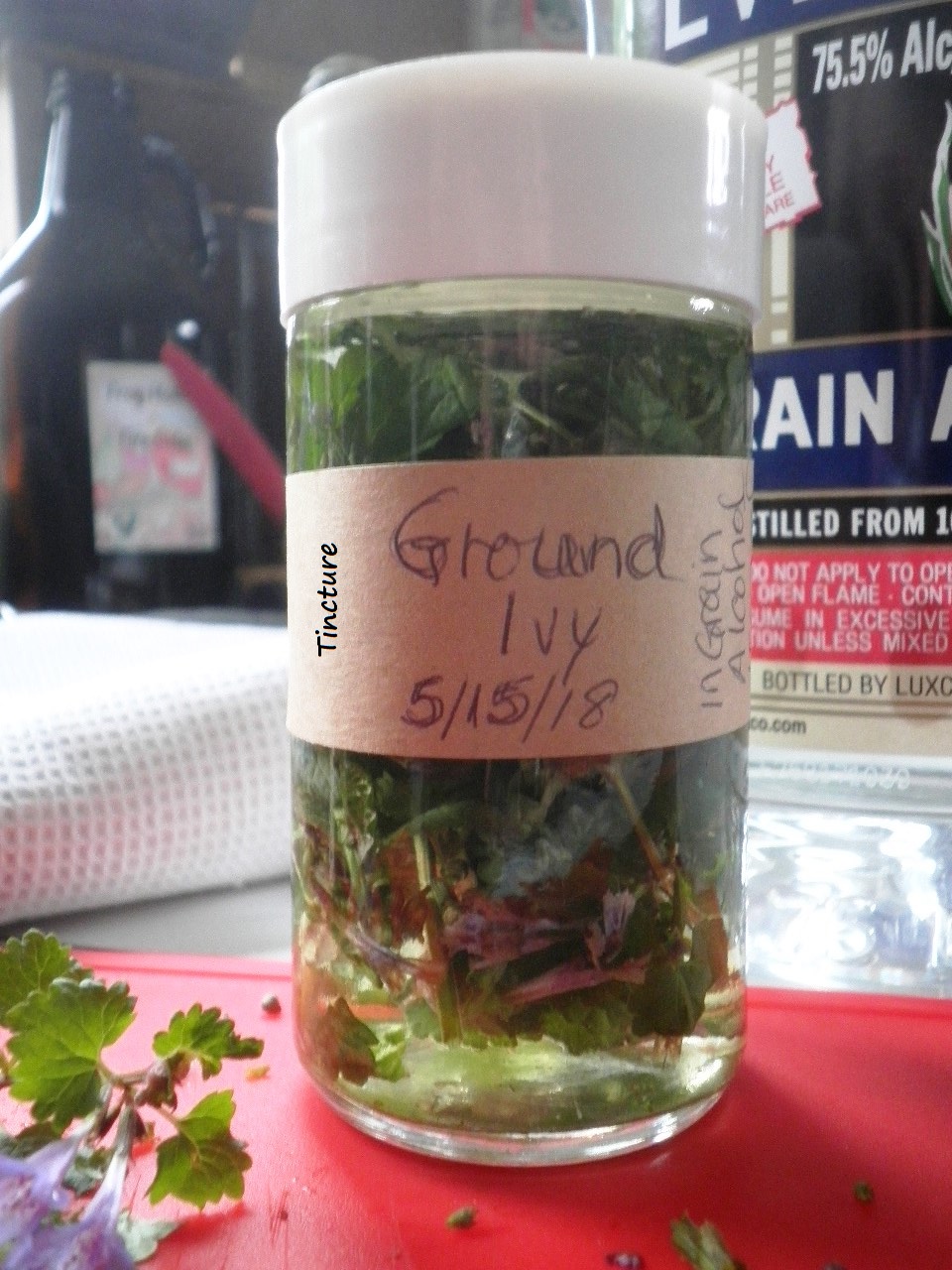
An example of a small tincture I’ve made in the past:

From Kristine Brown RH(AHG) of herbalrootszine.com
Ground Ivy Extract

This extract can be used for respiratory infections, tinnitus, and heavy metal toxicity, as well as urinary, digestive and bile issues. 

Fresh Ground Ivy
Grain alcohol
Water
Fill your jar halfway with chopped Ground Ivy. Add grain alcohol halfway then add water to fill the jar.
Let steep for 4 weeks before using, shaking daily. You may wish to strain off the Ground Ivy at the end of the 4 week period.
Dosage for adults: 30 drops 4-5 times daily. Double for chelation
Children 2-6 - 10 drops; Children 2 - 20 drops 4-5 times daily.
learn more:
https://theessentialherbal.blogspot.com/2020/04/ground-ivy-grimoire.html

With spring greens and things like asparagus coming up, I learned a little trick for making delicious soups very easily.  In Lancaster Co., chicken corn soup is a staple, and I made it for Maryanne’s husband a couple times before I noticed he was adding canned chicken cream soup to it.  He said he wanted it to have some thickener.  A couple tablespoons of instant mashed potatoes made it perfect. 
In years past, I’ve toyed with this same idea in nettle soup.  It’s very good.  Any wild (or not so wild) greens combined with almost any broth and a touch of potato flakes, and you’ve got a hearty soup!

Nettle Corn Chowder

1 T butter
2 T minced onion
1 stalk celery chopped
1 quart fresh nettle leaves
1 small potato, chopped
1 hard boiled egg, chopped
1/4 C 1/2 and 1/2
1/2 C corn
2 slices bacon, cooked til crisp
1 quart chicken (or veg) broth
1/2 C instant mashed potatoes

Instructions:
Process the rinsed nettles with about 2 cups of the broth until you get a green slush.
Melt butter in pan.
Sweat onion and celery in the butter.
Add the processed nettle to the pan.
Add chopped egg and potato, and the rest of the broth.
Add corn and whisk in instant potatoes
Add 1/2 and 1/2 and bacon (bits)

Heat thoroughly.  Serve with crackers.  There won't be any left, but just in case, it can be refrigerated.

 Greens Soup (generic) https://theessentialherbal.blogspot.com/2020/03/wild-and-free-food-greens-soup.html
You can add anything you want! Most ingredients are also optional.

If you follow TEH on Facebook, you probably saw the post of the above beads made with the powders available on our website. It got more reaction than anything I've posted for years.

In the 90's, my sister and I found some exquisite porcelain jewelry from Hillside Herbs that included herbal beads in the designs. The only problem was that if they were worn in the rain, or if there was a lot of perspiration, the beads would melt!

I spent the next 10 years experimenting to find a blend that when dropped into a glass of water, would not dissolve. They need to be strong, but still permeable enough to be fragrant. No small feat! But I didn’t give up.
After 1/2 hour sitting in water, these will get a bit soft/gooey on the surface, but will dry right out. They are durable enough to be used reliably in jewelry. It took a LOT of trial and error along the way.

The recipe was not given to me. It is original. You can get the bead powders with full instructions here.

 Shop HERE
... and the latest EXTRA! went out on Monday. All about Ginger - with lots of recipes and a remedy or two! If you aren't a subscriber, you're missing out!


 Get your subscription today HERE through the 20th of April '23 and you'll get the current issue AND the Extra.  Extras are not available individually.

We DO have a e-book with the first couple of years (12) of them, though!  HERE


I hope that you're getting a chance to get a whiff of spring. Maybe getting a chance to be doing something - no matter how small - with plants, seeds, or dirt! Hang on. It's coming!

Happy Spring!
Tina

Thursday, March 02, 2023

5 Great Herbs to Start With - Tea Garden Basics

 Our most recent newsletter went something like this.
You can sign up for the FREE "Just the Essentials" on our website.  It is separate from The Essential Herbal Magazine. 

I ran across this writing sample that I submitted for a book and ultimately chose not to write, and thought it might make an intro to a nice little newsletter/blog post!
Tea Garden Basics - 5 Great Herbs for Beginners

After deciding that it’s time to start a tea garden, there are some basics to think about.  It’s important to become familiar with what the individual plants require before starting to dig.  Plants all need varying amounts of sunlight, water/humidity, and nourishment from the soil.  Growth habit is another consideration, as some plants are tall, some short, some aggressive, and some easily overtaken.  This information is easily found by reading a bit about them or asking the herb farmer where you purchase the plants.  Seed packets will usually supply this information as well. 

One of the most reassuring bits of information given to me when starting out was that most herbs are weeds.  That means that if they are given some semblance of their requirements, they will find a way to flourish unless they are completely out of their native environment, although even then we might get a season of growth from them.

Remember that in general, plants aren’t very expensive.  You will lose a plant or two each season.  Sometimes a plant is contrary and doesn’t act the way it’s supposed to. That’s part of the adventure and part of the learning experience.  Each season is a new beginning and it never gets old.

Here are several nice options for a beginning herb tea garden.

 Chamomile
Matricaria chamomilla (or recutita) is also known as German, or wild Chamomile.  This is the one often found in disturbed areas, fields, and along the roadsides.  An annual, it spreads rapidly, with an upright, leggy growth habit.
Chamaemelum nobile, Roman, English or garden chamomile, is a much more behaved plant, better suited for the garden.  It grows closer to the ground and is sometimes used as a perennial ground cover, being resilient enough to put up with being walked up (and sending up soft apple-like fragrance) and the occasional mowing. 
Combine with equal parts Lemon Balm, Catnip, and Spearmint for a lovely relaxing tea.

Mint - Mentha
There are too many mints to list.  There are literally hundreds of varieties and cultivars.  If you get a few different ones and plant them too close together, you wind up with something completely different, and none of the original mints that were planted.  Mints are usually one of the first herbal teas that people enjoy, and they are blended in to many recipes for flavorful brews. All of the mints have a wide variety of attributes such as being analgesic, antimicrobial, antiseptic, antispasmodic, diaphoretic, digestive, and mildly stimulant.

Double Mint Tea
Blend together 1 part Spearmint and 1 part Peppermint.
Use a heaping teaspoon per cup of water.  Steep for 5 minutes.
Note:  One of my favorite ways to enjoy this is by mixing it half and half with black or orange pekoe tea (camellia sinensis).  It has the refreshing lift of mint with a little caffeine from the black tea, so it’s a real pick-me-up in the middle of the afternoon.

Holy Basil aka Tulsi, Ocimum tenuiflorum
I’m not sure I’ll ever not have holy basil growing in the garden, even though it is an annual here.  It is an ally in so many ways that it would take an entire book to talk about all of them.  It is revered in India, and in Ayurvedic medicine as well.
Holy basil is well suited to almost everyone.  That’s fortunate, because it is spectacular for anxiety or dread that causes some people to blow an interview or forget the answers on a test.  It calms that hot, sweaty panic that rises and allows one to almost stand aside and coolly assess a situation.  It may be more precise to say that the cloud of confusion and stress moves off to the side leading to more emotional and intellectual clarity.  Besides the emotional, there are many health properties, too.

Holy basil is very often blended with rose petals for a soothing, uplifting tea.

Lemon Balm
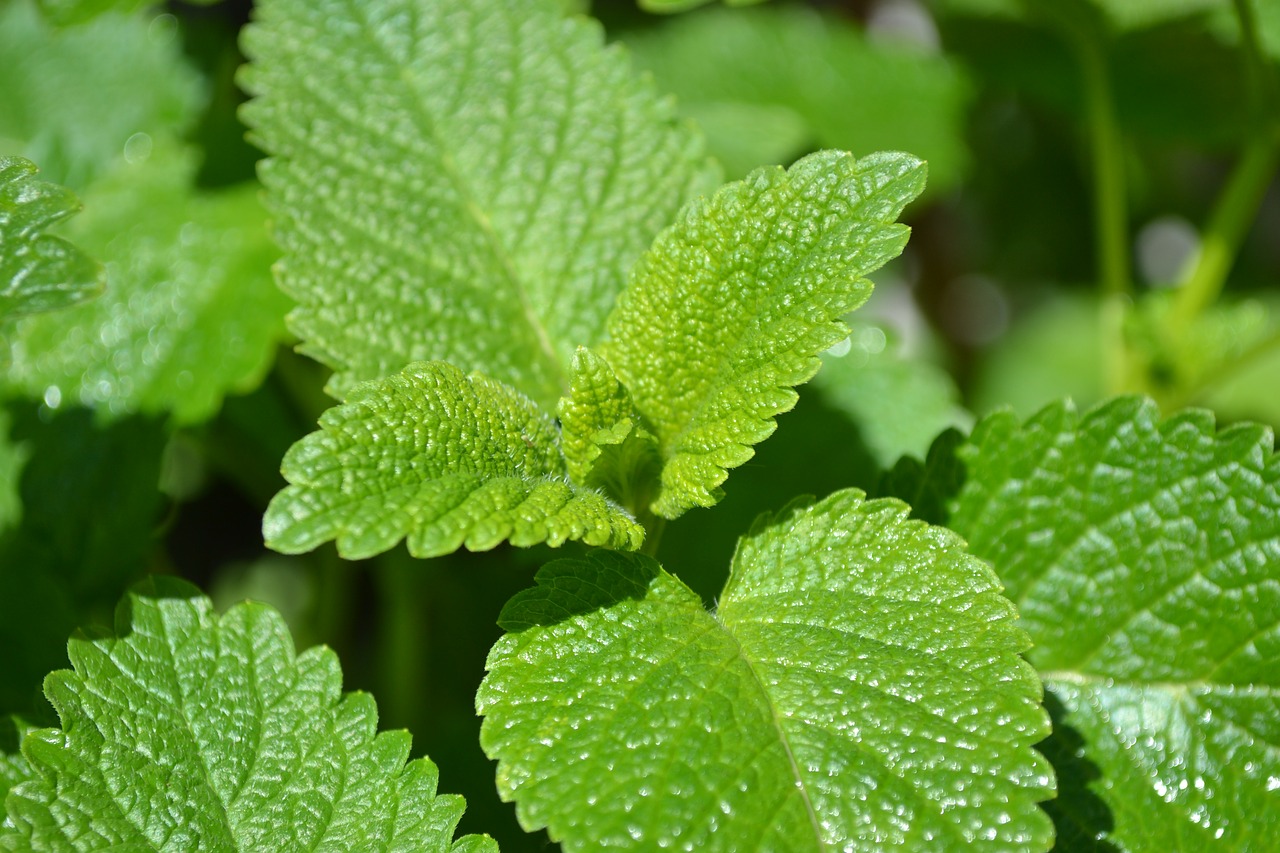
Lemon balm thrives incredibly well in whatever situation it is in. It likes well-drained soil with plenty of room (trust me it’ll grow), but unless you want it taking over every nook and cranny in your garden you may want to keep it contained. Lemon balm is well loved by pollinators. It’s Latin name Melissa officinalis actually means bee in Greek.
Lemon balm is wonderful for those who suffer from SAD but is also incredibly tasty in teas and baked goods. It is used mainly for anxiety, insomnia, and indigestion. It’s Latin name Melissa officinalis actually means bee in Greek. 
Lemon balm is a carminative, diaphoretic, and may reduce a fever. This plant is wonderful to give to little ones and fussy adults when they are sick with a cold or fever. You can also drink a tea after a large meal to fight off the symptoms of indigestion. It may also help you drift off to sleep afterward.

Sage, Salvia officinalis
Garden sage is a perennial in my zone 6b garden.  In lower zones, it depends on the winter, and may not withstand the weather.  It gets woody after a couple of years and needs to be trimmed back or the branches break and rot.
Sage has a strong ability to help with mouth and throat issues, making fast work of sore gums or throat.  It is calming and grounding when used either internally or topically.  It has been used traditionally to bring down fevers and bring sleep. Menopausal hot flashes respond to tea or tincture.
Sage tea with meals promotes digestion and helps with stomach pain, excess gas, diarrhea, bloating, and heartburn.   It is surprisingly delicious as a tea, especially with a little honey and lemon.

 There are so many plants that make great herbal infusions.  I always grow elderberry, but most berries are good and many (NOT elderberry) have leaves that taste great.  Raspberry, strawberry, and blueberry, for instance, are wonderful.  Thyme is a good tea herb, passionflower, catnip… the more you learn, the more you brew!

For more GREAT information in your email every single month, subscribe to our magazine - The Essential Herbal!

  www.essentialherbal.com