I spend a lot of time thinking about how connected everyone is these days. Not necessarily to each other, but to devices of communication. Even in my own home, there are times when several people are "together", but some of them will be engaged in a conversation of texts or emails while attempting to be present.
The thing that has really made me think about it a lot lately is the fact that a storm knocked out the answering machine on my phone a couple of months ago. I don't use a cell phone unless traveling, so at least when outside I am free.
At first, I mentally planned how to fix it and it would seriously take about 3 minutes of wire wrangling, yet it hasn't happened yet. "Oh no!" I thought, "How will people leave a message?" And still I don't fix it.
I get a little guff now and then for not having a telephone number on the web site. We're 11 years in, and email has worked out pretty well so far. The typical business-like reasons are that I am not available during regular hours, not willing to handle phone calls at all hours, and at one time there was a teenager with an unpredictable attitude. Perhaps anymore, the fact is that I just can't think on my feet anymore. I'm USED to being able to give responses some thought, look on the calendar, check back on prior communications, or whatever it might take to sound like the system here (and my mind) is intact.
Throughout my childhood, well into adolescence, my mother was bound to the front portion of our home 24/7. Extensions from over 40 businesses rang on a switchboard, and she took messages for all of them. She tracked down doctors, got emergency fuel deliveries taken care of, and pretty much juggled the problems of 100's of people a day. She rarely ventured outside, even after an outdoor ringer was installed. It wasn't worth the hassle. I started helping out with the phones at the age of nine. Really. Later, after that was sold and she went to work for someone else, at 14 I went to work on a bigger answering service with over 200 businesses, a few police departments, an alarm company, a Western Union office, and the first FAX line in the county. 2 people worked at a time, and it was ... um... fun. Afterwards I went on to be a police dispatcher with the county, where I learned the true meaning of the word emergency, and also how very many of them occur during an 8 hour shift.
So over the course of the last couple of months, I've realized the reason for my resistance to doing anything about the fried message machine. It is so much easier. There are probably fewer people who remember than those who don't, but there was a time when you could be alone. At one time, if the phone rang and nobody answered, that was that. No messages. No guilt about getting back to anyone. The caller could try later, or go ahead and live their life, perhaps checking in the next day. You could go on a hike and never talk to anyone except the person physically walking beside you, or maybe your dog.
Now that I've gotten that out of my system, I'll probably fix the phone in a few days. But always, I'm easier to reach by email :-)
Friday, August 24, 2012


Tuesday, August 21, 2012
Mid-Autumn Fruit Splurge

Earlier this year, I found a recipe for Vanilla Fig Bars and waited patiently. I made it the other night and it was very good (I added a touch of honey from my friend Zan's bees). The only thing is, I can never just leave a recipe alone. Eating one of those bars, I kept thinking how good that chock-full of health cookie base of almonds, coconut and figs would be used as a crust for a tart of some sort.
And so today, in order to step away from some of the less than savory bits of news coming across the computer, it became a reality. No eggs, dairy, or grains used. No baking. Just perfection.

The recipe for the fruit topping was just a conglomeration of what happens to be on my counter at the moment:
1 cup of fresh ripe elderberries
1 cup sweet ripe figs
1 large juicy peach
about a tablespoon of grated ginger
3 tablespoons of rich, dark honey
1/4 cup sugar
These were all set to simmer until it became a luscious, bubbling, fragrant mass - about 15 minutes .

In the meantime, I put together the crust. Using fresh figs with the coconut and almond makes the whole thing turn out looking just a little bit more like ham salad than I'd like, but that fades a bit as it sets up. It holds together exceptionally well.

At the very last minute, I added about 1/4 cup of coconut flour to the fruit mixture, just to help it thicken. It was taken off the heat for 10 minutes, and then spread over the crust. It is wonderful! Absolutely delicious, and while it is nowhere near low-calorie, it is full of things that are good for us.
I suspect my daughter will top it off with a dollop of yogurt with a smidge of honey.
Thursday, August 16, 2012
The Essential Herbal Sept/Oct '12
- We've been a little absent on the blog lately, but it isn't for lack of activity! All kinds of busy here on the farm, with harvesting, preserving, maintaining, and of course the magazine and soap businesses keeping us stepping.
The Sept/Oct '12 issue is headed out to subscribers now, and should be arriving in the next 2 weeks. If you'd like to join in the fun, subscribe! We've got plenty. Not sure? Click on the free issue along the right sidebar of this blog and check it out without risk.
Here's what you'll find in the current issue: - Field Notes
- During childhood, we establish our relationship with nature. Are we still playing and sharing that with the kids in our lives?
- Herbal Connections, Winter Herbs, Marita A Orr
- Getting our herbs lined up for the winter ahead, Marita shares her favorites and methods for use.
- Grooming & Pruning Herb Plants, Michele Brown
- The Herbfarmer gives advice for keeping our herbs in good shape to face the weather ahead so that they’ll be ready to spring into action as soon as the warmth and light return.
- Seasonal Support, Suzan T Scholl
- Lots of great herbs to have on hand, and now is the time to gather them.
- From the Vault, Secrets of the Scented Bead, Carol Huettner
- You may be very surprised to learn how myrrh beads and aromatic amber resin are created. It probably isn’t anything like what you expected.
- Medicinal Vinegar Tinctures, Marci Lautanen-Raleigh
- Alcohol-free medicinal herbal extracts in a base that is good for you? Read on!
- SouthRidge Treasures, Pesto, Mary Ellen Wilcox
- Look out basil, Mary Ellen is taking pesto far beyond the usual.
- Mullein the Great, Marci Tsohonis
- This common roadside weed has so much to offer. Like so many plants that we pass daily, it is worth a much closer look.
- Autumn Magic, Heddy Johannsen
- Welcome the season by celebrating the offerings of nature in the kitchen. Cider making without a press? Hmmm…
- Oatmeal—Food as Medicine, TEH Compilation
- We know about oatstraw and milky oatseeds as herbal preparations, but sometimes forget that it can be much simpler and we can incorporate the same benefits in delicious every day dishes.
- How to Dehydrate Lemons, Delores Harris
- Dehydrated citrus can be utilized in many ways over the holidays. Great instructions for excellent results.
- Pumpkin, TEH Compilation
- Is it the pumpkin, the spice combination, the delicious health benefits of deep orange foods, or the seasonal connection? All of the above? We love pumpkin in just about everything.
- Take Three Weeds, Sharon Wolfe Topsick
- Teachings from an elder.
- What is an Herbalist, Jackie Johnson, ND
- Do you ever wonder about this title and what it means?
- Herban Legends, Rita Richardson
- Old wives’ tales? Maybe, maybe not, but interesting either way.
- We're sure you're going to love this issue as much as we do.

Wednesday, July 25, 2012
Drying Elderberries
Right now, we only have a small quantity of berries ready for drying. Later, we'll have huge flats of screens out, but for now this is my favorite method and it works for just about anything you'd want to air-dry.
 Most everyone has some of these paper plate holders around the house. We rarely use paper plates, but the holders have become something that we use almost daily from the moment the first spring greens show up until the very end of autumn.

The berries can be heaped on the plate to a thickness of about 1/2 inch. They will quickly dry down and separate, and I've never had any spoilage. The same can be said for most flowers or leaves. There is a lot of circulation, and open baskets are great for drying.

After a couple of days the berries are starting to look like tiny raisins, and they will continue to dry for a week or more, depending on the temperature and humidity.

When they have completely dried, keep them in a sealed container in a cool, dry place and you'll have plenty to get through the winter!


The berries can be heaped on the plate to a thickness of about 1/2 inch. They will quickly dry down and separate, and I've never had any spoilage. The same can be said for most flowers or leaves. There is a lot of circulation, and open baskets are great for drying.

After a couple of days the berries are starting to look like tiny raisins, and they will continue to dry for a week or more, depending on the temperature and humidity.

When they have completely dried, keep them in a sealed container in a cool, dry place and you'll have plenty to get through the winter!
Tuesday, July 24, 2012
Treasure from the Storm
We had a gully-washer last night, and a lot of branches broke. We didn't notice any problem on any of our trees around the house, and I was very relieved to not lose any elderberry branches. They usually are the first to go in high winds, being so heavily weighted by fruit.
This evening my daughter and I wandered around the tree farm a little bit. We were about to go visit the puppies at my sister's when we came upon some mimosa branches that had come down in the storm.

We quickly set to work and soon found that a basket was needed, so Molly ran down to the workshop while I continued working in the quickly dwindling light.
The inner bark of mimosa feels so slick and emollient. The wood beneath is as white as bones. The bark came off easily in long straps, and we stuffed a large market basket with our treasure.

The bark and flowers of the mimosa tree are both considered to be extremely helpful for grief and sadness, and I have personally found this to be true during several intense situations over the past few years. The easiest way to describe its action is to say that it pushes the gray clouds away and allows the mind to stop focusing entirely on the sadness. It is also a wonderful herb to have on hand for winter blahs or times when I just want to cheer up a little bit because life is too serious.
 In the past, I've dried the flowers, but they are very labor intensive and an overflowing basket dries down to a few cups of material. It takes weeks of harvesting (and a few bee stings) to obtain a 1/2 gallon jar. This year I didn't dry any, instead making tincture with the fresh flowers only.

On the other hand, the bark dries beautifully and retains the components better and for a longer time. Every year I find a few small branches, but can't bring myself to cut a larger branch. Usually I wind up with a cup or so of dried bark. The bark is unusual in that the outer bark is almost paper thin (on branches - it's thick on the main trunks) and the inner bark is fairly thick. This will make a great addition to winter teas, and some of it will go into the jars of flower tincture that I started a couple of weeks ago.
To read a little more about mimosa:
https://theessentialherbal.blogspot.com/2009/07/happiness-herb-s.html
https://theessentialherbal.blogspot.com/2010/01/got-stress.html
This evening my daughter and I wandered around the tree farm a little bit. We were about to go visit the puppies at my sister's when we came upon some mimosa branches that had come down in the storm.

We quickly set to work and soon found that a basket was needed, so Molly ran down to the workshop while I continued working in the quickly dwindling light.
The inner bark of mimosa feels so slick and emollient. The wood beneath is as white as bones. The bark came off easily in long straps, and we stuffed a large market basket with our treasure.

The bark and flowers of the mimosa tree are both considered to be extremely helpful for grief and sadness, and I have personally found this to be true during several intense situations over the past few years. The easiest way to describe its action is to say that it pushes the gray clouds away and allows the mind to stop focusing entirely on the sadness. It is also a wonderful herb to have on hand for winter blahs or times when I just want to cheer up a little bit because life is too serious.


On the other hand, the bark dries beautifully and retains the components better and for a longer time. Every year I find a few small branches, but can't bring myself to cut a larger branch. Usually I wind up with a cup or so of dried bark. The bark is unusual in that the outer bark is almost paper thin (on branches - it's thick on the main trunks) and the inner bark is fairly thick. This will make a great addition to winter teas, and some of it will go into the jars of flower tincture that I started a couple of weeks ago.
To read a little more about mimosa:
https://theessentialherbal.blogspot.com/2009/07/happiness-herb-s.html
https://theessentialherbal.blogspot.com/2010/01/got-stress.html
Monday, July 23, 2012
From the Vault
Something old, something new...
A few months ago, we received an extraordinary gift from The Rosemary House!
Any herbie worth their salt has read something written by Bertha Reppert. She was a prolific writer whose mission in life was to spread the love of herbs far and wide. Besides writing many books herself (many of which are still available at The Rosemary House), she was also quoted in many herb books and contributed many writings to various herbal newsletters around the globe.
Prior to the advent of the internet, herb businesses were a completely different animal than what we've come to know. They were nearly all physical locations - stores, gardens, and classrooms with doors that people walked through. Marketing a business was an expensive proposition, and many herbal newsletters were published in order to stay in touch with customers and encourage visits and mail orders. Some newsletters were stand-alone businesses, but more often they were used as marketing tools. The herbal community enthusiastically provided content for these newsletters, contributing articles, recipes, and craft instructions in exchange for a way to also get their own names out there.
Mrs. Reppert was a favorite contributor, and she also received copies of all those newsletters and saved them - all of them - for close to 30 years.
So we were gifted with boxes and boxes of these herbal gems. For the most part, the businesses are gone, and in many cases so are the writers. The information varies from juicy tidbits to extraordinary revelations. The audiences were typically small, with between a few hundred to a thousand readers, so many of these items were seen by few people - most of whom have moved on in one way or another.
We mulled this over for some time, trying to figure out how or *if* we could ethically enrich The Essential Herbal with any of this treasure trove. We've decided to try to contact writers whenever possible, and give full credit to any re-print, putting it under the banner "From the Vault". In the upcoming issue, you'll find an article on myrrh beads!
We're very excited about the opportunity to reclaim some of this herbal knowledge and expect that you'll find a little "something old" mixed in with all of our usual content that teaches and inspires, in just about every issue of our magazine for years to come.
A few months ago, we received an extraordinary gift from The Rosemary House!
Any herbie worth their salt has read something written by Bertha Reppert. She was a prolific writer whose mission in life was to spread the love of herbs far and wide. Besides writing many books herself (many of which are still available at The Rosemary House), she was also quoted in many herb books and contributed many writings to various herbal newsletters around the globe.
Prior to the advent of the internet, herb businesses were a completely different animal than what we've come to know. They were nearly all physical locations - stores, gardens, and classrooms with doors that people walked through. Marketing a business was an expensive proposition, and many herbal newsletters were published in order to stay in touch with customers and encourage visits and mail orders. Some newsletters were stand-alone businesses, but more often they were used as marketing tools. The herbal community enthusiastically provided content for these newsletters, contributing articles, recipes, and craft instructions in exchange for a way to also get their own names out there.
Mrs. Reppert was a favorite contributor, and she also received copies of all those newsletters and saved them - all of them - for close to 30 years.
So we were gifted with boxes and boxes of these herbal gems. For the most part, the businesses are gone, and in many cases so are the writers. The information varies from juicy tidbits to extraordinary revelations. The audiences were typically small, with between a few hundred to a thousand readers, so many of these items were seen by few people - most of whom have moved on in one way or another.
We mulled this over for some time, trying to figure out how or *if* we could ethically enrich The Essential Herbal with any of this treasure trove. We've decided to try to contact writers whenever possible, and give full credit to any re-print, putting it under the banner "From the Vault". In the upcoming issue, you'll find an article on myrrh beads!
We're very excited about the opportunity to reclaim some of this herbal knowledge and expect that you'll find a little "something old" mixed in with all of our usual content that teaches and inspires, in just about every issue of our magazine for years to come.
Saturday, July 21, 2012
Summer "Salad"

All in all, we went about our business(es) and had a few adventures. We utilized the extreme heat to melt soaping fats and pounded out nearly 30 batches in the last month. Every time the shelves looked full, orders poured in and emptied them again - but that's the plan, isn't it?
I've gotten to play with some different tinctures, like wild lettuce and lobelia, made a gallon of sour cherry "bounce" and our CSA share is keeping me busy trying new recipes and eating great foods. Beets, squash, cucumbers, kale and eggplant are big right now. Bob's potatoes and onions were harvested the other day and sit in crates down in the work barn. We got to meet our favorite big-city beekeeping gypsy and Renegade Farmer, Zan Asha last week, and it was fun to toss ideas back and forth. That was followed by a few days with my guy, and now we're looking forward to a little time with friends from the Big Apple. It's a good mix here. Although it might sound a little wild, everything falls into a lovely rhythm and we enjoy every bit of it.
In the midst of this, the deadline for the Sept/Oct issue of The Essential Herbal arrived. I bundled up the well-stuffed file of articles and sent them on to Maryanne for lay-out. I was more than a little surprised to hear that it looked "light" to her after setting all the content, but then we realized that several of the articles were in a format that didn't carry over when she got started - and then realized that we'd need to use a smaller font and shrink the margins to get it all on the allotted pages. THAT'S more like it! There's a perfect blend of articles covering all aspects of herbal use - culinary, medicinal, growing, and enjoyment - and now if I can just get a focus for the field notes section, we'll be all set.
Tuesday, July 10, 2012
Yarrow Bath Tea and Compress

Yarrow Bath Tea and Compress
Dry yarrow
Dry lavender flowers
Dry rose petals
Dry milk powder
Light muslin square, reusable muslin bag or heat-seal tea bag
Make a mixture of dried botanicals. Three parts yarrow, one part lavender, one part rose petals, one part dry milk. Store a bulk amount in a dry jar with an airtight lid. Fill bags as needed and drop one into a warm bath. Alternatively, use the saturated bag as a small compress for sunburn. Gently swab tender areas.
Sunday, July 08, 2012
Reality of Herbal Fanaticism
The climate and landscape of alternative care has been changing rapidly over the last couple of decades. In herbs, we've gone from a time when medicinal herbs were something we did for our families, to a full-blown industry, with all the elements (good and bad) that entails.
Herbs, healthy eating, learning to manage stress, and a myriad of alternative preventive models have come to the forefront, allowing individuals to make a real difference in their own lives. In many cases, people have come to the study of herbs because they've learned to manage or even cure chronic illnesses that the allopathic medical community could not relieve.
Even when we had our shop in the mid-90's, we listened to our customers who were disappointed in the care they'd received by doctors, hospitals, insurance companies, and drug companies. It is hard not to jump on the bandwagon sometimes, but throwing the baby out with the bath water is not the answer. I personally despise drug companies and insurance companies. They've clearly demonstrated that they will choose money over mankind (or any species, for that matter) every time, but talk to the parent of a child whose life depends on a medication, and it changes the dialogue.
With the advent of heated discussions about funding insurance over the past 4 or 5 years, I've heard more and more herbalists saying that there is no place for the allopathic model. This is to me a childlike fanaticism. Charming, but foolish.
The argument is that with proper prevention and care using herbs and lifestyle, there is no need for medical intervention. On the surface, I admit that this argument sounds good. We can control all kinds of diseases that typical Americans moderate with drugs. Lots of herbalists treat themselves and their clients for things like diabetes, high blood pressure, chronic liver disease, bacterial infections, cancer, you name it. The other day I saw several postings about treating dental abscesses at home. Nevermind that *anyone* can show up and declare themselves an herbalist - we'll leave that for another day. In fact, there are many, many things that can be successfully treated with alternatives, good choices, and proper education on how to use these modalities. The truth is, the average person "cherry-picks" from the options that would help, and doesn't have time (or inclination) to devote to learning all there is to learn about what is required. This can be like teaching a man to fish where there is no body of water.
What they don't seem to be considering are all of the things that happen to people that cannot be healed with an herb or sutured up with some sinew in the backwoods. If I average it out, I'd say that I've seen a doctor about once every 5 years, and have been hospitalized about once every 10 years. I'm pretty healthy, and we use herbs for most any discomfort or self-limiting illness in this house. We try herbs first.
There are things that no amount of herbal knowledge will help. An ectopic pregnancy in my 20's had one and only one lifesaving solution - surgery, stat. A couple of my siblings were involved in car accidents that would have left them disfigured and disabled without surgical intervention. A brother-in-law developed bacterial meningitis from a tooth abscess. An herbalist friend who treated her own high blood pressure suffered a debilitating stroke. A sibling with Hepatitis C was cleared of the virus through medical intervention. A sister-in-law born with a heart defect so severe that her parents were advised not to name her, is now 57 because of medical intervention. These are just people in my close little world. The list of things that herbs and diet cannot address is long. Do we choose to ignore them?
In earlier times, it was fairly common for women to die in childbirth. Children born with congenital disease or malformations were doomed to live (or die) with them. People wandered around with puss-y sores and growths, poorly healed compound fractures, and all kinds of remnants of alternative healing, because that was the only thing that was available.
So now, when I talk to someone who has embraced this model, saying they don't need doctors because they can cure everything (and just how do they get those things diagnosed?), it makes me think about the damage they are doing to their brothers and sisters who work in herbs, and the legitimacy that so many have fought so long and hard to achieve. Showing up at the emergency room as a failed herbal experiment is exactly the sort of thing that brings the whole industry under scrutiny. This lack of responsibility that eventually falls back on allopathic medicine when it is too late to be of any help is how we lose options and access to herbs.
At a recent herb festival, I found myself in a cluster of long-time herbal friends ranging in age from 49 - 70ish. For the first time, the talk turned to medical issues some of the group or their loved ones were experiencing. Stuff happens as we age, no matter what kind of life we've led. A little life experience can go a long way...
There is an important place for all healing methods, and we would do well to remember that in order to keep what we have. Fanaticism blinds us to the value of that which we are not interested in seeing, but that doesn't mean that it isn't there.
Herbs, healthy eating, learning to manage stress, and a myriad of alternative preventive models have come to the forefront, allowing individuals to make a real difference in their own lives. In many cases, people have come to the study of herbs because they've learned to manage or even cure chronic illnesses that the allopathic medical community could not relieve.
Even when we had our shop in the mid-90's, we listened to our customers who were disappointed in the care they'd received by doctors, hospitals, insurance companies, and drug companies. It is hard not to jump on the bandwagon sometimes, but throwing the baby out with the bath water is not the answer. I personally despise drug companies and insurance companies. They've clearly demonstrated that they will choose money over mankind (or any species, for that matter) every time, but talk to the parent of a child whose life depends on a medication, and it changes the dialogue.
With the advent of heated discussions about funding insurance over the past 4 or 5 years, I've heard more and more herbalists saying that there is no place for the allopathic model. This is to me a childlike fanaticism. Charming, but foolish.
The argument is that with proper prevention and care using herbs and lifestyle, there is no need for medical intervention. On the surface, I admit that this argument sounds good. We can control all kinds of diseases that typical Americans moderate with drugs. Lots of herbalists treat themselves and their clients for things like diabetes, high blood pressure, chronic liver disease, bacterial infections, cancer, you name it. The other day I saw several postings about treating dental abscesses at home. Nevermind that *anyone* can show up and declare themselves an herbalist - we'll leave that for another day. In fact, there are many, many things that can be successfully treated with alternatives, good choices, and proper education on how to use these modalities. The truth is, the average person "cherry-picks" from the options that would help, and doesn't have time (or inclination) to devote to learning all there is to learn about what is required. This can be like teaching a man to fish where there is no body of water.
What they don't seem to be considering are all of the things that happen to people that cannot be healed with an herb or sutured up with some sinew in the backwoods. If I average it out, I'd say that I've seen a doctor about once every 5 years, and have been hospitalized about once every 10 years. I'm pretty healthy, and we use herbs for most any discomfort or self-limiting illness in this house. We try herbs first.
There are things that no amount of herbal knowledge will help. An ectopic pregnancy in my 20's had one and only one lifesaving solution - surgery, stat. A couple of my siblings were involved in car accidents that would have left them disfigured and disabled without surgical intervention. A brother-in-law developed bacterial meningitis from a tooth abscess. An herbalist friend who treated her own high blood pressure suffered a debilitating stroke. A sibling with Hepatitis C was cleared of the virus through medical intervention. A sister-in-law born with a heart defect so severe that her parents were advised not to name her, is now 57 because of medical intervention. These are just people in my close little world. The list of things that herbs and diet cannot address is long. Do we choose to ignore them?
In earlier times, it was fairly common for women to die in childbirth. Children born with congenital disease or malformations were doomed to live (or die) with them. People wandered around with puss-y sores and growths, poorly healed compound fractures, and all kinds of remnants of alternative healing, because that was the only thing that was available.
So now, when I talk to someone who has embraced this model, saying they don't need doctors because they can cure everything (and just how do they get those things diagnosed?), it makes me think about the damage they are doing to their brothers and sisters who work in herbs, and the legitimacy that so many have fought so long and hard to achieve. Showing up at the emergency room as a failed herbal experiment is exactly the sort of thing that brings the whole industry under scrutiny. This lack of responsibility that eventually falls back on allopathic medicine when it is too late to be of any help is how we lose options and access to herbs.
At a recent herb festival, I found myself in a cluster of long-time herbal friends ranging in age from 49 - 70ish. For the first time, the talk turned to medical issues some of the group or their loved ones were experiencing. Stuff happens as we age, no matter what kind of life we've led. A little life experience can go a long way...
There is an important place for all healing methods, and we would do well to remember that in order to keep what we have. Fanaticism blinds us to the value of that which we are not interested in seeing, but that doesn't mean that it isn't there.
Thursday, June 28, 2012
Neck Coolers–for keeping cool…
These neck coolers are one of the easiest ways to keep cool in really hot weather when you need to be outside, or just need to cool down quickly. We’ve used them at outdoor shows or in the garden, and the relief is pretty amazing.
With the heat wave that has been going on in many parts of the country, and is now heading eastward, I thought I’d share this craft. Now, understand that these can be found for sale – On our website. But… it’s the kind of thing you can make a dozen of for just a little money and time (although not as nicely done), and throw into the cooler with the beverages during the upcoming holiday. Having plenty of them will mean that they can be worn until they start to warm up, and then switched out with another, icy-cold one.
You’ll need some polyacrylamide crystals, marketed as root water crystals in the garden centers across the country, and some fairly closely woven cotton material. Old sheets that have worn spots would be great for this purpose.
I’ve whipped one up by hand because I know not everyone has a sewing machine. You will probably notice that I’m not terribly particular about measurements either. The only measurements that really matter are that:
*the scarf is long enough to tie loosely about the neck
*the pocket that holds the crystals is only about 5 or 6 inches wide
*do not be tempted to use more crystals – you’ll burst the seams
Start with a strip of fabric 40” long X 5” wide. Fold it in half lengthwise, and sew it into a tube.
Turn it inside out, and fold in half lengthwise. From the fold, measure 2 1/2” to 3” on each side.


Sew ONE of those lines, widthwise.

Add one teaspoon full of the crystals.

Sew the other line, forming a packet that holds the crystals and reinforce the seam that runs lengthwise so that the crystals stay inside.


If you’re hand-sewing, these three seams are the most important to use very small stitches on. The long initial seam isn’t too important, it just forms the tube.
You can then finish off the ends of the tube by turning them in and hemming. Doing so at an angle is a nice touch.
Submerge the neck cooler in cold water for about 15 minutes, and apply. It will stay cool for quite a while, and when it starts to warm up, flip it over for further cooling. Throw it back into the cold water and it’s ready to use again. It will be about 3/4 – 1” thick in the pocket.
These are reusable until the cloth wears out! Just allow them to dry naturally. The crystals release the water and return to their tiny dry selves. Until you need them again.

Thursday, June 21, 2012
Fruit popsicles
We eat a wide variety of fruits here, but lately the addition of our own berries in the yard and those from our CSA share have challenged even us to keep up. Today I found myself with a counter full of small containers of black raspberries and gooseberries, a couple of rapidly browning bananas, a couple of limes, and some frozen organic strawberries. Our first real heat wave had me thinking of smoothies, but then I remembered the popsicle mold that came home a couple of months ago…
Years ago, working in a factory that had no air-conditioning, I discovered that fruit can make a huge difference in extreme heat. Later when we worked long days in costume at a renaissance festival, strawberry and banana smoothies saved us on many afternoons.

There have been a lot of pictures and recipes for fresh fruit popsicles showing up on the various social media sites lately, but the thought of whole chunks of frozen fruit molded into a solid form, while beautiful, in reality seems like it would be messy. I got out the blender instead.
The basic “recipe” was 2 small bananas, a generous handful of frozen strawberries, an equally generous handful of mixed wild berries, and about 1/4 lime (rind and all). About 1/4 cup of water was added to help the blender, but that probably wasn’t necessary. It was good, though.
The resulting fruity goop was naturally sweet and thick. It poured easily into the molds. The part that didn’t fit into the mold was delicious, and the tiny chunks of lime rind were really a nice addition – as were the tiny fruit seeds.

Into the freezer for a few hours, and the popsicles were ready. Delicious!

This is definitely something I’ll be doing all summer, but the popsicle molds probably won’t be a part of it. Reusable lidded cups would work much better for us. We’re all adults, and it is murder getting those molds to let go without pulling the stick out.
Peaches will soon be ready, and all of the luscious summer fruits – melons, berries, nectarines, pineapple… I can’t think of a fruit that wouldn’t work. Herbs could be added too, but for the most part concentrated infusions in place of the water used above seem that they’d be best. Give it a try if you find you have leftover fruit. The banana gives it a creamier texture without overwhelming the flavor of the other fruits.
Thursday, June 14, 2012
Yarrow, Achillea millefolium
During the past week, we’ve been noticing the yarrow popping up and blooming. It isn’t quite in full swing yet, so in preparation, I thought I’d post a past article on this deceptively diminutive flower. We gather it throughout the summer to dry for use in teas, salves, tub teas and tincture. Don’t pass up this sweet weed.
Yarrow - Useful, Beautiful and Easy
Susan Evans
The Essential Herbal May/June 2010

With a lot of gardeners, yarrow, Achillea millefolium, is a love it or hate it plant. Sure, it has Napoleonic tendencies, marauding through the garden, but its many admirable qualities override this small flaw. I find it to be a beautiful, durable garden plant that blooms happily away in neglected areas of the yard in full sun, poor soil and limited water.

We first heard of yarrow from Achilles,
Homer’s warrior from the Illiad, who learned of its healing qualities from the centaur Charon. Constantly fighting over one thing, or another he used it to heal the battle wounds of his warriors. Some of its common names include Soldier’s Woundwort, Knights Milfoil, Bloodwort, Staunchweed and Nosebleed.
The first time I witnessed the curative powers of yarrow was when I ran a landscaping company. One of the boys on my crew was prone to profuse nosebleeds, occasionally sending him to the emergency room. While we were working away one afternoon I heard the familiar exclamation as Cameron started spurting blood all over the shrubbery he was pruning at the time. Having recently read about yarrow’s styptic qualities, I instructed him to chew up some nearby leaves and stick them up his nose. The rest of the crew jeered and laughed but he did it. We were all amazed and repulsed when Cameron pulled out the bloody bolus and the bleeding did not resume. Since then I have used the chewed leaves of yarrow as one of my favorite trail medicines to stop bleeding and temporarily disinfect cuts and abrasions.

Yarrow has a surplus of healing qualities. It is used for the internal bleeding of heavy menses, bleeding ulcers and hemorrhoids. Native Americans used it for everything from bleeding to urinary disorders and digestive ailments. Yarrow has been used to reduce fevers, relieve chest colds and as a digestive and general tonic. The roots have been chewed for sore gums and teeth. I have used yarrow as a disinfectant tea to wash injuries and skin rashes. Yarrow contains salicylic acid, which is a pain reliever used in aspirin and has anti-inflammatory properties. I’ve also heard it makes a good hair rinse. I find a lot of herbals recommending yarrow as a tea. I guess, if you like bitter. I prefer to make a tincture or capsule of the dried plant, thereby missing out on the tongue curdling taste.
Yarrow seems to have a split personality when it comes to magical properties. On one hand it was thought to be a favorite of the devil, used in evil spells. Two of its numerous common names are Devils Plaything and Devils Nettle. On the other hand it was often used to protect against evil. Sprigs were tied to cradles to prevent witches from stealing a baby’s soul. It was also worn and strewn over thresholds to protect against evil. Try it the next time the in-laws visit. Yarrow was used in love spells and divination, the stalks are used in readings of the I Ching.
For a durable garden plant yarrow is hard to beat. A hardy perennial, it grows from 1-3 ft high, depending on the variety. It blooms from late spring through fall if you remove faded blooms. Flowers come in pink, red, yellow and the wild form, white. It has ferny leaves and straight stems. I often read that it makes a good companion plant, enhancing the health of plants around it. I don’t know where these authors live, but in my Colorado garden, I have to keep a close eye on yarrow as it likes to overrun my less assertive perennials, which hardly consider it a good companion, more like the neighborhood bully. I consider this it’s only drawback.
Cut and hang yarrow flowers upside down to preserve for beautiful dried flower arrangements.
Useful for so many things, easy to grow and beautiful to boot, what’s not to love about this plant?
Susan Evans is a Certified Clinical Herbalist and owner of Chrysalis Herbs.
Yarrow - Useful, Beautiful and Easy
Susan Evans
The Essential Herbal May/June 2010

With a lot of gardeners, yarrow, Achillea millefolium, is a love it or hate it plant. Sure, it has Napoleonic tendencies, marauding through the garden, but its many admirable qualities override this small flaw. I find it to be a beautiful, durable garden plant that blooms happily away in neglected areas of the yard in full sun, poor soil and limited water.

We first heard of yarrow from Achilles,
Homer’s warrior from the Illiad, who learned of its healing qualities from the centaur Charon. Constantly fighting over one thing, or another he used it to heal the battle wounds of his warriors. Some of its common names include Soldier’s Woundwort, Knights Milfoil, Bloodwort, Staunchweed and Nosebleed.
The first time I witnessed the curative powers of yarrow was when I ran a landscaping company. One of the boys on my crew was prone to profuse nosebleeds, occasionally sending him to the emergency room. While we were working away one afternoon I heard the familiar exclamation as Cameron started spurting blood all over the shrubbery he was pruning at the time. Having recently read about yarrow’s styptic qualities, I instructed him to chew up some nearby leaves and stick them up his nose. The rest of the crew jeered and laughed but he did it. We were all amazed and repulsed when Cameron pulled out the bloody bolus and the bleeding did not resume. Since then I have used the chewed leaves of yarrow as one of my favorite trail medicines to stop bleeding and temporarily disinfect cuts and abrasions.

Yarrow has a surplus of healing qualities. It is used for the internal bleeding of heavy menses, bleeding ulcers and hemorrhoids. Native Americans used it for everything from bleeding to urinary disorders and digestive ailments. Yarrow has been used to reduce fevers, relieve chest colds and as a digestive and general tonic. The roots have been chewed for sore gums and teeth. I have used yarrow as a disinfectant tea to wash injuries and skin rashes. Yarrow contains salicylic acid, which is a pain reliever used in aspirin and has anti-inflammatory properties. I’ve also heard it makes a good hair rinse. I find a lot of herbals recommending yarrow as a tea. I guess, if you like bitter. I prefer to make a tincture or capsule of the dried plant, thereby missing out on the tongue curdling taste.

Yarrow seems to have a split personality when it comes to magical properties. On one hand it was thought to be a favorite of the devil, used in evil spells. Two of its numerous common names are Devils Plaything and Devils Nettle. On the other hand it was often used to protect against evil. Sprigs were tied to cradles to prevent witches from stealing a baby’s soul. It was also worn and strewn over thresholds to protect against evil. Try it the next time the in-laws visit. Yarrow was used in love spells and divination, the stalks are used in readings of the I Ching.
For a durable garden plant yarrow is hard to beat. A hardy perennial, it grows from 1-3 ft high, depending on the variety. It blooms from late spring through fall if you remove faded blooms. Flowers come in pink, red, yellow and the wild form, white. It has ferny leaves and straight stems. I often read that it makes a good companion plant, enhancing the health of plants around it. I don’t know where these authors live, but in my Colorado garden, I have to keep a close eye on yarrow as it likes to overrun my less assertive perennials, which hardly consider it a good companion, more like the neighborhood bully. I consider this it’s only drawback.
Cut and hang yarrow flowers upside down to preserve for beautiful dried flower arrangements.
Useful for so many things, easy to grow and beautiful to boot, what’s not to love about this plant?
Susan Evans is a Certified Clinical Herbalist and owner of Chrysalis Herbs.
Wednesday, June 13, 2012
The Essential Herbal July/August '12
The newest issue is on the way to subscribers - filled with all the summertime herbal goodness you've come to expect from The Essential Herbal. Subscribe today for 6 luscious issues each year. Choose from print or pdf format!

Field Notes
Musing on the harvested goodness of summer and how we obtain great food.
Druid Plant Quiz
Cover artist Suzan Scholl provided a quiz that takes the cover from being a picture into a learning opportunity. You'll love it!
Druid Herbals, Suzan T Scholl
An ancient people, we still use many of the same herbs today.
Louisiana Lagniappe, Shrimp Pasta Salad,Sarah Liberta
A cool, delicious dish to serve family or friends in the heat of summer.
A Rose by Any Other Name, Rita Richardson
Rose Geranium, to be precise!
What to Do About a Sunburn, Cindy Jones
Herbal relief from summer's ravages on the skin.
Herbal Recipes for Well-Being, Heddy Johannesen
Learn to make a tincture, salve, body scrub - and more!
May Apples in Summer, Maryanne Schwartz
Often thought of as a spring flower, we rarely see the apples. Time to look closer.
Wildharvest Adventure in Ohio, Jeni D Greenwood
Ready to grab your basket and go? Jeni will have you itching to harvest some wildlings.
The Rose, Marita A Orr
Oodles of delicious and delightful culinary treats made from roses. This article is one you'll want to keep for years to come.
Tomato Freezer Jam
Quick and easy? You bet!
Literary Seed Cake
Bake up a little history (and eat it too)
Summer Herb Sauces, Marcy Lautenan-Raleigh
Lots of new and interesting ways to use herbs and bring new zest to the table.
The Humble Dandelion, Sandy Michelsen
Dandelions are still in the yard. Use 'em up!
SouthRidge Treasures, Tansy, Mary Ellen Wilcox
"Today, it is used mainly as a decorative plant, but it does have an interesting past as a culinary and medicinal herb." Lots to learn!
The Soap Pot, Yarrow Sunburn Suite, Alicia Grosso
Full instructions for salve, lotion, soaps, and compresses for this wonderful, healing herb.
Salsa!, Tina Sams
If you've only tried tomato based salsa, you may want to check out these colorful, flavorful fiestas for the tastebuds.
Women Herbalists, Maud Grieve,Susanna Reppert Brill
Susanna takes us for a visit with another fascinating historical woman herbalist.
Herbal Mothproofer Mix
Gather those herbs and protect clothes and linens.

Field Notes
Musing on the harvested goodness of summer and how we obtain great food.
Druid Plant Quiz
Cover artist Suzan Scholl provided a quiz that takes the cover from being a picture into a learning opportunity. You'll love it!
Druid Herbals, Suzan T Scholl
An ancient people, we still use many of the same herbs today.
Louisiana Lagniappe, Shrimp Pasta Salad,Sarah Liberta
A cool, delicious dish to serve family or friends in the heat of summer.
A Rose by Any Other Name, Rita Richardson
Rose Geranium, to be precise!
What to Do About a Sunburn, Cindy Jones
Herbal relief from summer's ravages on the skin.
Herbal Recipes for Well-Being, Heddy Johannesen
Learn to make a tincture, salve, body scrub - and more!
May Apples in Summer, Maryanne Schwartz
Often thought of as a spring flower, we rarely see the apples. Time to look closer.
Wildharvest Adventure in Ohio, Jeni D Greenwood
Ready to grab your basket and go? Jeni will have you itching to harvest some wildlings.
The Rose, Marita A Orr
Oodles of delicious and delightful culinary treats made from roses. This article is one you'll want to keep for years to come.
Tomato Freezer Jam
Quick and easy? You bet!
Literary Seed Cake
Bake up a little history (and eat it too)
Summer Herb Sauces, Marcy Lautenan-Raleigh
Lots of new and interesting ways to use herbs and bring new zest to the table.
The Humble Dandelion, Sandy Michelsen
Dandelions are still in the yard. Use 'em up!
SouthRidge Treasures, Tansy, Mary Ellen Wilcox
"Today, it is used mainly as a decorative plant, but it does have an interesting past as a culinary and medicinal herb." Lots to learn!
The Soap Pot, Yarrow Sunburn Suite, Alicia Grosso
Full instructions for salve, lotion, soaps, and compresses for this wonderful, healing herb.
Salsa!, Tina Sams
If you've only tried tomato based salsa, you may want to check out these colorful, flavorful fiestas for the tastebuds.
Women Herbalists, Maud Grieve,Susanna Reppert Brill
Susanna takes us for a visit with another fascinating historical woman herbalist.
Herbal Mothproofer Mix
Gather those herbs and protect clothes and linens.
Friday, June 08, 2012
Change of pace - sigh...

I consider myself very fortunate for a lot of reasons. Usually they are counted on this blog in measures of the ways I love the natural world and all the beauty that offers on a daily basis. Sometimes though, it is because the man in my life thoroughly enjoys sharing some of the other delights the world has to offer. Things that just don't happen here on this heavenly hill...


The view from our hotel windows allowed us to see all the way to the tip of the island along the beach, as well as the bay. The skies blessed us with puffy clouds and beautiful nights.


Might as well mention that the slot machines were fairly kind and let us go home with everything we took along, plus some change.

I'll just hang onto this little bit of pure happy, and pull it out if I need it on cloudy days.
Monday, June 04, 2012
Happy Birthday Susanna Reppert Brill :-)

We've been friends for about 20 years, but I doubt if she knows how much I respect her or care about her. It seems like on those landmark birthdays, you look back over your life and wonder how you're doing with life and whether you're accomplishing what you'd like to do. Some people say that being a good friend is about all we can hope for in this life. Some would say that being a loving person would be the goal. Nobody really knows the answer, I guess, but she's got those two cornered.
I knew her as a single woman, watched her meet and marry her husband, rejoiced over her children's births, and mourned the passing of her parents. She's been a reasonable ear/voice for some of my best and worst moments too and didn't remind me if/when I didn't heed her advice . I watch her juggle her family, full-time shop, speaking engagements, full schedule of classes, and friendships with awe. Like my own situation, she has a sister nearby who helps a lot and that cannot be underestimated, but she manages all of these things with grace and steadfast integrity.
She's one of those people who, when the chips are down, steps up. Really steps up.
She says, "this is what I can do for you, and I want to do it, and it's no trouble."
She's the kind of friend who tells you when you're being an idiot.
When you say something snarky about someone you both know, she defends them without fail.
When you set up next to her at an herb faire, she'll start selling your products and setting you up with people who are looking for a speaker or a writer.
She has a dry wit that took me a while to peg, but now makes me laugh til I choke.
She's a fantastic writer, a brilliant and seasoned speaker, and knows more about herbs than just about anyone I know, besides being modest to a fault.
She's probably going to hate this post :-D
Sorry about that!
Happy Birthday Susanna Reppert. Love you.
Friday, June 01, 2012
The Lazy Gardener
I've been whining about weeding a lot lately, but a new rechargeable battery powered (lightweight!) weed whacker has really solved that problem.
So here's the thing...
In my high school year book, someone or some group anonymously made a list of 10 year predictions about different people. For me, the prediction was: "Will still be trying to get out of work."
That stung. I didn't even remind myself that I'd held paid jobs from the age of 14 or worked at our home business for many years before that. No... it just made me feel lazy. I was also well aware of how many times I'd rushed through my school work to knock off the afternoon and go swimming in the river with my friends, so accepted the slap and "owned it" for many years.
It took a long time to realize that doing less work while accomplishing the objective is most certainly one of my strengths, and employers over the years valued it. That's sort of the point, isn't it? Nobody every says, "let's make this as hard as we can", do they?
It should come as no surprise that when it comes to gardening, lazy is how I roll, too.
Probably 95% of the plants we've put in are perennials that only require that we give them room to grow. The only annuals we put in each year are holy basil, culinary herbs, some white sage for distilling, and rose geranium for drying.
The garden itself is mostly on either side of the split-rail fence that borders the tree farm that surrounds the house. It is a long row, and each year we take out one of the conifers that originally lined the fence on the inside to provide more space and more light. Usually, that tree goes home with someone to decorate at Christmas.
The first year, the ends of the fence were planted with elderberry bushes and the gate was flanked with a vitex and some mountain mint. We put in a half dozen blueberry bushes that would eventually need to be replanted inside their own fence for their own protection. I got a package of sunchokes at the grocery store, chopped them up, and raked them into a corner. They've (of course) thrived behind the ever-spreading chamomile that I rescued that year from a construction site nearby. The thyme, chives, and oregano that were planted that year have become enormous and the echinacea has multiplied extensively.
The next year, the fig tree came to join us, and it resides next to the wild black raspberries that I've decided to stop trying to bargain with. They can have that side of the house if they want it so badly. Valerian, balloon flowers, and a particular non-spreading variety of Japanese knotweed went in, and the butterfly bush started to spread.
Somewhere along the line, along came the gooseberries, currants, and serviceberry. We also got some pawpaws, but that's never going to grow, I'm afraid. It comes up each year, and doesn't do a thing. The rows of different kinds of lavender are interspersed with St John's wort, comfrey, elecampane, sage, horehound, monarda, and anise hyssop. There's also a hardy patch of goldenrod that was encouraged to stay.
Last year, I put in a sour cherry tree and a persimmon tree. A wee patch of stinging nettles went in, but needs to find a better permanent home. Horseradish and witch hazel came to live here, along with some butterfly weed and bottle gentian. The volunteer mimosa that sprouted the year before was guarded and will probably bloom shortly.
This year, the side yard was planted with daylilies so that we can eat the buds in spring and early summer. New additions with be some perennial poppies and hyssop.
Down below on the farm, dozens of bayberry bushes, rugosa roses, and hazelnut trees were put in. Part of their purpose is to provide food for the once common pheasants and partridges that my brother-in-law often raises from chicks to release back into the wild, which is a hobby of his, although they don't seem to stick around too much. I'm hoping some wild turkeys will stumble across our place and decide to stay.
There is still the mowing, hand-weeding and occasional watering (although with perennials, they get over that requirement the second year.
So... in the end, I'm okay with the prediction. Little by little, I've completely surrounded myself with food producing plants that require almost no work. Mostly likely someone has coined a phrase for this kind of gardening. I just do my own thing and follow my own tune. Works for me, but you know... I'm lazy :-)
So here's the thing...
In my high school year book, someone or some group anonymously made a list of 10 year predictions about different people. For me, the prediction was: "Will still be trying to get out of work."
That stung. I didn't even remind myself that I'd held paid jobs from the age of 14 or worked at our home business for many years before that. No... it just made me feel lazy. I was also well aware of how many times I'd rushed through my school work to knock off the afternoon and go swimming in the river with my friends, so accepted the slap and "owned it" for many years.
It took a long time to realize that doing less work while accomplishing the objective is most certainly one of my strengths, and employers over the years valued it. That's sort of the point, isn't it? Nobody every says, "let's make this as hard as we can", do they?
It should come as no surprise that when it comes to gardening, lazy is how I roll, too.
Probably 95% of the plants we've put in are perennials that only require that we give them room to grow. The only annuals we put in each year are holy basil, culinary herbs, some white sage for distilling, and rose geranium for drying.
The garden itself is mostly on either side of the split-rail fence that borders the tree farm that surrounds the house. It is a long row, and each year we take out one of the conifers that originally lined the fence on the inside to provide more space and more light. Usually, that tree goes home with someone to decorate at Christmas.
The first year, the ends of the fence were planted with elderberry bushes and the gate was flanked with a vitex and some mountain mint. We put in a half dozen blueberry bushes that would eventually need to be replanted inside their own fence for their own protection. I got a package of sunchokes at the grocery store, chopped them up, and raked them into a corner. They've (of course) thrived behind the ever-spreading chamomile that I rescued that year from a construction site nearby. The thyme, chives, and oregano that were planted that year have become enormous and the echinacea has multiplied extensively.
The next year, the fig tree came to join us, and it resides next to the wild black raspberries that I've decided to stop trying to bargain with. They can have that side of the house if they want it so badly. Valerian, balloon flowers, and a particular non-spreading variety of Japanese knotweed went in, and the butterfly bush started to spread.
 |
| This year, we beat the groundhogs! |
 |
| Wild black raspberries are more stubborn than I. |
Somewhere along the line, along came the gooseberries, currants, and serviceberry. We also got some pawpaws, but that's never going to grow, I'm afraid. It comes up each year, and doesn't do a thing. The rows of different kinds of lavender are interspersed with St John's wort, comfrey, elecampane, sage, horehound, monarda, and anise hyssop. There's also a hardy patch of goldenrod that was encouraged to stay.
 |
| Red currant is loaded this year. |
 |
| Gooseberries will soon turn purple and delicious. |
 |
| Persimmons this year? Yes, I think so! |
 |
| Serviceberry - if they ripen before the birds get enough of the neighbor's cherries, I might get some of them. |
This year, the side yard was planted with daylilies so that we can eat the buds in spring and early summer. New additions with be some perennial poppies and hyssop.
Down below on the farm, dozens of bayberry bushes, rugosa roses, and hazelnut trees were put in. Part of their purpose is to provide food for the once common pheasants and partridges that my brother-in-law often raises from chicks to release back into the wild, which is a hobby of his, although they don't seem to stick around too much. I'm hoping some wild turkeys will stumble across our place and decide to stay.
 |
| Grosso lavender is almost ready to be woven into wands |
So... in the end, I'm okay with the prediction. Little by little, I've completely surrounded myself with food producing plants that require almost no work. Mostly likely someone has coined a phrase for this kind of gardening. I just do my own thing and follow my own tune. Works for me, but you know... I'm lazy :-)
Monday, May 21, 2012
Poison Ivy Remedy–Easy!
In the early 90’s we listened to Bertha Reppert, founder of The Rosemary House talking about some simple home remedies, and within a few days, several of the actors at the Renaissance Festival where we had an herb shop showed up covered with poison ivy. Bertha had talked about steeping sage in apple cider vinegar, and we’d gone home and started a batch. It was very effective for the poor sweaty, suffering actors, and we were impressed. This couldn’t be simpler, and is just wonderful as is. Just fill a jar with sage from the garden (or grocery store) and cover with vinegar. If you’re in a hurry, heat the vinegar and steep the sage in it as you would an herbal tea.
The following year we added plantain and jewelweed to the original brew, to add even more healing properties to the vinegar. We’ve used it ever since.
I just made a quart up today.
The ingredients are shown below.
If you don’t have or know how to identify jewelweed, her cousin – garden impatiens is a good stand-in. We like to harvest jewelweed in the spring while the stems are succulent and full of juice. After it flowers, the stems get woody and aren’t worth much. Some people like to harvest the leaves and flowers after it blooms, but this is how we do it.
The sage we grow here is Bergarten, which has a very high essential oil content. That’s really what we want to come through in the vinegar, so any garden sage is fine, but we like this one. In a pinch, you can even use the dried stuff in the spice aisle at the grocery store, but fresh will have more punch.
Even city dwellers most likely have plantain in their midst. Plantain is exceptional for skin irritations, bug bites and stings, and all kinds of rashes. We have both types here, the long strappy lanceolata, and the large major, and use them interchangeably.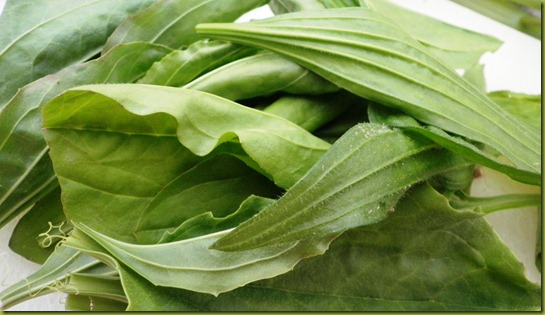
All of the plants are chopped up and placed into the jar. Cutting them up (or even placing them into a blender with a little vinegar to get it going) helps release their properties into the vinegar.

After all the plant matter is chopped and placed into the jar, it is covered with vinegar. I reserved some large plantain leaves and some jewelweed stems. The plant matter is carefully covered with the leaves, and then the stems are inserted in such a way as to hold everything below the surface. Be careful not to enclose air pockets under the leaves, though.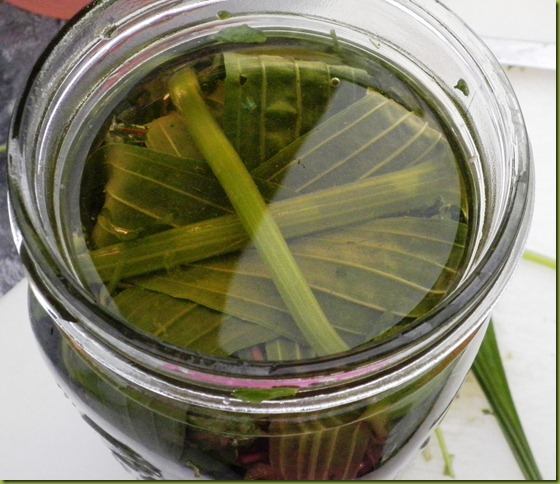
All ready to sit and age for a couple of weeks. It is perfectly fine to leave everything as it is until needed.

Then, just strain it out and apply to any area that has been exposed to poison ivy (preferably before a rash appears!). It stings slightly when applied, but will really help dry up a rash in a hurry.
The other best remedy is to learn how to identify poison ivy and avoid it.
We make a soap with jewelweed, plantain, and the essential oils of lavender and tea tree that works well after exposure = Happy Camper Soap
and also have the vinegar spray on our website, but we’re very happy to encourage you to make it yourself. Or go all out and get the Outdoor Trio
The following year we added plantain and jewelweed to the original brew, to add even more healing properties to the vinegar. We’ve used it ever since.
I just made a quart up today.
The ingredients are shown below.

If you don’t have or know how to identify jewelweed, her cousin – garden impatiens is a good stand-in. We like to harvest jewelweed in the spring while the stems are succulent and full of juice. After it flowers, the stems get woody and aren’t worth much. Some people like to harvest the leaves and flowers after it blooms, but this is how we do it.

The sage we grow here is Bergarten, which has a very high essential oil content. That’s really what we want to come through in the vinegar, so any garden sage is fine, but we like this one. In a pinch, you can even use the dried stuff in the spice aisle at the grocery store, but fresh will have more punch.

Even city dwellers most likely have plantain in their midst. Plantain is exceptional for skin irritations, bug bites and stings, and all kinds of rashes. We have both types here, the long strappy lanceolata, and the large major, and use them interchangeably.

All of the plants are chopped up and placed into the jar. Cutting them up (or even placing them into a blender with a little vinegar to get it going) helps release their properties into the vinegar.

After all the plant matter is chopped and placed into the jar, it is covered with vinegar. I reserved some large plantain leaves and some jewelweed stems. The plant matter is carefully covered with the leaves, and then the stems are inserted in such a way as to hold everything below the surface. Be careful not to enclose air pockets under the leaves, though.

All ready to sit and age for a couple of weeks. It is perfectly fine to leave everything as it is until needed.

Then, just strain it out and apply to any area that has been exposed to poison ivy (preferably before a rash appears!). It stings slightly when applied, but will really help dry up a rash in a hurry.
The other best remedy is to learn how to identify poison ivy and avoid it.
We make a soap with jewelweed, plantain, and the essential oils of lavender and tea tree that works well after exposure = Happy Camper Soap
and also have the vinegar spray on our website, but we’re very happy to encourage you to make it yourself. Or go all out and get the Outdoor Trio
Subscribe to:
Posts (Atom)