Saturday, June 22, 2013

Sum-sum-summertime!

This morning's gatherings.

With talk of the temperature rising this afternoon, I headed out to gather calendula blossoms and some lavender for wand weaving later this afternoon.  Things went very differently than what I had in mind, but in a good way.
First stop was the blueberry patch, followed by the gooseberry plants.  Maybe I should head over along the side of the woods and see if there are any black raspberries ready?
Black raspberries are our favorite berry with a flavor all their own.  A childhood memory...

A magnificent stand of blooming motherwort has established itself along the path, and I will be back to cut some later.  Lucky thing, because my usual stand got in the way of a project this spring, and there's only a few plants left there.
At the end of the path at the far end of the field, there are a couple of mulberry trees I hadn't thought about for years, so I pulled down a branch and picked a few to eat and stick in the basket for later.  Doing so, there was a rustle a few feet to my left, about a foot above my head... after which a juvenile ground hog plunked to the ground and looked at me.  We locked eyes for a few moments, and then I think he realized I was that woman his parents had been talking about because he took off running, scurrying under the giant burdock leaves.  I'm not sure which of us was more startled, honestly.
Munstead lavender.  A shot of the little groundhog would be apropos, but we prefer lavender!  Little cuss...

While all this has been taking place, Bob has come out to work in the fields with the tractor, removing stumps, straightening rows, and whatever else he does out there.  He is a virtuoso on large equipment.  I swear, that man could pluck a single daisy with a backhoe, BUT he doesn't much notice things like people while he's working so I cut him a wide berth.
Finally arriving back at the garden patch we have planted this year, the calendula are basking in the sunlight.  The row of white sage beside it is really loving this plot, and has reached a bushy, lush 18" while the rows of lavender, rose geranium, and patchouli are looking pretty good too.  The resiny flowers plop into the basket one by one as my fingers get ever stickier.
The calendula flowers couldn't be more beautiful!

My mind was on the wild yarrow I'd seen on my way to the field.  I forgot all about the long-stemmed wand lavender, and headed to the yarrow.  Wishing I'd brought clippers, I gathered a good quantity because I've been wanting to distill it for years.  My friend Marcia Elston of Winged Seed kindly pointed out to me that the still shouldn't be more than half full of plant material, so there is plenty out there.
Yarrow packed in the still, ready for my return.

The last stop was at the side garden to gather up the Munstead lavender that will be used in teas over the winter.  The sweet purple blossoms are the very best of the varieties that over-winter here for things like that.
Now it's back down to the soap shed to cut the batches of soap we made last night, and then I can come home and fire up the still.  Can't wait to see how this turns out.

And so the madness of summer begins!

Saturday, June 15, 2013

The Essential Herbal - July/August '13

The latest issue of the magazine is whirling around out there, making its way into mailboxes across the country at a pretty good clip. If you are a subscriber, you should see it well before the end of June. If you aren't a subscriber, you can remedy that situation pretty easily by going to our website and getting yourself a subscription!
This issue is filled with all kinds of summer.  Lots of delicious recipes and instructions, some great crafting ideas, and the usual dose of lore, usage, and growing information.  Another perfect brew of herbal information splashed upon our pages!  We know you'll enjoy this one.  I found myself setting aside the work of editing and writing in order to do some of the projects that came in the articles - something I usually force myself to do AFTER we've gone to press.  
Field Notes
Perennial food gardening is a gradual, thoroughly satifying experience. 7 years in, it is starting to make a difference!
About the Cover
How do we cope with leaving behind beloved gardens?
A Bible Garden, Jackie Johnson
A fascinating look at what went into planning and executing a public garden from a historical perspective.
Herb Craft: Painting & Pounding, Suzan T Scholl
We can never get enough herb themed accoutrements! Clothing, linens, notepaper; your imagination is your only barrier with this decorative craft.
Thyme, Thymus Vulgaris, Heddy Johannesen
Versatile and lovely, there are so many uses for thyme. So unassuming that we often take it for granted. Heddy includes recipes for syrup and vinegar.
Thyme in a Magical Garden, Jacquie Beveridge
Off we go to visit the charming Thyme Garden Herb Garden in Alsea Valley of the Oregon Coast Range Mountains.
Cimicifuga Racemosa (Black Cohosh,) Sandy Michelsen
One of the next plants to be introduced into the woods here, Sandy gives us some good reasons to include Black Cohosh in the garden.
SouthRidge Treasures, Coriander (Cilantro), Mary Ellen Wilcox
As usual, Mary Ellen goes beyond the lore, history, and growing information to include 6 great recipes/uses, including Black Bean Salad and Crispy Coriander Potatoes.
Seashore Stirrings, Marci Tsohonis
Oceana Soap… Dreams of the beach and the water and the sun all rolled into a fragrant decadent bar of soap. There are also instructions for a couple of different ways to swirl colors into soap.
Herbal Wines, Infused Wines, Champagne, Marita Orr
Be prepared to find yourself running outside to find ingredients to get started! Marita has outdone herself with this stunning article filled with information, ideas, inspiration, and recipes. I’ve already made 2 batches of the elderflower champagne!
Fun, Sillies & Puns, Jessica Morgan
Jessica collects cute herbal puns and jokes, and has graciously shared a bushel of them with us!
Summer Garden Party with Wine & Cheese, Marcy Lautanen-Raleigh
Cheese Balls, Crisps, and Logs, Citrus Olives, Pickled Carrots, and all manner of pairing cheeses and wine to make for a memorable picnic or gathering.
The Fragrant Geraniums, Susanna Reppert Brill
So many simple ways to use those wonderful leaves, way beyond potpourri! Tea, cake, sugar and more plus how to keep them as house plants.
Pure? Natural? Organic?, Maryanne Schwartz
How do you wade through the hype when people throw around these words until they no longer have any meaning at all?
Pressed into Service, Rita Richardson
As the flowers bloom, it can be almost impossible to just let them go. Press them and keep them for decorative purposes!

Friday, June 07, 2013

You might be an herbie if...

Back in spring '11, Marnie Plunkett suggested on our email list that it might be fun to try to answer this question.  It was!  And we turned it into an article, which I'm shaking out for some chuckles today.


Remember Jeff Foxworthy's "You might be a redneck if..." standup? Let's play "you might be an herbie if...." I'll go first. You might be an herbie if....


you say "excuse me, but...you're standing on my dandelion".
you spend a lot of time scraping labels off food jars that will be just perfect for herbs later on. 
Your herb seed budget exceeds the gross national product of some small countries.  You have lost a room or two of your house; the ceiling beams have become drying racks... ...   .

...while showing people your gardens, you unconsciously reach down, grab a leaf and start munching on it. ..

You can name plants that other people call weeds.

Latin has become your second language.

Your neighbors are used to see you early in the morning in your PJ harvesting or taking care of your garden....


You've been reported to the local sheriff for walking along the roads putting what is considered a "noxious weed" in a gallon jar! (St. John's Wort!)  

You might be an herbie if your kid is the one on the playground fixing boo-boos with plantain growing in the grass....

You know your a (city) herbie when..... You visit your relatives in the country but can't concentrate on conversations because you are constantly eyeballing...

My, this one hit home! For us though there is a little different twist. We live in the country, but often we'll be riding down the road and I'll scream thingslike, "JEWELWEED! Stop! Back-up"! Now to an outsider this might seem weird, but at our house in invariably means that one of us will ask the other, "do you think anyone would mind?"


" You MIGHT be an herbie if.......your neighbors show your wee ones their flowers and they ask 'can you EAT IT???

You might be an herbie if you spend hours picking chamomile by hand even thoughit would cost you just pennies because you know your's has been treated thebest!

You name your kids after herbs

if there is no way you can pass a rosemary plant without touching it!

...you empty your daughter's playhouse and set up a table in the corner because the windows are perfect for infusing oils!

...you think Scented Geraniums make great room deordorizers

Or you might be an herbie if you you go out of your way to walk past the nursery just to see what new plants they have out.

 ... your family has been disappointed many times after finding you working in the kitchen over non-food creations.

...you have a blender, a coffee grinder, an immersion blender, and a crockpot - all of which you wouldn't dream of using to cook with.

...your child has to plan sleepovers for those days when there are NOT herbs spread on sheets on the guestroom floor.


....people hate to have you in the car with them because you shriek so often at the sight of herbs in the wild.

...your daughter brings home a date while you're cleaning a pile of dried herbs, and he gives you the hairy eyeball...

... friends and family realized I was an herbie when they saw me buying gallons and gallons of cheap vodka (for tinctures), none of which I was going to drink. (they also wanted to stage an intervention...but that's another story~)
 
your wine cellar is full of shelves with containers of dried herbs, tincture and seeds. 

or you might...just might be an herbie if your wine store knows you by name and tells you when he sees you on the street, "we've gotten another shipment of that crystal palace vodka in today."

If there is no room in your refrigerator because it is stuffed with remedies, infusions and half finished Lavender Wands....

When you are the only one without the chemically treated manicured lawn in the neighborhood.

Or

When you tell your neighbor to stop treating their lawn so that you can make more dandelion jelly.

If you're considering getting rid of the dining room furniture to make more room for your "stuff"! Good bye pretty dishes and glasses Hello HERBS!!

your kids think everyone chews on licorice roots when they come down with a sore throat.


You grow your own weed! LOL

you get 'spices' from your office cupboard.....

you tell your husband not to mow yet because you want to make soup.

...you carry fennel seeds in your purse instead of rolaids.

you overseeded your "lawn" with dandelions....

You own more mason jars than the mason jar company :)

"You got any herb, man?" is greeted with "Yes, I do! I've got French tarragon, English tyme, evening primrose, rosemary, scented geraniums, golden oregano, painted sage, cuban oregano, feverfew, marshmallow, horehound, peppermint, curled spearmint, flat parsley...

When the "uninformed" starts to complain about their mint growing all over the place you tell them that there is a mint for mojitos!


You know and have a cooking or medicinal use for every "weed" in your yard.

you are out there digging under the snow to see if anything is growing yet.

you never take a sick day from work..because you're never sick!

you're known to go off the road often, looking at road side moreso than road!

or

you carry a shovel in your trunk.

when you are walking and you tell others these flowers are good to eat, or say or I wonder what that green plant over there is and what I can use it for.


You might be an herby if you're scared to death the neighbors will see you distilling herbs through your kitchen window & turn you in for making meth or moonshining!!

you routinely refer to things by their latin names/species names... ie what a nice patch of anthemis!!!

Being a herbie adds a certain spice to life, wouldn't you say?  We're having a bit of a gray, dreary day today, so a little smile came over me when reading these again.  Hope you enjoyed them!

Wednesday, June 05, 2013

Permissions

The other day a friend of mine was looking for a way to protect her property.  She was finding her photographs on various sites across the web without credit or permission.  Her pictures are well composed, often deeply moving, and she can make the simplest thing appear to be tinged with magic.  Often I can tell it is hers just by the feel of the picture, before I note whose it is because they are like looking into a dream.
So imagine my surprise when, last night while searching for the answer to a random question that arrived by email, I stumbled across this:

That's my kitchen with my still in my picture from my blog.  No credit.
Later, looking for something about making tinctures, I found this:
Come on now.  I can recognize my own handwriting on this picture of my tinctures from my blog.  I ate the salsa that came in that squatty jar behind the holy basil tincture.  No credit, but the author IS asking for tips.  I have one...
We're not naive enough not to realize that putting things online means they can be considered up for grabs, but seriously now, would it be that hard to note where the picture came from?  Give the person who did the work a little notice?  In the past, I've run across entire blog posts copied with pictures included, and pasted to another blog.  That's a whole different animal that required some reporting to the host, but pictures shouldn't be this tough.
8 years ago this blog was started, and pictures are often the catalyst for a post.  A camera is nearly always with me, and when my childhood friend Patty showed me the macro setting 3 years later (yeah, really...) all hell broke loose.  In that time 1000's of photos have been posted here on the blog or on the magazine's Facebook page.  I am not alone.  All of my herbie friends share this penchant for showing each other the offerings of nature and what we create with those leaves, blossoms and roots. For many of us, it's part of what we do for a living.  So there's a very easy answer.
Just add credit.  Better would be a link because often that gives your reader even more information.  The pictures above led to A) a full step-by-step pictorial view of a distillation and B) simple ways to preserve herbs. 
You want to make a friend?  Ask for permission.  Who knows?  Maybe the originator will even want to link back to your piece, but at the very least they won't feel like you ripped them off.  I don't know anyone who would deny permission for their photos to be used with proper crediting (although I probably shouldn't try to speak for everyone).

Sunday, May 26, 2013

Ode to Calendula - Excerpt

In the May/June '13 issue of The Essential Herbal Magazine, Marci Tsohonis graced our pages with an instructive article on making castile soap with calendula, but along the way she described so well several ways of preserving and using the flowers that she so obviously loves.  I have been a benefactor of her painstaking care of these lovelies, and have never in my life seen such beautiful, vibrant dried calendula.  It was obviously a labor of love.  Below is a section of that article, and as the flower buds are just starting to turn to the sun and open in many parts of the country right now, we're sharing it here for you...


DRYING CALENDULA FLOWER HEADS:
When I harvest Calendula flower heads, I leave a half inch stem attached, making it easier to press the whole flower face down on a screen for drying.  As I flatten it, I gently break off the remaining stem.  If the weather is warm, the flowers should be almost weightless, dry and crispy in less than a week.  Each petal will shrink to half its width.  You’ll be able to tell when they are ready.  Once they are dry, hold the flower head and gently pull outward at the edges of the petals to remove them from the head. 

Calendula flowers dry beautifully on a rack or screen in a warm, covered, shady area when given plenty of air circulation.  I press them onto a screen in our garden shed, and leave the windows ajar to promote air flow.  A garage would work, or even a covered patio that is out of the wind.  I sometimes notice bulk Calendula flowers for sale in natural food stores, stuffed in jars every which way, in a brownish tangle.  They lack memory of the life force when handled that way.  When carefully dried, they are a joyous addition to a summer Potpourri.

NOTE!  If you see something resembling worm larvae in either the finished oil or soap,
it is most likely just a Calendula seed!  Simply lift it out with tweezers or a spoon. It is easy to inadvertently pull a seed off the head when you are removing the petals. I found several the first time I made the infused oil.  The seeds are a somewhat curly, crescent moon shape.


SOLAR INFUSED CALENDULA OIL:
This is my favorite method.  Fill any size jar half full of dried Calendula petals.  Pour Olive oil over the petals, filling jar to within 2 inches of the top of the jar.  A little headspace is needed as the petals will expand once they become saturated with the oil.  (an overflow is quite messy) Stir the oil and petals a few times.  Cover the top of the jar with a double layer square of cheesecloth and apply the screw band (or a rubber band) over that.  Place in a sunny, south facing windowsill for at least 6 weeks.  Stir contents daily.


HURRY-UP CALENDULA OIL:
Place dried Calendula petals and olive oil in a crock pot.  I suggest you use a Rheostat/Light dimmer to regulate the heat setting on your crock pot.  Alternately, take the temperature of the oil frequently, turning the crock pot on or off, to ensure the oil temperature is maintained between 100 and 110 degrees for several hours.  The crock pot method works well, though the oil will not be quite as resinous as it would be using the solar method with a longer infusion period.

RESINOUS, FRESH CALENDULA OIL: 
I don’t use fresh infused Calendula oil in soap recipes, generally, though there is no reason you couldn’t. It is more work to make the oil, and the yield is not as good.  But this is a special oil.   Alcohol frees and dissolves the resin in Calendula, adding medicinal properties to the oil that you would not be able to access with water or plain oil alone. I’m including the recipe, while I’m up, because it makes a highly resinous, healing oil, courtesy of the late Michael Moore.  He stated that most of the Alcohol evaporates during the cook.   Some expert herbalists consider the scent from the trace of Alcohol remaining in the oil to be unpleasant.  Others swear by this method.  You’ll need to make that call for yourself.

Want to try it yourself?  Fill a food processor with cut Calendula heads.  Little bits of stem are fine to add as well.  Pour 1/8 to 1/4 cup of 100 proof Grain Alcohol over them.  Process briefly, long enough to chop the Calendula and distribute the Alcohol.  Allow to sit several hours.  Transfer ingredients to a blender.  Cover with Olive Oil.  Blend on “Chop” until Calendula is finely diced.  Scrape contents into a crock pot.  Maintain temperature of oil & herb mixture at a range of 100-110 for 8-12 hours. Strain thoroughly through Cheesecloth or old t-shirt, squeezing every last drop of this incredible oil.
Don't want to make your own?  We have it HERE

Thursday, May 23, 2013

Elderflower Champagne


It isn't often that in the middle of working on getting an issue put to bed for the printer that something in an article makes us stop in our tracks and try it.  Marita Orr from With Seeds of Intention sent us just such a project inside an article full of wonderful summer beverage recipes.  The elderflowers are just starting to bloom, and so I asked her if we could publish the recipe separately so folks wouldn't miss their chance to make it this year.
I started on it right away!

We had everything necessary in the cupboard.  We had Bragg's vinegar, and I have a feeling that vinegar with the mother is where the fizz comes from, but wild yeast in the air probably is part of it too.  Here's the recipe:

ELDER FLOWER CHAMPAGNE
7 large heads of elder blossoms
1 pound of white sugar, no substitutes!!
2 large or 3 small organic lemons/oranges
2 tablespoons apple cider vinegar
1 gallon water
4 liter-sized wine or champagne bottles and corks
Dissolve sugar in 1 quart of boiling water. Add rest of water. Slice lemons very thinly and add to water/sugar.


Add vinegar and mix well.
I used the removable crock from a 2 gallon oblong crockpot.

Place elder flowers head down in a crock, large glass bowl, or non-metal pot. Pour liquid mixture over flower heads. Cover with a kitchen towel held in place with a rubber band. After 24 hours, strain through a fine cloth (I use a clean cotton diaper), bottle, and cork.
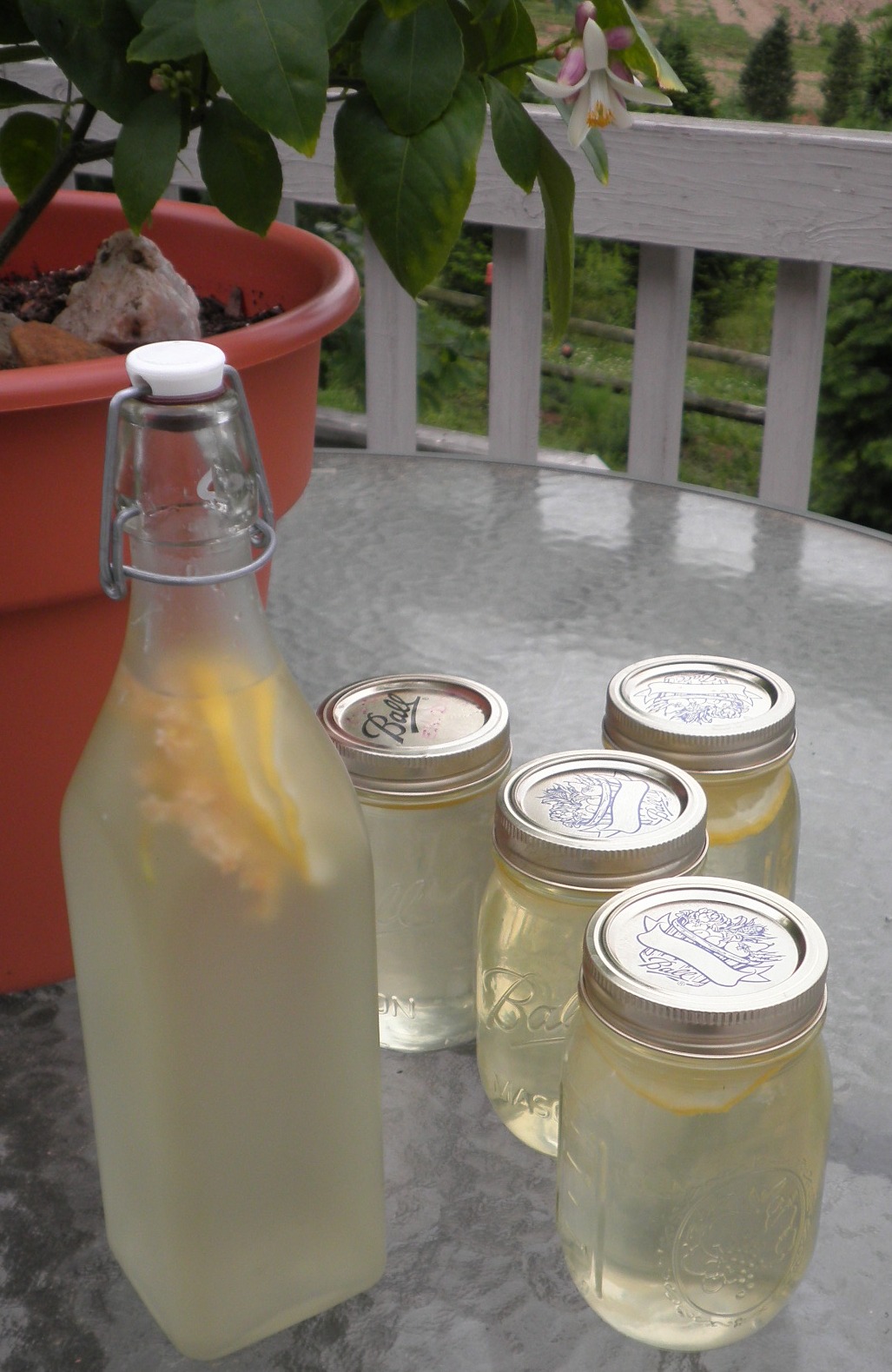
So pretty it looked ready to drink immediately!

Mature your Elder Flower Champagne in the dark for three or more weeks. It will be naturally fizzy when ready to drink, so watch out when you pop the cork!
 

After 24 hours, most of the elderflowers are a little browned.  It tastes very good (sweet).

Because I can't follow directions very well, I was COMPELLED to ad a slice of lemon and a bit of elderflower.  I also used Mason jars.  It remains to be seen how that will work.  I'm highly optimistic - as always.

Tuesday, May 21, 2013

Actually, everyone *doesn't* know that.

Many times in conversations over the last year or so, people become exasperated to think that people are not reacting to something in a way that they feel is reasonable.  Certainly everyone knows about the ________ crisis (sadly, the blank can be many things).
What is very easy to forget is that we are not all looking at the same things.  Being very involved with nature, conservation, and all the areas affected, my friends are mostly aware of the same things that I am interested in.  We all tend to worry a great deal about what fracking is doing to the finite amount of water that the earth holds (for starters...).  We all hold the same sense of dread when the subject of the Tar Sands comes up.  We think breast-feeding in public should be a non-issue, home-schooling is a-ok, and more than anything, we think that Monsanto is one of the biggest dangers to life as we know it that we've ever faced. 
But we forget that a vast percentage of the population is equally absorbed by other matters.  There are so many important things happening, and for an awful lot of people just getting by, paying the bills, keeping a job, and getting from one day to the next is about all they can handle.  We need to be more cognizant of that, and do what we can to share what we know without any judgment or anger.  Taking an occasional job outside of my field over the years has opened my eyes to that fact with stunning clarity.
So this Saturday, there is a worldwide March Against Monsanto.  In the spirit of the above statements, I'd like to talk about it a little bit in case one person who didn't know, reads it.

WHAT'S THE BIG DEAL ABOUT MONSANTO?

"Who controls the food supply controls the people."  Henry Kissinger

Some of us probably remember during our school days hearing about new crops that would end hunger worldwide.  Glowing descriptions of vastly increased yields, possibly even enhanced nutrition hailed the dawn of GMOs (genetically modified organisms) that would save the world.
But why is it that country after country bans GMOs?  Why are the test crops burned in other countries where the people are much more connected to their food sources?  Closer to home, the question is, why are they fighting so hard to resist having to label GMOs in our foods?  Corn is in nearly every processed food in one way or another, and just about all corn is now GMO.  If they are working so hard on something so good, shouldn't they be proud of it?

And then there are the small family farmers.  You know... the people we used to call "the salt of the earth," the "heart of America."  Well these hard-working folks who just want to put wholesome, sometimes organic, often heirloom variety food on our tables are systematically being run off their farms.  It's intentional.  Monsanto wants it all.
According to a 2005 report by the Center for Food Safety (CFS),
   "Farmers have been sued after their field was contaminated by pollen or seed from someone else's genetically engineered crop; when genetically engineered seed from a previous year's crop has sprouted, or "volunteered," in fields planted with non-genetically engineered varieties the following year; and when they never signed Monsanto's technology agreement but still planted the patented crop seed."
Yep, it's true.  A farmer who has maintained an organic, Monsanto free farm, whose crops are pollinated by wind or insects with GMO stock, can be sued and they will lose.  They can lose everything because the wind blew in the wrong direction and a big powerful company wants it all.

Then they came up with "Roundup Ready GMO stock."  It just keeps getting better.  The seeds are genetically manipulated (with all sorts of organisms; animal, viral, bacterial, etc.) and they are resistant to the herbicide Roundup so that when everything else dies, the intended crop will grow unimpeded.  In response, we now have super weeds that have mutated to resist the poison.  More and more poison is poured onto the fields and taken up in the groundwater.  Insecticides are also being used in the same ever-increasing manner, producing super bugs and it is strongly suspected (okay... pretty much certain) that the disastrous and horrific bee colony collapses are the result.
Oh, by the way, do you know who makes Roundup?  Monsanto does.

Not enough?  Well there's more.  We didn't really think we could destroy every other form of life and humans would be spared, did we?
http://www.organicconsumers.org/articles/article_27523.cfm
"Last September, the causal link between cancer and genetically modified food was confirmed in a French study, the first independent long-term animal feeding study not commissioned by the biotech corporations themselves. The disturbing details can be found here: New Study Finds GM Corn and Roundup Causes Cancer In Rats
Now, a new study published in the Journal of Hematology & Thromboembolic Diseases indicates that the biopesticides engineered into GM crops known as Bacillus Thuringensis (Bt) or Cry-toxins, may also contribute to blood abnormalities from anemia to hematological malignancies (blood cancers) such as leukemia.[i]"
Roundup (glyphosate) has been linked to Parkinson's Disease, autism, cancer, infertility, and allergies.

So there's my piece.  I could go on and on, but hopefully have inspired you to do a little digging around if your curiosity has been piqued.  I'll be joining a local march on Saturday.  I hope to see you there.

Tuesday, May 14, 2013

the maple in the yard

Maple trees are common and we almost don't even notice them.  In the early spring, sugar maples are tapped for their sweet sap, but otherwise their usefulness and beauty is pretty much taken for granted. Walking up the back steps after working in the yard today, I paused in the shade of the maple tree and thought back to other maples I've loved over the years.


Growing up, we lived in an old farm house with 2 giant maples in the front corners of the house and a third along the side.  They stood guard over the house with their leaves swaying sweetly in the summer breezes.  We didn't have air conditioning, but the deep shade offered by their dense growth made it bearable.  The trunks of those trees were immense and their canopy met over the top of the 3 story house.  In the side tree, my brothers built a tree house.  It was higher than the second floor bedroom windows.  Looking back, there was no adult supervision and the safety of this structure built by kids of around 12 was never checked out.  Boards nailed to the trunk were the ladder.  It was a little scary to be honest, but on the few occasions I found the nerve to climb those boards and rest in the middle of the tree were magical.  The swaying branches with the leaves singing gently in the moving air mesmerized me and allowed my mind to wander unfettered.  Those trees were as much a part of the house and our childhood as any wall, window, furnace or pipe.


Later, when my daughter was little, we lived in a house with a row of large maples between the yard and the road.  Many hours were spent watching the trees dancing in the wind, and she named them all "Maple-y."  We watched the moon sail between the upper branches, and thrilled in the spring to see them quickly go from bud to leaf.  Eventually there was a rope swing hanging from the largest tree, and she loved to play among the exposed roots and trunks on hot days when the shade welcomed her.

As soon as this house was built, a maple tree went in.  It now shades the kitchen and one side of the deck in the morning.  The branches tickle us as we go up the steps.  As each season passes, the tree trumpets its arrival, changing leaf color, dropping leaves, swelling buds, blooming, leafing out in the brightest of spring greens, and finally settling on a deep cool green before starting over again.  Each of those colors and seasons changes the whole feel of the house.  Spring green casts a cheery glow in the morning, and walking into the kitchen to make coffee just makes me happy - right off the bat, first thing in the morning.  The clear, mellow yellow of autumn does the same thing, but brings a certain coolness with it.


The shade in the middle of summer is a blessing that cannot be matched.  Even in the dead of winter, I can see where the buds will be swelling in a month or so, and am warmed at the thought.  Ice sometimes clings to the branches in a stunning display.  When a friend from the city visits, we find ourselves sitting beneath the branches in the grass, talking quietly. It is simply always beautiful.

So often with herbs, the question, "What is it used for?" comes up.  Before writing this, it crossed my mind to put together some medicinal or culinary uses, or maybe a craft using the whirling seed pods, but that would be overkill.  This tree is used for comfort, joy, beauty and as an anchor in time and space.
  It doesn't really need to be more than that.

Friday, April 26, 2013

Violet Leaf Experiment #1

 Disclaimer - I am so far from a scientist that my high school science teacher probably rolls around uncomfortably in his grave every time I even use the *word* scientist.  This is an interesting hobby, but no testing is done except with my senses.

A few days ago I decided that it would be interesting to try to distill violet leaf.  To the best of my knowledge, true violet FLOWER essential oil is non-existent.  You will possibly find people who sell it, but my guess is that they are either misinformed or dishonest.  The LEAF oil is available and is obtained through solvent extraction.  The leaf oil is soothing and relaxing, green and earthy at the same time.  It is often used in skin care products.  So even though I knew there would be no essential oil produced from a steam distillation, sometimes I get some pretty interesting hydrosols.  That would be pretty cool in a lotion, if it works...
Originally my thought was to wait until fall when the leaves would be more substantial, but I just couldn't wait.  Now it will be fun to do it again at that time and compare the results.  
As it turns out, in the spring it is almost as time-consuming to pick a basketful of leaves as it is to pick a basket full of blossoms.  The young leaves are still below the flowers, making the picking a little complicated.  It took a few hours to do, but it was such a gorgeous day that the time flew.  The best leaves were in the woods, along the path.
Getting set up, I packed the still with the leaves.
There is a full market basket of leaves crammed into that globe.
Usually it doesn't really get stuffed, but I wanted as much material in there as possible.  It was so tightly packed that after the water below started to boil, I started to ponder what would happen if the steam was unable to penetrate the leaves and gave the boiling flask a wide berth until it was clear that it could.
The first few tablespoons of hydrosol to be produced had an almost melon-y scent.  Very interesting and complex.  However, over the course of the next 45 minutes, the green bean scent that is typical of leaves with little or no essential oil became more pronounced.  Plantain, jewelweed, comfrey, chickweed - all produce a green bean type aroma.  In many cases, the hydrosol still has the property we're looking for, especially jewelweed and comfrey.
So the basketful of leaves eventually steams down to about 3 cups worth of green goo.  In less than an hour, the steam finds a direct channel through the goo and bubbles up through that one spot consistently.  It occurs to me that the distillation is finished, because it is pretty much just steam anymore - not passing through the material, but making a straight shot through it instead.

If you look just below the clamp and compare it to the picture above, you'll see the mesh plug protruding downward.
The heat is turned off and we have a couple of cups of the clear hydrosol.  The bean scent is prominent, but there is more... a very light floral, and something that makes me want to keep sniffing it from time to time.  If the bean fades, it might turn out to be pretty nice (but not holding my breath).

It was late, so I left the still to cool and went to bed.  This morning the goo had really settled in and was starting to ooze out of the bottom of the flask.  There's a mesh plug that is not a tight fit - but it never got pushed out before.  Fortunately the goo was pretty intertwined in the mesh...  Not my favorite before-breakfast activity, but it all worked out.
I'm very curious to see what happens in a few months with leaves that are not so tender, and also to see if the background fragrance will develop. 

Thursday, April 25, 2013

Missing my little violet picker

When my daughter was little, she was always my companion and helper during violet season.  For a week or two each spring, on sunny afternoons we'd go down to the orchard with baskets and sit under the blossoming trees picking violets for drying, syrups and jelly.  During those hours, she and I would discuss all the burning questions of the day.  Why aren't there violets all year long?  Why does the dog always chase the rabbits and groundhogs?  Do bird mamas love their babies?  And so the days would pass.  Quickly.  Ever so quickly.
Eventually Aunt Susie taught her to see 4-leaf clovers, and that took her focus for a little while, but she was still around, talking and singing and chewing on a piece of onion grass.  We'd string rosebud necklaces as soon as that time came, and we'd walk along the creek and make discoveries as soon as it got warm (we usually waited until it was warm because bodies of water seem to have a magnetic pull on her - have water, will fall in).  I can sometimes convince people to do some of those things with me, but she was always game for everything.

  I used to tell her that she wasn't allowed to grow up and my mother would gasp and say, "Don't EVER say that!"  Mom had 5 of us and perhaps missed my point, having been pretty happy to have us grow up and get on with our lives.  It wasn't that she didn't adore the "little us's", it was just exhausting, I suppose.
I never knew that each stage of life - infancy, early childhood, kid-ness, young adulthood, and onward would all be like different people that I would come to miss.  That little kid is now a young lady who is a joy to be around, but I miss all of the others as if they were separate individuals.  Especially during violet season.
So now I sit in the yard and pick by myself.  She's off earning a living.  It doesn't make me sad so much as it gives me time to reflect on how perfect those days were and wonder if I appreciated them as fully as I should have.  It truly is the everyday occurrences that we most treasure later on.

Mamas -  stop a minute and take a mental picture of this day.  Write it down, savor it and know that the day will come that you will miss the little person who is in the process of growing up.  That's all.

Monday, April 22, 2013

The View from this Side of the Fence

Because of what I do for a living, more than half of my close friends are business owners.  Most likely they have no employees and pour their hearts and souls into their businesses.  We call our various businesses our "babies," and are often raising our kids at the same time, again often without help.
So when a friend wrote to me the other day hurt and angry that she was being slandered on a large plant/herb forum by (oddly enough) a brand new woman in business, my heart really went out to her. 
My friend is a wholesale supplier.  She accepts orders and then produces to fill those orders.
When those orders are cancelled, she scrambles to find another way to sell the items.

The complaint was about the cost of shipping.  She doesn't make a cent on it, and every year she agonizes over how to shave some of that cost off for the customer.  I'm not talking about her spending 15 minutes looking at websites.  She researches the various shipping companies, box measurements, the weight of boxes and every other minutiae one could possibly think of - while still ensuring that the product arrives in good shape.  Other than that, shipping is completely out of her control.

I won't name her business (nor that of the newbie complainer - Karma will take care of that), but can tell you that the order was not charged for several months while it was in production.  The shipping charge was clearly stated, yet ignored for all that time.  When the order was cancelled, a small restocking charge was levied (also clearly stated), causing newbie complainer to howl like a banshee. 

So the thing is, in all the years I've been in business (more than 20), there have been very few times when I've noticed people owning businesses who don't make huge sacrifices for their customers - even if the customer doesn't know it.  Occasionally there are greedy business owners, but they go for a lot more than a few dollars in excess shipping. 

Maybe she thought she could get my friend to pay her shipping, thinking she had her over a barrel.  Maybe she ran out of funds, changed her mind, or found a local supplier.  Either way, that wasn't the fault of the business she's complaining about any more than the cost of shipping is. 

Get to know your suppliers. Ask other people for recommendations If you feel like they're taking you for a ride, find someone else.  If you have a complaint, take it to them - not a public forum.   And if it is something that they have no control over, get a grip.
Stepping off soapbox.

Friday, April 19, 2013

The Woodland Cure

Being inside today means being in some way connected to the news of the manhunt in Boston.  Even several states away, it is surreal and it saturates everything with fear and the feeling that bad people are everywhere.  Enough!  Into the woods!
I happily snapped as I went along, but the pictures are in no particular order.  They are all taken between my backyard and the far edge of the property.  Come on.  It'll make you feel better.  It sure did help me!
A tiny barberry plant growing right next to a dead nettle.

Blackberry canes have arched across some parts of the path.  They are very prickly.

Missed the blooms of the Bloodroot, but the seedpods are ripening.

In a few square inches, we have the leaves of Bloodroot, Jewelweed, and Trout Lily. 

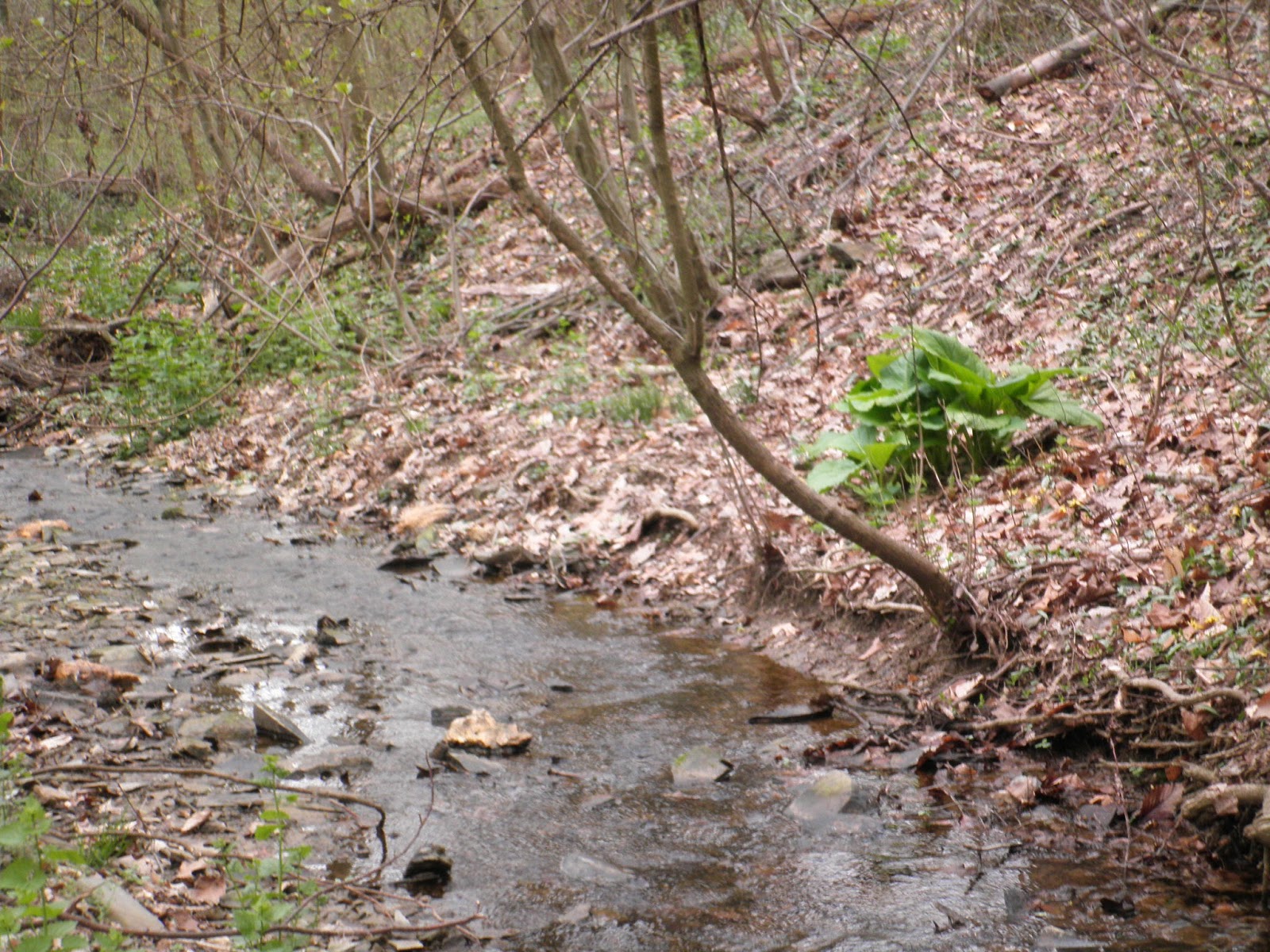
The creeksides are waking up and really getting gussied up.

Overnight (seriously!) the dandelions have burst into bloom.

Dutchman's Breeches.  We introduced these, and love to watch them spread.

False Solomon's Seal are one of the most prevalent plants on the forest floor.

Standing in the forsythia by the pond turned the world bright yellow for a few minutes.

I've not identified the ferns in the woods, but this frilly little lovely caught my eye.

Garlic Mustard is already in bloom.  If we could convince people to eat this as much as we eat lettuce, we'd never run out of it.  Very invasive, it is very aggressively moving across the floor of the woods.

These actually have a sweet pink blush, but my camera isn't picking up some colors lately.  I'll have to look these up.  The Spring Beauties that carpet the other hillside across the creek have petals that are more oval shaped and separate.
Although this doesn't look impressive, it made me let out a little "whoop" when I saw it.  Ramps are another introduced species here, and this singleton showed up nearly 10 feet from the nearest spreading clump.  Awesome!

Mayapple preparing to unfold.  The center bud will become a flower and the "shoulders" are 2 individual leaves.

This is the pathway between our homes - my sister and I.  It is lined with fruit trees and bayberry bushes.

The lush, gorgeous, full spreading clumps of ramps.

Also introduced, the blood-red trillium has made herself at home and is spreading very slowly.

One of the 2 introduced wild gingers, this one shiny leaved, the other fuzzy leaves and stems.  Both are doing well and stretching out, covering ground.

Introduced white trillium is even slower to reproduce than the reds.  Still, it does seem to be forming clumps rather than single stems in close proximity like the others.

Spicebushes are everywhere throughout the woods and are in full bloom right now.  They are what spring looks like in my mind's eye.  That color, caught in the sunlight is the essence of spring.


Just in the past few years the trout lilies have found their way to the near side of the creek.  This is a nice clump right off the main path.  I appreciate their cooperation in helping me avoid falling in the water.  Maybe they can have a word with the red Trillium, the Dutchman's Breeches, and all the Spring Beauties.

We have also introduced Solomon's Seal (although we've recently found huge plants near one of the bamboo patches).  It started with one stem, and I counted 6 this morning.  The uppermost of these plants is a false Solomon's Seal.

All along the path, violets carpet my footsteps.

A nice clump of white Trillium.  It makes me so happy to see them getting comfortable here.

Yellow is a nearly impossible color to pick up for some reason.  It washes out for me, but there are tons of bright yellow violets all along the woodland floor, along with various shades of blue and purple violets.
Greater Celandine is just starting to bloom, and I was thrilled to see that 2 out of 3 of the Pawpaws we planted last year were not eaten, and have leaves.  Didn't see a single Jack in the Pulpit up yet, which seems odd, especially that they have been plentiful in years past.
I still think we need to put some VA bluebells in there, and we've got some native foxgloves ready to go in along the edges of the woods.  I have no doubt that an herb festival or visit to a garden center will bring other natives into reach, and we'll add them.  A third attempt at wintergreen is not excessive in my opinion, especially because we'd really like to have it handy.

There.  Doesn't it feel like you can breathe a little more deeply now?